
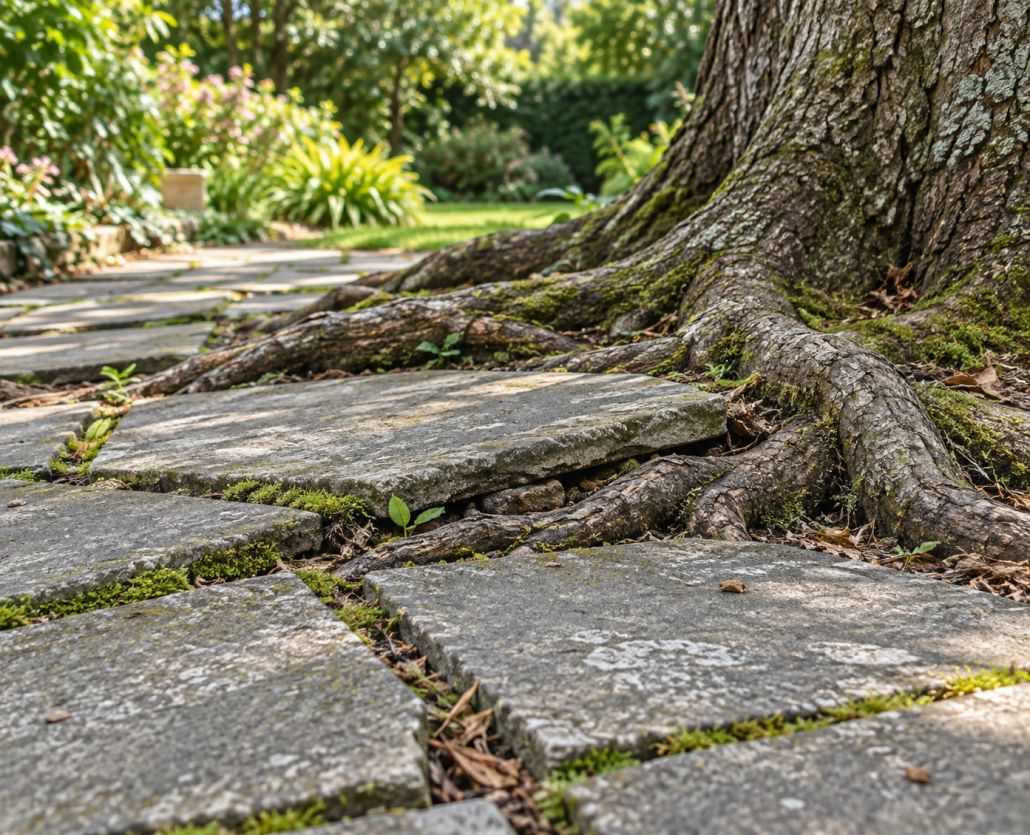
Tree Roots Lifting Patios, Paths or Driveways: What Can Be Done?
Root Size
A small fibrous root and a major structural root are very different problems.
Distance
Roots immediately beside the stem deserve particular caution.
Surface Type
Patios, paths and vehicle-bearing driveways have different construction needs.
Tree Condition
Root loss matters more where a tree already has defects or restricted rooting.
Alternative Design
Changing the surface can often be preferable to changing the tree.
Future Growth
A repair needs to allow for the tree and roots continuing to increase in diameter.
What Should You Do if Tree Roots Are Lifting Your Patio or Driveway?
Do not start by cutting the root.
First establish which root is causing the problem, how large it is, how close it is to the trunk and whether removing it could affect the tree’s stability or health.
In many cases, the safer long-term solution is to alter the hard surface around the root rather than forcing the root system to fit the original paving level.
The objective is not simply to make the paving flat today. It is to produce a safe, usable surface while leaving the retained tree with a viable rooting system for the years ahead.
Why Are Tree Roots Often So Close to the Surface?
A common misconception is that trees have a deep, compact root system mirroring the shape of the crown.
In reality, much of a tree’s active rooting occurs relatively close to the soil surface where oxygen, moisture and nutrients are available.
Current Street Works UK guidance notes that most roots occur within approximately the upper 600mm of soil and can extend out farther than the height of the tree.
Roots need aerated soil for normal biological function.
Roots proliferate where usable water is available.
Biologically active upper soil often contains valuable nutrients.
Roots favour routes offering less physical resistance.
Hard landscaping can restrict where roots are able to develop.
Some trees characteristically produce particularly shallow roots.
How Do Tree Roots Lift Paving?
Roots grow in length, but they also increase in diameter as the tree matures.
Where a root is already positioned immediately beneath a paving slab, block-paved driveway, path edge or shallow sub-base, increasing root diameter can progressively distort the surface above it.
A structural root occupies shallow soil beneath or beside the surface.
The root increases in diameter as the tree grows.
Paving or sub-base above has insufficient room to accommodate the root.
Slabs rock, levels change or surfacing cracks.
The root is not deliberately “attacking” the paving. The conflict occurs because two things are trying to occupy the same shallow space.
Why Is Paving Close to the Tree Trunk Particularly Vulnerable?
The base of a mature tree naturally broadens where the trunk transitions into major structural roots.
These buttress roots help anchor the tree and can become substantial as the tree matures.
RHS guidance notes that much direct lifting of patios and drives occurs close to the trunk, commonly within roughly one metre, where this buttressing is most pronounced.
A large root causing an inconvenient paving hump may also be contributing substantially to the stability of the entire tree.
Are Some Trees More Likely to Cause Surface Root Problems?
Yes, although soil conditions and available rooting space can be just as important as species.
RHS guidance highlights cherries and other Prunus as trees that can develop roots particularly close to the soil surface.
Other trees may also develop prominent surface roots where soil is shallow, compacted, poorly aerated, waterlogged or physically restricted.
A tree’s actual root form reflects the site it has grown in, not simply the name on its plant label.
Does a Root Lifting the Patio Mean It Is Damaging the House Foundations?
No.
A paving slab, shallow path or domestic driveway is fundamentally different from a substantial load-bearing building foundation.
RHS guidance specifically distinguishes direct root lifting of lightweight surfaces from foundation damage and states that there is no direct link between a root lifting paving and that same root physically lifting a house.
Patio / Path / Drive
Relatively shallow construction can be physically displaced by an expanding root immediately beneath it.
House Foundation
A substantial footing behaves differently. Tree-related foundation movement, where it occurs, is more commonly associated with soil conditions such as shrinkable clay rather than a root simply pushing the building upwards.
Can You Cut Tree Roots That Are Lifting a Driveway?
Sometimes — but root cutting should never be the automatic first response.
The consequences depend on the size of the root, its distance from the tree, how many other roots will be affected, species, condition, soil and the distribution of the remaining root system.
A relatively small root some distance from the trunk may be entirely different from a major structural root emerging directly from the root flare.
Large roots close to the tree can be important for anchorage. Removing them can create a tree-safety problem that is far more serious than the original paving defect.
What Do the Roots You Cannot See Actually Do?
Larger structural roots help resist wind loading and keep the tree upright.
Fine roots absorb water required by the canopy and living tissues.
The root system collects essential nutrients from the surrounding soil.
Roots store carbohydrates used for growth, defence and recovery.
Removing a root therefore has both structural and physiological consequences, depending on the root involved.
Why Can Cutting a Large Root Make a Tree Unstable?
A mature tree experiences substantial wind loading through its canopy.
That load is transferred down through the trunk and into the structural root system and surrounding soil.
Removing an important anchoring root can change the way those forces are distributed.
Wind acts on leaves and branches.
Forces pass through the trunk.
Structural roots spread loads into the ground.
Part of that anchoring system may be lost.
The result may not be obvious immediately. A tree can remain green and apparently healthy while having less structural resistance available during a future storm.
Root Cutting Is Also a Wounding Operation
Cutting a root creates a wound just as pruning a branch does.
The tree must compartmentalise the damaged tissue, and microorganisms can potentially colonise exposed wood.
Where a very large root is severed close to the trunk, the potential consequences are therefore not limited to immediate loss of anchorage. Longer-term dysfunction or decay can also develop.
“The paving contractor needed the root out of the way” is not enough information to establish whether the cut is safe.
Can You Just Shave the Top Off a Root and Relay the Slab?
This can be tempting where only a small amount of additional clearance is needed, but cutting into the upper side of a major root is still a significant wound.
Root shaving can reduce the cross-sectional strength of the root and expose internal wood.
Whether any selective modification is acceptable depends on the individual root and tree.
Have the root assessed first and consider changing the surface level instead.
What Can Actually Be Done About Roots Lifting Hard Landscaping?
| Option | What It Does | Best Suited To | Main Consideration |
|---|---|---|---|
| Lift and reprofile surface | Creates more space above retained roots. | Patios and paths. | Finished levels and trip gradients must remain safe. |
| Reroute path | Moves the hard surface away from major roots. | Garden paths and flexible layouts. | Often one of the least damaging options. |
| Enlarge tree opening | Removes paving immediately around trunk and buttress roots. | Patios and drive edges. | Future stem and root growth should be allowed for. |
| No-dig surface | Builds above existing ground without conventional excavation. | Paths, access and some driveways. | Requires specialist arboricultural and construction design. |
| Flexible / permeable surface | Can accommodate some future movement more readily than rigid slabs. | Selected pedestrian and landscape areas. | Product and base must suit expected loading. |
| Selective root pruning | Removes a particular root where arboriculturally acceptable. | Localised problems with suitable minor roots. | Must not compromise tree health or stability. |
| Root barrier | Attempts to redirect future root development. | Specific localised situations. | Installation itself may require damaging excavation and roots can grow around barriers. |
| Tree removal | Eliminates future growth from that tree. | Unresolvable or disproportionate conflicts. | Should usually follow assessment of retention options. |
Lift the Paving and Build Over the Root
Where the root is structurally important, altering the paving level can be safer than altering the root.
A patio or path can sometimes be carefully lifted, the root retained and the finished surface reprofiled around or above it.
No unnecessary severance of important woody tissue.
The repaired area can bridge or ramp over the root.
The design should recognise that the root may continue thickening.
The final surface still needs safe gradients and appropriate drainage, particularly where the area is used frequently.
Create More Unpaved Space Around the Tree
In many gardens, paving has simply been installed too close to a tree that subsequently became much larger.
Removing a ring or section of slabs around the trunk and root flare can immediately remove the conflict.
Hard surfacing fitted tightly around the trunk may eventually be displaced by both stem flare and buttress-root expansion even if today’s paving is perfectly level.
The resulting area can potentially be finished using mulch or another root-friendly landscape treatment appropriate to the site.
Reroute the Path Around the Root Zone
Garden paths are often relatively easy to redesign.
If several significant roots cross the existing route, moving the path away may protect the tree better than repeatedly cutting roots every time the surface moves.
Force a straight path through the root system.
Curve or reposition the route around major roots.
Less root damage and less likelihood of the same conflict immediately returning.
Could a No-Dig Surface Work Around the Tree?
Potentially.
No-dig construction is designed to avoid conventional excavation through important rooting areas.
Rather than digging out soil and roots to install a deep sub-base, an engineered surface can be built above existing ground levels using load-distribution systems and appropriately designed materials.
Existing root-bearing soil is retained wherever possible.
Cellular or engineered systems spread pedestrian or vehicle loads.
Surface design should consider the continuing needs of the root system.
BS 5837 recommends site-specific specialist arboricultural and construction advice where permanent hard surfacing must be installed within a retained tree’s Root Protection Area.
Would a More Flexible Surface Be Better Than Rigid Paving?
In some situations, yes.
Large rigid slabs and brittle surfacing can make relatively small amounts of root movement obvious.
A correctly specified flexible or permeable landscape surface may be more tolerant of minor future movement and easier to adjust.
A material suitable for a lightly used garden path may be completely inappropriate for a driveway carrying cars, vans or heavier vehicles.
Why Is a Driveway More Complicated Than a Garden Path?
A driveway must carry vehicle loads while also providing a safe, durable finished surface.
Standard driveway construction often requires excavation for a sub-base, precisely the type of work that can damage tree roots if the driveway crosses an important rooting area.
Where a valuable tree is being retained, the driveway designer and arboricultural professional should therefore work from the same plan rather than treating the tree after the construction design has already been fixed.
Can Building a Driveway Damage Roots Even if You Do Not Cut Them?
Yes.
Heavy machinery, repeated vehicle movement and compacted construction layers can alter the soil environment around roots.
Compaction reduces pore space in the soil, potentially restricting oxygen movement and water infiltration.
Soil structure, excavation, levels, drainage and vehicle loading all matter when hard landscaping is constructed around a retained tree.
When Can Selective Root Pruning Be Considered?
Root pruning can be appropriate in some carefully assessed situations.
The most favourable scenario is usually a clearly identified root that is relatively minor, sufficiently far from the trunk and whose removal is unlikely to materially affect the tree’s stability or health.
Where there is uncertainty, an arboricultural assessment is preferable to guessing based solely on the diameter visible after lifting one paving slab.
Will a Root Barrier Stop the Problem Coming Back?
Sometimes a barrier can redirect future root growth, but it is not a universal solution.
Installing a barrier normally requires excavation — potentially through the very root system you are trying to protect.
Roots can also grow around or underneath barriers where suitable soil conditions exist beyond them.
It should not be installed simply because somebody has found a root beneath the paving.
How Can Roots Be Investigated Without Damaging Them?
Where the root arrangement is unclear, careful exploratory investigation can reveal the size and direction of roots before decisions are made.
Depending on the site, this may involve hand excavation or specialist compressed-air soil excavation rather than immediately digging through the area with a mechanical excavator.
What Investigation Can Show
Root diameter, orientation, depth, relationship with the surface and whether several roots are involved.
What It Helps Avoid
Designing the repair around assumptions about where important roots are positioned.
What Is Usually the Best Approach for a Patio?
Patios offer more flexibility than vehicle-bearing driveways because the loads are normally lower.
Depending on levels and layout, solutions can include lifting affected slabs, increasing the unpaved area around the tree, regrading locally or adjusting the patio boundary.
What Is Usually the Best Approach for a Garden Path?
Paths are often the easiest surfaces to adapt.
A small change of route, a wider curve around the trunk or a short raised section may resolve the conflict without significant root work.
Moving a lightweight garden feature can be far simpler and safer than compromising a mature tree’s structural roots.
What Is Usually the Best Approach for a Driveway?
Driveway repairs often need more coordination because the finished construction must carry vehicles.
Where important roots pass beneath the driveway, a conventional repair involving deep excavation and heavy compaction may not be compatible with retaining the tree.
| Situation | Possible Starting Point | Why |
|---|---|---|
| One localised hump | Expose and assess root before redesigning surface. | Avoid unnecessary full-drive reconstruction. |
| Several large roots below drive | Consider specialist no-dig / load-spreading design. | Conventional excavation could remove major roots. |
| Root immediately beside trunk | Redesign driveway edge. | Root may form part of structural buttressing. |
| Tree and driveway fundamentally incompatible | Compare retention redesign with tree removal. | Long-term repeated repairs may be unsustainable. |
What if Tree Roots Are Cracking a Tarmac Driveway?
A linear ridge or cracking above a known root often indicates that the surface has been displaced as the root thickened.
Simply cutting the raised asphalt away and resurfacing at the old level may only disguise the underlying conflict.
If the root must remain, the replacement design needs sufficient vertical space and an appropriate construction system to tolerate its presence.
Can Block Paving Be Re-Laid Around Tree Roots?
Often, depending on the severity of the movement and available finished levels.
Individual blocks can be lifted relatively easily, which can make investigation and local adjustment simpler than with a continuous rigid surface.
The important point is that the root should not automatically be planed or cut simply to restore the original sub-base depth.
If the same root remains directly below the same rigid level, the same movement may return as the root continues developing.
What About Pipes and Cables Beneath the Driveway?
Tree roots may not be the only thing beneath the surface.
Domestic drives and paths can contain electricity supplies, water pipes, drainage, telecoms and other buried services.
Any investigation requiring excavation should therefore also consider known or suspected utilities before tools or machinery are used.
Root management, service location and hard-landscape construction may all need to be coordinated.
What if Roots Are Lifting a Garden Wall or Kerb?
Lightweight garden walls, edging and kerbs can also be affected by direct root growth.
The correct response depends on how substantial the structure is and whether it can be rebuilt with more space for future root development.
If the wall is retaining ground, carries another structure or its failure could cause injury, structural advice may also be required.
When Might Removing the Tree Be the Better Long-Term Option?
Tree removal should not automatically follow the first lifted paving slab.
However, there are sites where the tree and essential hard surface are fundamentally competing for the same space and neither can reasonably be redesigned.
If removal becomes the evidence-based option, TD Trees also provides professional tree felling and sectional dismantling services.
Could Tree Removal Be Safer Than Cutting Several Structural Roots?
In some cases, yes.
If an essential driveway repair requires severing several important roots close to the tree, retaining the tree after substantial root loss can be a poor compromise.
The options should then be compared honestly:
Cut Major Roots & Retain Tree
May leave the tree with reduced anchorage, wounds and uncertain long-term stability.
Redesign the Surface
Can retain both the tree and access where practical engineering options exist.
Remove & Replace Tree
May provide a more predictable long-term outcome where the conflict genuinely cannot be engineered around.
Does Removing the Tree Mean All the Roots Disappear Immediately?
No.
Felling removes the tree above ground but leaves the stump and root system unless further work is undertaken.
Dead roots then decay gradually over time.
The required depth of stump and root-plate clearance should be matched to the future construction rather than using a generic grinding depth.
What if the Roots Come From Your Neighbour’s Tree?
Do not assume that crossing the property boundary makes substantial root cutting risk-free.
Rights relating to encroaching roots can come with responsibility for the consequences of the work.
If cutting major roots destabilises or seriously damages the neighbour’s tree, liability can arise.
Photograph the damage, establish tree ownership and obtain arboricultural advice where the work could affect the tree’s health or stability.
What if the Tree Has a TPO or Is in a Conservation Area?
Protected-tree controls should be checked before significant root cutting or tree removal.
In Scotland, work to a tree protected by a Tree Preservation Order can require planning-authority consent. Qualifying work to trees in conservation areas is generally subject to six weeks’ prior notice, subject to relevant exemptions.
Do not assume planning controls only apply to visible branches and trunks. Check with the relevant planning authority before potentially damaging work to a protected root system.
What if the Driveway Is Part of a New Development or Extension?
Where retained trees are part of a development site, hard landscaping should be considered during design rather than after construction has begun.
BS 5837 uses the concept of a Root Protection Area to identify soil and rooting space requiring protection around retained trees.
If new hard surfacing must enter that area, specialist design may be needed to avoid damaging excavation, excessive compaction or unacceptable changes to the rooting environment.
TD Trees provides professional tree reports and BS 5837 surveys for planning and development sites.
When Should You Get an Arboricultural Assessment?
Not every lifted paving slab requires a formal report.
Professional assessment becomes increasingly useful as the root size, tree size or consequences of making the wrong decision increase.
TD Trees’ arboricultural reports and surveys can record tree condition, root-related constraints and appropriate management recommendations where more formal evidence is required.
What Will an Arborist Look at Before Recommending Root Work?
How Should an Approved Root Be Cut?
Where an arboricultural assessment supports selective root pruning, the work should create a clean cut rather than tearing or crushing the root.
The root should only be removed to the extent required by the agreed specification.
Surrounding roots should be protected during the surface repair, with unnecessary excavation and compaction avoided.
The paving contractor needs to understand the arboricultural constraints before reconstruction begins.
Should the Crown Be Reduced After Roots Are Cut?
Not automatically.
Tree pruning should be based on the actual condition and management objective rather than applied as a routine response to every root cut.
In some situations an arborist may recommend canopy management as part of a wider response, but this depends on the tree, degree of root loss, structural condition and site exposure.
Where crown work is appropriate, TD Trees provides professional tree pruning services.
Will the Roots Keep Getting Bigger?
Living woody roots can continue increasing in diameter as the tree develops.
A repair that leaves only a few millimetres of clearance above an important root may therefore look perfect today but fail again as the root expands.
Good repairs provide tolerance for continuing biological growth rather than restoring exactly the same conflict in a new surface.
Does the Age of the Tree Affect the Decision?
Yes.
A young tree with many decades of future expansion ahead presents a different design problem from a mature tree whose major root architecture is already well established.
The surface design should allow generously for future stem and root enlargement.
Existing roots may be substantial and structurally important, making excavation less forgiving.
Long-term retention value and condition should be considered before investing heavily in complex surface redesign.
Why Does the Same Driveway Keep Lifting After Repair?
Often because the original root-surface conflict was never redesigned.
If contractors repeatedly remove the distorted surfacing and replace it at exactly the same level, the living root remains underneath and continues increasing in diameter.
Repair the Symptom
Replace the cracked paving but keep the same restrictive construction around the root.
Redesign the Conflict
Create space, alter levels, reroute, change construction or make an evidence-based decision about the tree.
How Can You Avoid Root Damage When Planting a New Tree?
The best time to solve a root-and-paving problem is before either the tree or surface is installed.
A small nursery tree may fit comfortably beside a driveway today while its eventual stem flare and structural roots need substantially more room.
Is a Private Driveway Different From a Public Pavement?
Yes.
Public roads and pavements involve highway authorities, public access requirements and wider statutory responsibilities.
A private patio or driveway generally gives the homeowner more freedom to redesign levels and alignment around an important tree.
For trees affecting public routes, see TD Trees’ guide to trees near roads and footpaths and homeowner responsibilities.
Arborist, Landscaper or Driveway Contractor: Who Do You Need?
| Question | Best Starting Point | Role |
|---|---|---|
| Can this root safely be cut? | Arboricultural professional | Assess root importance, tree condition and stability implications. |
| How should the patio be re-laid? | Landscape contractor | Design and install suitable finished levels and materials. |
| Can the driveway carry vehicles without excavation? | Specialist paving / engineering contractor | Specify load-spreading or no-dig construction. |
| Will a retaining wall remain stable? | Structural professional | Assess load-bearing structure and foundations. |
| Should the tree be retained or removed? | Arboricultural professional | Compare tree condition, retention value and realistic management options. |
Tree Roots Under Paving: What to Do and What to Avoid
| Do | Don’t |
|---|---|
| Identify the root before deciding on work. | Cut the first root you uncover. |
| Get advice for major roots close to the tree. | Assume large roots are expendable because the canopy looks healthy. |
| Consider altering levels or alignment. | Force the new surface back to the same level regardless of roots. |
| Protect soil and remaining roots during work. | Park heavy machinery over exposed rooting areas unnecessarily. |
| Check protected-tree status. | Assume TPO rules apply only to branches. |
| Design for continuing root growth. | Create the same root-surface conflict again beneath new paving. |
Tree Roots and Driveways: Myth vs Reality
| Common Assumption | More Accurate Explanation |
|---|---|
| “Just cut the root off.” | Large roots can be important to tree stability and should be assessed first. |
| “Roots lift patios, so they can lift my house too.” | Lightweight paving and substantial load-bearing foundations behave very differently. |
| “Tree roots mainly grow straight down.” | A large proportion of roots occupy relatively shallow soil and spread laterally. |
| “If the root is on my property, cutting it cannot cause a problem.” | Root cutting can damage or destabilise a tree regardless of which side of a boundary the cut is made. |
| “A root barrier guarantees the problem will stop.” | Barriers require careful design and roots may grow around or beneath them. |
| “Tree removal is the only permanent answer.” | Rerouting, surface redesign, increased rooting space and no-dig construction can often retain the tree. |
Questions to Ask Before Repairing a Root-Damaged Patio or Driveway
What Photographs Are Useful for a Root-Damage Enquiry?
Photographs can help with initial discussion, but a site assessment may still be needed where significant roots or tree stability are involved.
FAQs About Tree Roots Lifting Patios, Paths and Driveways
Can tree roots lift a driveway?
Yes. Shallow woody roots can increase in diameter beneath a driveway and progressively distort block paving, asphalt or other relatively shallow surfacing.
Can tree roots lift patio slabs?
Yes. This is particularly common where paving has been laid close to the trunk and major buttress roots.
Why are the roots so close to the surface?
A large proportion of tree roots naturally develop in relatively shallow, oxygenated soil rather than growing vertically downwards.
Can I just cut the root underneath the paving?
Not without considering the tree. Large structural roots can contribute to anchorage, and removing them can damage or destabilise a tree.
How do I know if a root is safe to cut?
Root diameter, distance from the trunk, tree size, species, condition, previous root loss and site exposure all need to be considered.
Can cutting one root make a tree fall?
Potentially, if the root is structurally important. The consequence depends on the particular root system and tree rather than simply the number of roots cut.
Can I shave a root down instead of removing it?
Shaving a major root still removes structural wood and creates a wound. It should not be undertaken without arboricultural assessment.
Does root lifting mean my house foundations are at risk?
No. Lightweight paving can be physically displaced by roots much more easily than substantial building foundations. The two problems should not be treated as equivalent.
Can I relay paving over an existing root?
Often, yes, where levels allow it. The replacement design should leave sufficient space for the root and consider future growth.
Can I raise a path over a root?
Potentially. Reprofiling or bridging a path over important roots can be preferable to cutting them, provided the finished gradient remains safe.
What is a no-dig driveway?
It is a surface construction designed to minimise excavation into existing root-bearing soil, often using load-spreading systems above the existing ground.
Can no-dig construction carry cars?
Suitable engineered systems can be designed for vehicle loading, but the specification needs to match expected vehicles, ground conditions and tree constraints.
Would a gravel driveway be better around a tree?
A permeable or adaptable surface may offer advantages in some situations, but its base construction still matters. Simply replacing one surface material does not remove the need to protect the roots beneath it.
Will a root barrier stop roots lifting the driveway?
Not necessarily. Barriers can redirect roots in certain situations, but roots may grow around them and installation can itself require damaging excavation.
Can roots grow back after being cut?
Tree roots can continue developing from the retained system, and new roots may exploit suitable soil nearby. Root pruning does not permanently stop all root growth in an area.
Why does my driveway keep lifting after repairs?
If the living root remains directly below the same restrictive surface level, continued root thickening can recreate the problem.
Should I remove the tree instead?
Only after comparing realistic retention options. Removal may become appropriate where essential access and major structural roots cannot reasonably coexist.
Does removing the tree immediately remove the roots?
No. Felling leaves the stump and underground root system unless stump and root-plate work is also undertaken.
Can roots from a neighbour’s tree damage my driveway?
Yes, roots can cross boundaries. However, significant roots should not be cut indiscriminately because weakening the tree can create liability and safety issues.
Can I cut my neighbour’s roots at the boundary?
Rights to manage encroaching roots come with responsibility for the consequences. Seek professional advice before cutting anything substantial or structurally important.
Does a TPO protect the roots as well as the branches?
Potentially damaging work to the root system of a protected tree should be checked with the planning authority. Do not assume that tree protection ends at ground level.
Do I need permission to remove a protected tree because of driveway damage?
Tree Preservation Order, conservation-area and felling controls can apply depending on the tree and location. Check the relevant requirements before work.
Can an arborist tell exactly where all the roots are?
Not from the surface alone. Where necessary, careful exploratory excavation can help establish the location, size and direction of specific roots.
Should a driveway contractor decide which roots to remove?
A paving contractor can advise on the surface, but decisions about significant root removal should involve someone competent to assess the tree and stability implications.
Can a path simply be moved around the tree?
Often, yes. Where the layout allows it, rerouting can be one of the simplest ways to avoid unnecessary root damage.
Can roots lift garden walls?
Roots can displace lightweight garden walls, edgings and other shallow structures. More substantial or retaining walls may require structural assessment as well.
Which trees commonly develop surface roots?
Root depth depends heavily on soil and site conditions, although species such as cherries can be particularly prone to shallow rooting.
Should I get a tree survey before rebuilding the driveway?
It is sensible where large roots, a mature tree, significant excavation or uncertainty about stability are involved.
Tree Roots Damaging Your Patio, Path or Driveway?
Do not let a surface repair create a tree-safety problem. If significant roots are involved, the tree and hard landscaping should be assessed together before anything is cut.
TD Trees provides professional arboricultural surveys, reports and practical tree-management services across Edinburgh, Central Scotland, Southern Scotland, the Scottish Borders, Northumberland and surrounding areas.
We can assess the tree, identify relevant root constraints and help establish whether the best approach is root retention, selective work, surface redesign, pruning, monitoring or removal.
Sources and References
- Royal Horticultural Society – Trees Near Buildings:
https://www.rhs.org.uk/plants/types/trees/near-buildings - Royal Horticultural Society – Trees and the Law:
https://www.rhs.org.uk/plants/types/trees/the-law - Street Works UK – Guidelines for the Planning, Installation and Maintenance of Utility Apparatus in Proximity to Trees, Volume 4:
https://streetworks.org.uk/resources/publications/ - British Standards Institution – BS 5837:2012 Trees in Relation to Design, Demolition and Construction – Recommendations
- Trees and Design Action Group – Trees in Hard Landscapes: A Guide for Delivery:
https://www.tdag.org.uk/trees-in-hard-landscapes.html - Scottish Government – Planning Circular 1/2011: Tree Preservation Orders:
https://www.gov.scot/publications/planning-circular-1-2011-tree-preservation/ - Scottish Government – Guide to Conservation Areas in Scotland:
https://www.gov.scot/publications/guide-to-conservation-areas-in-scotland/ - TD Trees – Tree Reports & Surveys:
https://www.tdtrees.co.uk/consultancy/tree-reports-surveys/ - TD Trees – Trees Near Roads & Footpaths: Homeowner Responsibilities Explained:
https://www.tdtrees.co.uk/trees-near-roads-footpaths-homeowner-responsibilities-explained/