Tree Roots Lifting Patios, Paths or Driveways: What Can Be Done?


TD Trees • Tree Roots & Hard Landscaping

Tree Roots Lifting Patios, Paths or Driveways: What Can Be Done?

Tree roots can lift paving slabs, distort paths and create humps or cracking in driveways, but cutting the offending roots is not automatically the right solution.
Large roots close to the trunk may be important to the tree’s health and stability. A successful repair therefore needs to solve the surface problem without creating a more serious tree-safety problem.

Quick answer:
start by identifying which roots are causing the movement and how important they are to the tree. Depending on the site, the best solution may be to reprofile or reroute the surface, enlarge the unpaved area around the trunk, use a root-friendly no-dig surface, selectively manage minor roots or, where the conflict cannot reasonably be resolved, consider tree removal.

At TD Trees, our arboricultural teams assess trees, roots and surrounding structures across Scotland and Northumberland, helping homeowners make evidence-based decisions before potentially important roots are cut.

01

Root Size
A small fibrous root and a major structural root are very different problems.

02

Distance
Roots immediately beside the stem deserve particular caution.

03

Surface Type
Patios, paths and vehicle-bearing driveways have different construction needs.

04

Tree Condition
Root loss matters more where a tree already has defects or restricted rooting.

05

Alternative Design
Changing the surface can often be preferable to changing the tree.

06

Future Growth
A repair needs to allow for the tree and roots continuing to increase in diameter.

The Short Answer

What Should You Do if Tree Roots Are Lifting Your Patio or Driveway?

Do not start by cutting the root.

First establish which root is causing the problem, how large it is, how close it is to the trunk and whether removing it could affect the tree’s stability or health.

In many cases, the safer long-term solution is to alter the hard surface around the root rather than forcing the root system to fit the original paving level.

Treat the tree and surface as one design problem.
The objective is not simply to make the paving flat today. It is to produce a safe, usable surface while leaving the retained tree with a viable rooting system for the years ahead.

Understanding Tree Roots

Why Are Tree Roots Often So Close to the Surface?

A common misconception is that trees have a deep, compact root system mirroring the shape of the crown.

In reality, much of a tree’s active rooting occurs relatively close to the soil surface where oxygen, moisture and nutrients are available.

Current Street Works UK guidance notes that most roots occur within approximately the upper 600mm of soil and can extend out farther than the height of the tree.

Oxygen
Roots need aerated soil for normal biological function.
Moisture
Roots proliferate where usable water is available.
Nutrients
Biologically active upper soil often contains valuable nutrients.
Soil structure
Roots favour routes offering less physical resistance.
Existing surfaces
Hard landscaping can restrict where roots are able to develop.
Species
Some trees characteristically produce particularly shallow roots.

How Surface Damage Develops

How Do Tree Roots Lift Paving?

Roots grow in length, but they also increase in diameter as the tree matures.

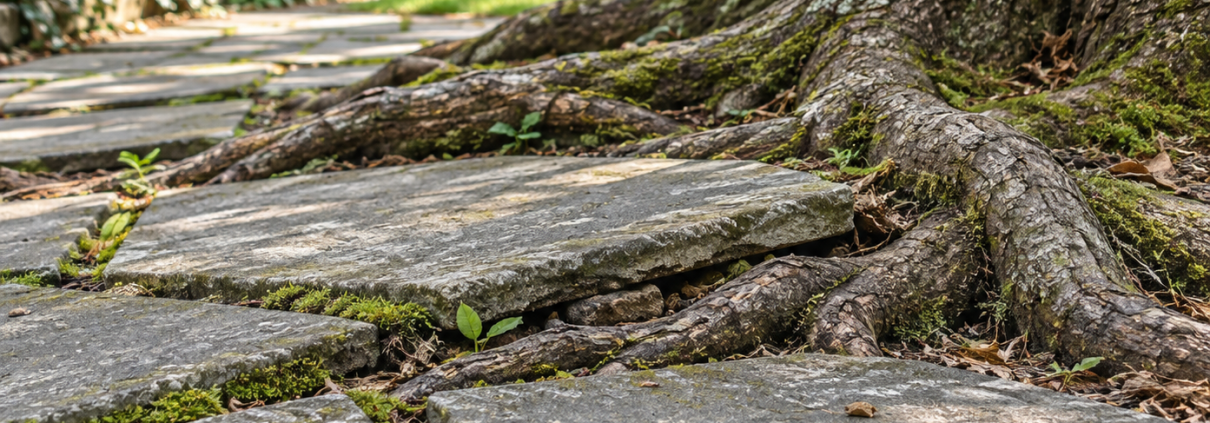
Where a root is already positioned immediately beneath a paving slab, block-paved driveway, path edge or shallow sub-base, increasing root diameter can progressively distort the surface above it.

1. Root Develops
A structural root occupies shallow soil beneath or beside the surface.
2. Root Thickens
The root increases in diameter as the tree grows.
3. Surface Is Displaced
Paving or sub-base above has insufficient room to accommodate the root.
4. Trip / Vehicle Defect Forms
Slabs rock, levels change or surfacing cracks.

The root is not deliberately “attacking” the paving. The conflict occurs because two things are trying to occupy the same shallow space.

Close to the Trunk

Why Is Paving Close to the Tree Trunk Particularly Vulnerable?

The base of a mature tree naturally broadens where the trunk transitions into major structural roots.

These buttress roots help anchor the tree and can become substantial as the tree matures.

RHS guidance notes that much direct lifting of patios and drives occurs close to the trunk, commonly within roughly one metre, where this buttressing is most pronounced.

This is exactly where root cutting requires the greatest caution.
A large root causing an inconvenient paving hump may also be contributing substantially to the stability of the entire tree.

Species Matters

Are Some Trees More Likely to Cause Surface Root Problems?

Yes, although soil conditions and available rooting space can be just as important as species.

RHS guidance highlights cherries and other Prunus as trees that can develop roots particularly close to the soil surface.

Other trees may also develop prominent surface roots where soil is shallow, compacted, poorly aerated, waterlogged or physically restricted.

Do not diagnose the problem from species alone.
A tree’s actual root form reflects the site it has grown in, not simply the name on its plant label.

An Important Distinction

Does a Root Lifting the Patio Mean It Is Damaging the House Foundations?

No.

A paving slab, shallow path or domestic driveway is fundamentally different from a substantial load-bearing building foundation.

RHS guidance specifically distinguishes direct root lifting of lightweight surfaces from foundation damage and states that there is no direct link between a root lifting paving and that same root physically lifting a house.

Patio / Path / Drive

Relatively shallow construction can be physically displaced by an expanding root immediately beneath it.

House Foundation

A substantial footing behaves differently. Tree-related foundation movement, where it occurs, is more commonly associated with soil conditions such as shrinkable clay rather than a root simply pushing the building upwards.

The Critical Question

Can You Cut Tree Roots That Are Lifting a Driveway?

Sometimes — but root cutting should never be the automatic first response.

The consequences depend on the size of the root, its distance from the tree, how many other roots will be affected, species, condition, soil and the distribution of the remaining root system.

A relatively small root some distance from the trunk may be entirely different from a major structural root emerging directly from the root flare.

Never simply expose a large root and cut it because it is underneath a slab.
Large roots close to the tree can be important for anchorage. Removing them can create a tree-safety problem that is far more serious than the original paving defect.

Why Roots Matter

What Do the Roots You Cannot See Actually Do?

Anchorage
Larger structural roots help resist wind loading and keep the tree upright.
Water Uptake
Fine roots absorb water required by the canopy and living tissues.
Nutrient Uptake
The root system collects essential nutrients from the surrounding soil.
Energy Storage
Roots store carbohydrates used for growth, defence and recovery.

Removing a root therefore has both structural and physiological consequences, depending on the root involved.

Stability

Why Can Cutting a Large Root Make a Tree Unstable?

A mature tree experiences substantial wind loading through its canopy.

That load is transferred down through the trunk and into the structural root system and surrounding soil.

Removing an important anchoring root can change the way those forces are distributed.

Canopy
Wind acts on leaves and branches.
Stem
Forces pass through the trunk.
Root Plate
Structural roots spread loads into the ground.
Root Severed
Part of that anchoring system may be lost.

The result may not be obvious immediately. A tree can remain green and apparently healthy while having less structural resistance available during a future storm.

Wounds Below Ground

Root Cutting Is Also a Wounding Operation

Cutting a root creates a wound just as pruning a branch does.

The tree must compartmentalise the damaged tissue, and microorganisms can potentially colonise exposed wood.

Where a very large root is severed close to the trunk, the potential consequences are therefore not limited to immediate loss of anchorage. Longer-term dysfunction or decay can also develop.

Root pruning should have a specific arboricultural reason and specification.
“The paving contractor needed the root out of the way” is not enough information to establish whether the cut is safe.

Root Shaving

Can You Just Shave the Top Off a Root and Relay the Slab?

This can be tempting where only a small amount of additional clearance is needed, but cutting into the upper side of a major root is still a significant wound.

Root shaving can reduce the cross-sectional strength of the root and expose internal wood.

Whether any selective modification is acceptable depends on the individual root and tree.

Do not use a grinder, chainsaw or reciprocating saw on a living structural root simply to recover paving depth.
Have the root assessed first and consider changing the surface level instead.

Your Main Options

What Can Actually Be Done About Roots Lifting Hard Landscaping?

OptionWhat It DoesBest Suited ToMain Consideration
Lift and reprofile surfaceCreates more space above retained roots.Patios and paths.Finished levels and trip gradients must remain safe.
Reroute pathMoves the hard surface away from major roots.Garden paths and flexible layouts.Often one of the least damaging options.
Enlarge tree openingRemoves paving immediately around trunk and buttress roots.Patios and drive edges.Future stem and root growth should be allowed for.
No-dig surfaceBuilds above existing ground without conventional excavation.Paths, access and some driveways.Requires specialist arboricultural and construction design.
Flexible / permeable surfaceCan accommodate some future movement more readily than rigid slabs.Selected pedestrian and landscape areas.Product and base must suit expected loading.
Selective root pruningRemoves a particular root where arboriculturally acceptable.Localised problems with suitable minor roots.Must not compromise tree health or stability.
Root barrierAttempts to redirect future root development.Specific localised situations.Installation itself may require damaging excavation and roots can grow around barriers.
Tree removalEliminates future growth from that tree.Unresolvable or disproportionate conflicts.Should usually follow assessment of retention options.

Option 1

Lift the Paving and Build Over the Root

Where the root is structurally important, altering the paving level can be safer than altering the root.

A patio or path can sometimes be carefully lifted, the root retained and the finished surface reprofiled around or above it.

Retains the structural root
No unnecessary severance of important woody tissue.
Changes the surface level
The repaired area can bridge or ramp over the root.
Allows future growth
The design should recognise that the root may continue thickening.

The final surface still needs safe gradients and appropriate drainage, particularly where the area is used frequently.

Option 2

Create More Unpaved Space Around the Tree

In many gardens, paving has simply been installed too close to a tree that subsequently became much larger.

Removing a ring or section of slabs around the trunk and root flare can immediately remove the conflict.

The tree needs space to grow.
Hard surfacing fitted tightly around the trunk may eventually be displaced by both stem flare and buttress-root expansion even if today’s paving is perfectly level.

The resulting area can potentially be finished using mulch or another root-friendly landscape treatment appropriate to the site.

Option 3

Reroute the Path Around the Root Zone

Garden paths are often relatively easy to redesign.

If several significant roots cross the existing route, moving the path away may protect the tree better than repeatedly cutting roots every time the surface moves.

Old approach
Force a straight path through the root system.
Alternative
Curve or reposition the route around major roots.
Long-term benefit
Less root damage and less likelihood of the same conflict immediately returning.

Option 4

Could a No-Dig Surface Work Around the Tree?

Potentially.

No-dig construction is designed to avoid conventional excavation through important rooting areas.

Rather than digging out soil and roots to install a deep sub-base, an engineered surface can be built above existing ground levels using load-distribution systems and appropriately designed materials.

Minimal excavation
Existing root-bearing soil is retained wherever possible.
Load distribution
Cellular or engineered systems spread pedestrian or vehicle loads.
Drainage and aeration
Surface design should consider the continuing needs of the root system.

BS 5837 recommends site-specific specialist arboricultural and construction advice where permanent hard surfacing must be installed within a retained tree’s Root Protection Area.

Option 5

Would a More Flexible Surface Be Better Than Rigid Paving?

In some situations, yes.

Large rigid slabs and brittle surfacing can make relatively small amounts of root movement obvious.

A correctly specified flexible or permeable landscape surface may be more tolerant of minor future movement and easier to adjust.

Surface selection still needs engineering consideration.
A material suitable for a lightly used garden path may be completely inappropriate for a driveway carrying cars, vans or heavier vehicles.

Driveways

Why Is a Driveway More Complicated Than a Garden Path?

A driveway must carry vehicle loads while also providing a safe, durable finished surface.

Standard driveway construction often requires excavation for a sub-base, precisely the type of work that can damage tree roots if the driveway crosses an important rooting area.

Vehicle loading
Sub-base depth
Existing root levels
Drainage
Surface deformation
Root-zone compaction
Future root growth
Finished threshold levels

Where a valuable tree is being retained, the driveway designer and arboricultural professional should therefore work from the same plan rather than treating the tree after the construction design has already been fixed.

Another Hidden Risk

Can Building a Driveway Damage Roots Even if You Do Not Cut Them?

Yes.

Heavy machinery, repeated vehicle movement and compacted construction layers can alter the soil environment around roots.

Compaction reduces pore space in the soil, potentially restricting oxygen movement and water infiltration.

Root protection is about more than avoiding the chainsaw.
Soil structure, excavation, levels, drainage and vehicle loading all matter when hard landscaping is constructed around a retained tree.

Selective Root Work

When Can Selective Root Pruning Be Considered?

Root pruning can be appropriate in some carefully assessed situations.

The most favourable scenario is usually a clearly identified root that is relatively minor, sufficiently far from the trunk and whose removal is unlikely to materially affect the tree’s stability or health.

Root diameter
Distance from stem
Tree species
Tree height
Root distribution
Condition and vitality
Other previous root loss
Exposure to wind

Where there is uncertainty, an arboricultural assessment is preferable to guessing based solely on the diameter visible after lifting one paving slab.

Root Barriers

Will a Root Barrier Stop the Problem Coming Back?

Sometimes a barrier can redirect future root growth, but it is not a universal solution.

Installing a barrier normally requires excavation — potentially through the very root system you are trying to protect.

Roots can also grow around or underneath barriers where suitable soil conditions exist beyond them.

A barrier should solve a defined problem.
It should not be installed simply because somebody has found a root beneath the paving.

Finding Out What Is There

How Can Roots Be Investigated Without Damaging Them?

Where the root arrangement is unclear, careful exploratory investigation can reveal the size and direction of roots before decisions are made.

Depending on the site, this may involve hand excavation or specialist compressed-air soil excavation rather than immediately digging through the area with a mechanical excavator.

What Investigation Can Show

Root diameter, orientation, depth, relationship with the surface and whether several roots are involved.

What It Helps Avoid

Designing the repair around assumptions about where important roots are positioned.

Patio Repairs

What Is Usually the Best Approach for a Patio?

Patios offer more flexibility than vehicle-bearing driveways because the loads are normally lower.

Depending on levels and layout, solutions can include lifting affected slabs, increasing the unpaved area around the tree, regrading locally or adjusting the patio boundary.

Lift affected slabs
Assess exposed roots
Retain important roots
Alter finished levels
Increase tree opening
Use a more adaptable edge treatment

Path Repairs

What Is Usually the Best Approach for a Garden Path?

Paths are often the easiest surfaces to adapt.

A small change of route, a wider curve around the trunk or a short raised section may resolve the conflict without significant root work.

Ask whether the path really needs to remain exactly where it is.
Moving a lightweight garden feature can be far simpler and safer than compromising a mature tree’s structural roots.

Driveway Repairs

What Is Usually the Best Approach for a Driveway?

Driveway repairs often need more coordination because the finished construction must carry vehicles.

Where important roots pass beneath the driveway, a conventional repair involving deep excavation and heavy compaction may not be compatible with retaining the tree.

SituationPossible Starting PointWhy
One localised humpExpose and assess root before redesigning surface.Avoid unnecessary full-drive reconstruction.
Several large roots below driveConsider specialist no-dig / load-spreading design.Conventional excavation could remove major roots.
Root immediately beside trunkRedesign driveway edge.Root may form part of structural buttressing.
Tree and driveway fundamentally incompatibleCompare retention redesign with tree removal.Long-term repeated repairs may be unsustainable.

Tarmac & Asphalt

What if Tree Roots Are Cracking a Tarmac Driveway?

A linear ridge or cracking above a known root often indicates that the surface has been displaced as the root thickened.

Simply cutting the raised asphalt away and resurfacing at the old level may only disguise the underlying conflict.

If the root must remain, the replacement design needs sufficient vertical space and an appropriate construction system to tolerate its presence.

Block Paving

Can Block Paving Be Re-Laid Around Tree Roots?

Often, depending on the severity of the movement and available finished levels.

Individual blocks can be lifted relatively easily, which can make investigation and local adjustment simpler than with a continuous rigid surface.

The important point is that the root should not automatically be planed or cut simply to restore the original sub-base depth.

Use the repair as an opportunity to redesign the conflict.
If the same root remains directly below the same rigid level, the same movement may return as the root continues developing.

Before Excavating

What About Pipes and Cables Beneath the Driveway?

Tree roots may not be the only thing beneath the surface.

Domestic drives and paths can contain electricity supplies, water pipes, drainage, telecoms and other buried services.

Any investigation requiring excavation should therefore also consider known or suspected utilities before tools or machinery are used.

Never assume a visible root is the only underground constraint.
Root management, service location and hard-landscape construction may all need to be coordinated.

Walls & Edging

What if Roots Are Lifting a Garden Wall or Kerb?

Lightweight garden walls, edging and kerbs can also be affected by direct root growth.

The correct response depends on how substantial the structure is and whether it can be rebuilt with more space for future root development.

If the wall is retaining ground, carries another structure or its failure could cause injury, structural advice may also be required.

When Retention May Not Work

When Might Removing the Tree Be the Better Long-Term Option?

Tree removal should not automatically follow the first lifted paving slab.

However, there are sites where the tree and essential hard surface are fundamentally competing for the same space and neither can reasonably be redesigned.

Multiple structural roots conflict with essential access
Driveway cannot reasonably be rerouted
Repeated repairs have already failed
Tree is itself in poor structural condition
Necessary root removal would destabilise the tree
Long-term management is disproportionate

If removal becomes the evidence-based option, TD Trees also provides professional tree felling and sectional dismantling services.

A Critical Decision

Could Tree Removal Be Safer Than Cutting Several Structural Roots?

In some cases, yes.

If an essential driveway repair requires severing several important roots close to the tree, retaining the tree after substantial root loss can be a poor compromise.

The options should then be compared honestly:

Cut Major Roots & Retain Tree

May leave the tree with reduced anchorage, wounds and uncertain long-term stability.

Redesign the Surface

Can retain both the tree and access where practical engineering options exist.

Remove & Replace Tree

May provide a more predictable long-term outcome where the conflict genuinely cannot be engineered around.

After Tree Removal

Does Removing the Tree Mean All the Roots Disappear Immediately?

No.

Felling removes the tree above ground but leaves the stump and root system unless further work is undertaken.

Dead roots then decay gradually over time.

If a new driveway is planned after tree removal, tell the contractor before stump work begins.
The required depth of stump and root-plate clearance should be matched to the future construction rather than using a generic grinding depth.

Neighbouring Trees

What if the Roots Come From Your Neighbour’s Tree?

Do not assume that crossing the property boundary makes substantial root cutting risk-free.

Rights relating to encroaching roots can come with responsibility for the consequences of the work.

If cutting major roots destabilises or seriously damages the neighbour’s tree, liability can arise.

For significant roots, communicate before cutting.
Photograph the damage, establish tree ownership and obtain arboricultural advice where the work could affect the tree’s health or stability.

Protected Trees

What if the Tree Has a TPO or Is in a Conservation Area?

Protected-tree controls should be checked before significant root cutting or tree removal.

In Scotland, work to a tree protected by a Tree Preservation Order can require planning-authority consent. Qualifying work to trees in conservation areas is generally subject to six weeks’ prior notice, subject to relevant exemptions.

Roots are part of the tree.
Do not assume planning controls only apply to visible branches and trunks. Check with the relevant planning authority before potentially damaging work to a protected root system.

Extensions & Development

What if the Driveway Is Part of a New Development or Extension?

Where retained trees are part of a development site, hard landscaping should be considered during design rather than after construction has begun.

BS 5837 uses the concept of a Root Protection Area to identify soil and rooting space requiring protection around retained trees.

If new hard surfacing must enter that area, specialist design may be needed to avoid damaging excavation, excessive compaction or unacceptable changes to the rooting environment.

TD Trees provides professional tree reports and BS 5837 surveys for planning and development sites.

When Professional Advice Helps

When Should You Get an Arboricultural Assessment?

Not every lifted paving slab requires a formal report.

Professional assessment becomes increasingly useful as the root size, tree size or consequences of making the wrong decision increase.

Large mature tree
Large root close to trunk
Several roots need removing
Tree already has defects
Driveway reconstruction planned
Tree beside a house or road
Protected tree
Neighbour-owned tree
Removal is being considered
Long-term solution is unclear

TD Trees’ arboricultural reports and surveys can record tree condition, root-related constraints and appropriate management recommendations where more formal evidence is required.

Tree Assessment

What Will an Arborist Look at Before Recommending Root Work?

Tree species
Height and crown spread
Stem diameter
Root flare
Root diameter
Distance of root from tree
Existing structural defects
Previous excavation
Restricted rooting
Wind exposure
Potential targets
Alternative surface options

If Root Pruning Is Agreed

How Should an Approved Root Be Cut?

Where an arboricultural assessment supports selective root pruning, the work should create a clean cut rather than tearing or crushing the root.

The root should only be removed to the extent required by the agreed specification.

Surrounding roots should be protected during the surface repair, with unnecessary excavation and compaction avoided.

Approval to remove one root is not approval to excavate everything else in the trench.
The paving contractor needs to understand the arboricultural constraints before reconstruction begins.

A Common Question

Should the Crown Be Reduced After Roots Are Cut?

Not automatically.

Tree pruning should be based on the actual condition and management objective rather than applied as a routine response to every root cut.

In some situations an arborist may recommend canopy management as part of a wider response, but this depends on the tree, degree of root loss, structural condition and site exposure.

Where crown work is appropriate, TD Trees provides professional tree pruning services.

Think Long Term

Will the Roots Keep Getting Bigger?

Living woody roots can continue increasing in diameter as the tree develops.

A repair that leaves only a few millimetres of clearance above an important root may therefore look perfect today but fail again as the root expands.

Design for the future tree, not just the existing bump.
Good repairs provide tolerance for continuing biological growth rather than restoring exactly the same conflict in a new surface.

Tree Age & Future Growth

Does the Age of the Tree Affect the Decision?

Yes.

A young tree with many decades of future expansion ahead presents a different design problem from a mature tree whose major root architecture is already well established.

Young Tree
The surface design should allow generously for future stem and root enlargement.
Mature Tree
Existing roots may be substantial and structurally important, making excavation less forgiving.
Declining Tree
Long-term retention value and condition should be considered before investing heavily in complex surface redesign.

Recurring Problems

Why Does the Same Driveway Keep Lifting After Repair?

Often because the original root-surface conflict was never redesigned.

If contractors repeatedly remove the distorted surfacing and replace it at exactly the same level, the living root remains underneath and continues increasing in diameter.

Repair the Symptom

Replace the cracked paving but keep the same restrictive construction around the root.

Redesign the Conflict

Create space, alter levels, reroute, change construction or make an evidence-based decision about the tree.

Preventing Future Problems

How Can You Avoid Root Damage When Planting a New Tree?

The best time to solve a root-and-paving problem is before either the tree or surface is installed.

Choose appropriate mature tree size
Allow generous unpaved rooting space
Consider surface loading
Avoid restrictive tree pits
Plan utilities before planting
Design for mature trunk flare
Use suitable soil volume
Allow water and oxygen into rooting soil
Plant for the mature tree, not the sapling.
A small nursery tree may fit comfortably beside a driveway today while its eventual stem flare and structural roots need substantially more room.

Private Property vs Public Routes

Is a Private Driveway Different From a Public Pavement?

Yes.

Public roads and pavements involve highway authorities, public access requirements and wider statutory responsibilities.

A private patio or driveway generally gives the homeowner more freedom to redesign levels and alignment around an important tree.

For trees affecting public routes, see TD Trees’ guide to trees near roads and footpaths and homeowner responsibilities.

The Right Professional

Arborist, Landscaper or Driveway Contractor: Who Do You Need?

QuestionBest Starting PointRole
Can this root safely be cut?Arboricultural professionalAssess root importance, tree condition and stability implications.
How should the patio be re-laid?Landscape contractorDesign and install suitable finished levels and materials.
Can the driveway carry vehicles without excavation?Specialist paving / engineering contractorSpecify load-spreading or no-dig construction.
Will a retaining wall remain stable?Structural professionalAssess load-bearing structure and foundations.
Should the tree be retained or removed?Arboricultural professionalCompare tree condition, retention value and realistic management options.

A Better Repair Process

What Should Happen Before a Root-Damaged Driveway Is Rebuilt?

Investigate first. Design second. Cut roots only if the evidence supports it.

1. Identify where the surface is moving
2. Confirm which tree is involved
3. Carefully expose relevant roots if necessary
4. Assess root size and structural importance
5. Check underground services
6. Decide whether roots can be retained
7. Explore rerouting or revised levels
8. Consider no-dig construction where appropriate
9. Specify any approved root pruning
10. Rebuild without damaging remaining roots
11. Allow for future root growth
12. Monitor both surface and tree afterwards

Do & Don’t

Tree Roots Under Paving: What to Do and What to Avoid

DoDon’t
Identify the root before deciding on work.Cut the first root you uncover.
Get advice for major roots close to the tree.Assume large roots are expendable because the canopy looks healthy.
Consider altering levels or alignment.Force the new surface back to the same level regardless of roots.
Protect soil and remaining roots during work.Park heavy machinery over exposed rooting areas unnecessarily.
Check protected-tree status.Assume TPO rules apply only to branches.
Design for continuing root growth.Create the same root-surface conflict again beneath new paving.

Common Misunderstandings

Tree Roots and Driveways: Myth vs Reality

Common AssumptionMore Accurate Explanation
“Just cut the root off.”Large roots can be important to tree stability and should be assessed first.
“Roots lift patios, so they can lift my house too.”Lightweight paving and substantial load-bearing foundations behave very differently.
“Tree roots mainly grow straight down.”A large proportion of roots occupy relatively shallow soil and spread laterally.
“If the root is on my property, cutting it cannot cause a problem.”Root cutting can damage or destabilise a tree regardless of which side of a boundary the cut is made.
“A root barrier guarantees the problem will stop.”Barriers require careful design and roots may grow around or beneath them.
“Tree removal is the only permanent answer.”Rerouting, surface redesign, increased rooting space and no-dig construction can often retain the tree.

Which Solution Fits?

Tree Root Damage: Homeowner Decision Guide

Start with the root and tree — not the paving catalogue.

“One patio slab has lifted beside the trunk.”
Increase space around the tree or alter the paving level before considering structural-root cutting.
“A small root is lifting a path several metres away.”
Selective root pruning may be possible after assessment, or the path may simply be rerouted.
“Several large roots cross my driveway.”
Explore no-dig or load-spreading construction before major root removal.
“The driveway contractor wants to cut every root in the excavation.”
Stop and obtain arboricultural advice before work proceeds.
“The path can easily move half a metre.”
Rerouting may be substantially simpler than root cutting.
“The tree is protected.”
Check planning controls before root cutting or removal.
“The roots belong to my neighbour’s tree.”
Document the problem and obtain advice before work that could destabilise the tree.
“Retaining the tree would require removing several major anchoring roots.”
Compare surface redesign with tree removal rather than leaving a potentially compromised tree.

Before Work Starts

Questions to Ask Before Repairing a Root-Damaged Patio or Driveway

1. Which root is causing the lifting?
2. How large is the root?
3. How close is it to the trunk?
4. Is it likely to be structurally important?
5. Has the tree lost roots elsewhere?
6. Can the surface be moved instead?
7. Can finished levels be raised locally?
8. Could a no-dig solution work?
9. Are utilities beneath the surface?
10. Is the tree protected?
11. How will future root growth be accommodated?
12. What happens if the same surface moves again?

Getting Initial Advice

What Photographs Are Useful for a Root-Damage Enquiry?

Whole tree from ground to crown
Tree base and root flare
Full affected patio or driveway
Close-up of lifted area
Relationship between root and trunk
Nearby walls or buildings
Any exposed roots
Wider access to the site

Photographs can help with initial discussion, but a site assessment may still be needed where significant roots or tree stability are involved.

Common Questions

FAQs About Tree Roots Lifting Patios, Paths and Driveways

Can tree roots lift a driveway?

Yes. Shallow woody roots can increase in diameter beneath a driveway and progressively distort block paving, asphalt or other relatively shallow surfacing.

Can tree roots lift patio slabs?

Yes. This is particularly common where paving has been laid close to the trunk and major buttress roots.

Why are the roots so close to the surface?

A large proportion of tree roots naturally develop in relatively shallow, oxygenated soil rather than growing vertically downwards.

Can I just cut the root underneath the paving?

Not without considering the tree. Large structural roots can contribute to anchorage, and removing them can damage or destabilise a tree.

How do I know if a root is safe to cut?

Root diameter, distance from the trunk, tree size, species, condition, previous root loss and site exposure all need to be considered.

Can cutting one root make a tree fall?

Potentially, if the root is structurally important. The consequence depends on the particular root system and tree rather than simply the number of roots cut.

Can I shave a root down instead of removing it?

Shaving a major root still removes structural wood and creates a wound. It should not be undertaken without arboricultural assessment.

Does root lifting mean my house foundations are at risk?

No. Lightweight paving can be physically displaced by roots much more easily than substantial building foundations. The two problems should not be treated as equivalent.

Can I relay paving over an existing root?

Often, yes, where levels allow it. The replacement design should leave sufficient space for the root and consider future growth.

Can I raise a path over a root?

Potentially. Reprofiling or bridging a path over important roots can be preferable to cutting them, provided the finished gradient remains safe.

What is a no-dig driveway?

It is a surface construction designed to minimise excavation into existing root-bearing soil, often using load-spreading systems above the existing ground.

Can no-dig construction carry cars?

Suitable engineered systems can be designed for vehicle loading, but the specification needs to match expected vehicles, ground conditions and tree constraints.

Would a gravel driveway be better around a tree?

A permeable or adaptable surface may offer advantages in some situations, but its base construction still matters. Simply replacing one surface material does not remove the need to protect the roots beneath it.

Will a root barrier stop roots lifting the driveway?

Not necessarily. Barriers can redirect roots in certain situations, but roots may grow around them and installation can itself require damaging excavation.

Can roots grow back after being cut?

Tree roots can continue developing from the retained system, and new roots may exploit suitable soil nearby. Root pruning does not permanently stop all root growth in an area.

Why does my driveway keep lifting after repairs?

If the living root remains directly below the same restrictive surface level, continued root thickening can recreate the problem.

Should I remove the tree instead?

Only after comparing realistic retention options. Removal may become appropriate where essential access and major structural roots cannot reasonably coexist.

Does removing the tree immediately remove the roots?

No. Felling leaves the stump and underground root system unless stump and root-plate work is also undertaken.

Can roots from a neighbour’s tree damage my driveway?

Yes, roots can cross boundaries. However, significant roots should not be cut indiscriminately because weakening the tree can create liability and safety issues.

Can I cut my neighbour’s roots at the boundary?

Rights to manage encroaching roots come with responsibility for the consequences. Seek professional advice before cutting anything substantial or structurally important.

Does a TPO protect the roots as well as the branches?

Potentially damaging work to the root system of a protected tree should be checked with the planning authority. Do not assume that tree protection ends at ground level.

Do I need permission to remove a protected tree because of driveway damage?

Tree Preservation Order, conservation-area and felling controls can apply depending on the tree and location. Check the relevant requirements before work.

Can an arborist tell exactly where all the roots are?

Not from the surface alone. Where necessary, careful exploratory excavation can help establish the location, size and direction of specific roots.

Should a driveway contractor decide which roots to remove?

A paving contractor can advise on the surface, but decisions about significant root removal should involve someone competent to assess the tree and stability implications.

Can a path simply be moved around the tree?

Often, yes. Where the layout allows it, rerouting can be one of the simplest ways to avoid unnecessary root damage.

Can roots lift garden walls?

Roots can displace lightweight garden walls, edgings and other shallow structures. More substantial or retaining walls may require structural assessment as well.

Which trees commonly develop surface roots?

Root depth depends heavily on soil and site conditions, although species such as cherries can be particularly prone to shallow rooting.

Should I get a tree survey before rebuilding the driveway?

It is sensible where large roots, a mature tree, significant excavation or uncertainty about stability are involved.

Before Anyone Cuts a Root

Root-Damaged Patio & Driveway Checklist

The cheapest immediate repair is not always the safest or most durable long-term solution.

✓ Identify the tree involved
✓ Locate the actual root causing damage
✓ Measure how close it is to the trunk
✓ Assess root size and significance
✓ Check tree condition
✓ Check previous root disturbance
✓ Consider raising the surface
✓ Consider rerouting the path
✓ Consider a no-dig solution
✓ Check buried services
✓ Check TPO / conservation status
✓ Speak to neighbour if their tree is involved
✓ Plan for future root growth
✓ Specify approved root pruning clearly
✓ Protect remaining roots during construction
✓ Compare retention with removal only after assessment

Professional Root & Tree Assessment

Tree Roots Damaging Your Patio, Path or Driveway?

Do not let a surface repair create a tree-safety problem. If significant roots are involved, the tree and hard landscaping should be assessed together before anything is cut.

TD Trees provides professional arboricultural surveys, reports and practical tree-management services across Edinburgh, Central Scotland, Southern Scotland, the Scottish Borders, Northumberland and surrounding areas.

We can assess the tree, identify relevant root constraints and help establish whether the best approach is root retention, selective work, surface redesign, pruning, monitoring or removal.


Tree Reports & Surveys

Sources and References

  • Royal Horticultural Society – Trees Near Buildings:
    https://www.rhs.org.uk/plants/types/trees/near-buildings
  • Royal Horticultural Society – Trees and the Law:
    https://www.rhs.org.uk/plants/types/trees/the-law
  • Street Works UK – Guidelines for the Planning, Installation and Maintenance of Utility Apparatus in Proximity to Trees, Volume 4:
    https://streetworks.org.uk/resources/publications/
  • British Standards Institution – BS 5837:2012 Trees in Relation to Design, Demolition and Construction – Recommendations
  • Trees and Design Action Group – Trees in Hard Landscapes: A Guide for Delivery:
    https://www.tdag.org.uk/trees-in-hard-landscapes.html
  • Scottish Government – Planning Circular 1/2011: Tree Preservation Orders:
    https://www.gov.scot/publications/planning-circular-1-2011-tree-preservation/
  • Scottish Government – Guide to Conservation Areas in Scotland:
    https://www.gov.scot/publications/guide-to-conservation-areas-in-scotland/
  • TD Trees – Tree Reports & Surveys:
    https://www.tdtrees.co.uk/consultancy/tree-reports-surveys/
  • TD Trees – Trees Near Roads & Footpaths: Homeowner Responsibilities Explained:
    https://www.tdtrees.co.uk/trees-near-roads-footpaths-homeowner-responsibilities-explained/
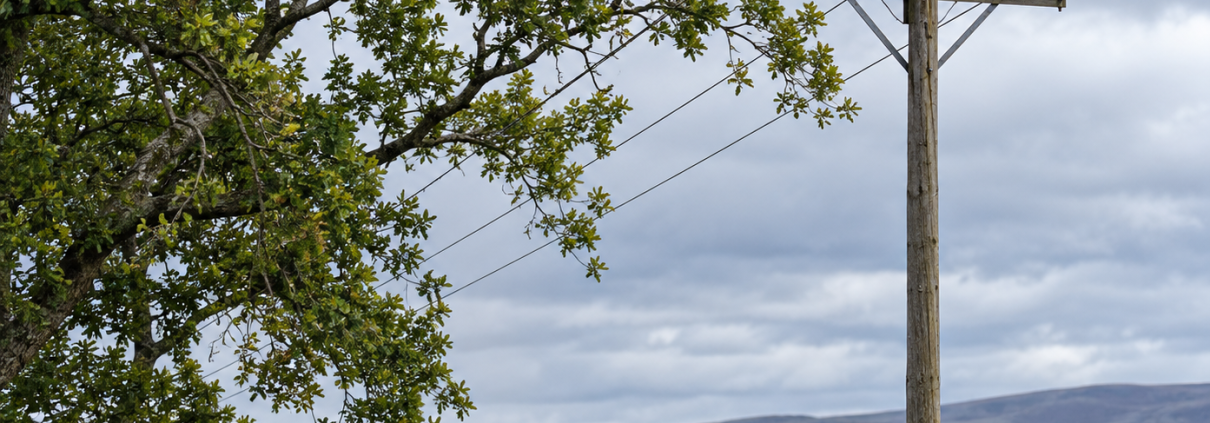
Trees Touching Power Lines: Who Should You Call and What Should You Do?


TD Trees • Power Line & Tree Safety

Trees Touching Power Lines: Who Should You Call and What Should You Do?

If a tree or branch is touching an overhead electricity line, do not approach it, climb it, cut it or try to pull the branch away.
Electricity can cause fatal injury without somebody directly touching the conductor, and a tree, branch, rope, ladder, pole saw, MEWP or other object can create a route for electrical current.

Safety first: stay clear and call 105.
Report a tree touching, damaging or dangerously close to electricity network equipment through the national 105 service. If somebody is seriously injured, there is a fire or another life-threatening emergency, call 999 as well and tell the emergency services that electricity is involved.

TD Trees carries out professional arboricultural work including technical tree removals near power lines. Electrical safety arrangements must be agreed with the relevant network operator before tree work proceeds where the electricity network could be affected.

01

Stay Away
Do not touch the tree, branch, wire, fence or equipment involved.

02

Do Not Cut
Do not use a saw, ladder, pole pruner, rope or garden tool near the line.

03

Call 105
105 connects you with the electricity network operator for the area.

04

Keep Others Clear
Keep children, neighbours, pets, vehicles and contractors away.

05

Wait for Advice
The network operator determines the electrical safety arrangements.

06

999 if Life-Threatening
Tell emergency services clearly that electricity is involved.

The Short Answer

What Should You Do if a Tree Is Touching a Power Line?

Move away, prevent other people from approaching and report it to the electricity network operator.

In Great Britain, the easiest route is normally to call 105. The service is designed for power cuts and electricity-network safety issues and directs the report to the appropriate network operator.

Do not first call an ordinary gardener or tree surgeon and ask them to remove the branch. Tree work close to live electrical equipment requires specific planning with the network operator.

Never assume the line is safe because nothing is sparking.
An overhead conductor can remain live without visible arcing, and a line that has tripped off may be automatically or remotely re-energised.

Electrical Danger

Why Are Trees Near Power Lines So Dangerous?

The danger is not limited to somebody physically grabbing a bare electrical conductor.

Electricity can flash across a gap where a person, machine, branch or tool gets sufficiently close to a live line. HSE specifically warns that direct contact is not necessary for a fatal incident to occur.

Flashover
Electricity can jump through an air gap without physical contact.
Wet wood
Wood should never be relied upon as electrical insulation.
Long tools
Pole saws, ladders and pruning equipment greatly extend reach.
Falling timber
A branch can swing or fall towards the conductors unexpectedly.
Machinery
MEWPs, cranes and loaders introduce additional reach and conductive paths.
Re-energisation
A line that appears dead may become live again without warning.

Do Not Test It

Can the Tree Itself Become Electrically Dangerous?

Potentially, yes.

If a branch or stem is in contact with electrical equipment, do not assume that the danger exists only at the wire itself.

Moisture, contamination and the route through the tree can affect conductivity. HSE warns that electricity can pass through materials such as wood, plastic and rubber when circumstances allow.

Do not touch the trunk to “see whether it is live”.
Electrical hazards cannot be assessed safely by touch, appearance or whether you can hear buzzing.

Identifying the Cable

How Do You Know Whether an Overhead Wire Is an Electricity Line?

Do not make the safety decision yourself based only on what the cable looks like.

HSE specifically warns that electricity lines carried on wooden poles can be mistaken for telephone or communications lines.

Looks like a telephone wire?
Do not assume it is. Confirm ownership before tree work.
Covered cable?
Do not assume the outer covering makes it safe to touch or work beside.
No sparks?
Lack of visible electrical activity does not prove the line is dead.

Who to Contact

Who Should You Call About a Tree Touching Power Lines?

The correct first contact depends on whether the situation is an electricity-network hazard, a life-threatening emergency or planned tree management.

SituationWho to ContactWhat to Do
Branch touching or damaging an electricity line105 / electricity network operatorStay clear and report the network safety issue.
Line down, damaged or dangerously low105 immediatelyKeep everybody away and assume it is live.
Fire, serious injury or immediate threat to life999 and 105Tell emergency services clearly that electricity is involved.
Tree is near the line but not yet touching itNetwork operator before pruningAsk for safety advice and clearance requirements.
Tree work has been cleared/planned by network operatorAppropriately competent arboricultural contractorComplete the agreed tree work under the required safe system.

National Electricity Number

What Is 105?

105 is the national telephone number for reporting electricity power cuts and network-related safety issues in Great Britain.

You do not need to work out which distribution network company owns the line before reporting an urgent problem.

This is particularly useful for homeowners who may not know whether their local electricity network is operated by SP Energy Networks, SSEN Distribution, Northern Powergrid or another distribution company.

For a dangerous tree-power-line situation, remember one number: 105.
The network operator can then determine what electrical safety measures and tree-management response are required.

Scotland & Northumberland

Which Electricity Network Operator Covers Your Area?

TD Trees works across areas served by more than one electricity distribution network operator.

Central & Southern Scotland

Large parts of central and southern Scotland are within the SP Energy Networks distribution area.

North of Scotland

Much of northern Scotland is served by SSEN Distribution.

North East England

Northumberland and the wider North East are within the Northern Powergrid region.

For a safety report, you do not need to memorise these boundaries: calling 105 is normally the simplest starting point.

Who Is Responsible?

Is the Network Operator or the Tree Owner Responsible for Cutting the Tree?

There is no single answer for every site.

The network operator is responsible for the safe operation of its electricity network and controls how work can take place close to its electrical equipment.

A landowner may still have responsibilities for managing trees on their property, but that does not mean the owner should independently arrange cutting next to live lines.

Network Operator

Controls the electrical network, determines safe clearances and can arrange isolation, specialist advice or utility tree work where required.

Tree / Land Owner

May be responsible for ordinary tree management but should involve the network operator before work that could enter the electrical danger zone.

Do not settle the responsibility question with a chainsaw.
Contact the network operator first. They can inspect the relationship between the tree and line and explain what work, isolation or specialist contractor arrangements are required.

Example: SP Energy Networks

What Does SP Energy Networks Say About Trees Near Its Lines?

SP Energy Networks tells customers not to undertake tree-cutting work near an overhead power line themselves or arrange ordinary cutting without involving the network.

For non-emergency tree concerns close to its lines, SP Energy Networks can arrange for a tree cutter to inspect the trees and assess what work is required.

It also operates ongoing vegetation-management programmes to maintain safety and network reliability.

This illustrates the correct order:
report the tree-line conflict, let the network operator assess the electrical risk, then establish who will undertake any necessary tree work.

Example: SSEN Distribution

Can the Electricity Supply Be Temporarily Switched Off for Tree Work?

Yes, where the network operator determines that temporary isolation is appropriate.

SSEN Distribution specifically provides a temporary-isolation service for situations including tree cutting near its overhead electricity cables.

The operator needs information about the work, location, line type, access and required timing so that the electrical network can be managed safely.

The tree contractor does not simply decide that a line “looks safe enough”.
Isolation and re-energisation remain matters for the network operator.

HSE Planning Guidance

How Close Can Tree Work Be to an Overhead Power Line?

HSE tree-work guidance uses a 10-metre planning threshold for arboricultural, aerial and ground work near overhead power lines.

Where work is proposed within 10 metres horizontally of the nearest wire — or where a tree, branch, machine or load could breach that zone — specialist advice from the line owner or network operator is required.

This does not mean 10 metres is a universal electrical “safe distance”.
It is a trigger for specialist planning. The actual controls and safe working arrangements must come from the network operator for the particular line and job.

Falling Distance

What if the Tree Is More Than 10 Metres Away but Could Fall Onto the Line?

It can still require network-operator involvement.

HSE guidance specifically says that work farther than 10 metres away must still be considered where a falling tree, branch, crane, MEWP or other equipment could enter the danger zone.

Tree height
Direction of lean
Branch length
Wind direction
Rigging movement
Machine reach

The correct question is therefore not just “how far is the trunk from the wire?” but “can any part of the work reach the electrical equipment?”

Do Not DIY

Why You Should Never Prune a Tree Near Power Lines Yourself

Ordinary garden pruning becomes a completely different risk when electricity is involved.

Branch moves unpredictably after the cut
Pole saw extends into danger zone
Ladder brings worker closer to line
Rope can pull timber towards cable
Wind can alter branch movement
Line may be live despite appearance
Wood cannot be relied on as insulation
A severed limb can damage network equipment

HSE explicitly advises the public not to arrange their own tree cutting where trees come near or into contact with overhead electricity lines without involving the electricity company.

Choosing the Right Contractor

Can Any Tree Surgeon Cut Branches Near Power Lines?

No.

Competence for normal tree pruning does not automatically mean competence to work near live electrical infrastructure.

HSE says tree work near electrical equipment should be carried out only as recommended by the network operator and according to the procedures it has established, using appropriately qualified and competent people.

Electrical proximity changes the job specification.
The safe system may require isolation, additional supervision, specialist utility arboriculture or another control determined by the network operator.

How Safe Work Is Planned

What Can the Network Operator Do Before Tree Work Starts?

The appropriate response depends on the voltage, line construction, tree position and intended work.

Assess the line
Confirm the relevant electrical equipment and risk.
Set safe clearances
Determine restrictions appropriate to the network.
Arrange isolation
Switch the line off where this is the safe approach.
Arrange specialist work
Utility arboricultural contractors may be used where appropriate.
Coordinate timing
Planned interruptions may affect neighbouring customers.
Confirm re-energisation
Power is restored only through the operator’s procedures.

Live Electrical Equipment

Can Tree Work Ever Be Carried Out While the Line Is Live?

Specialist live-line arrangements exist, but this is not something a homeowner or ordinary contractor should decide for themselves.

HSE states that the first choice for managing the risk should be to undertake the work with the electrical equipment made dead where reasonably practicable.

Any decision to work close to live conductors has to satisfy stringent legal and safety requirements and requires appropriate procedures, competence and protective measures.

For a homeowner, the rule remains simple:
never assume that a live line can be worked around safely. Let the network operator determine the method.

Technical Tree Work

What Equipment Might Be Used for Trees Near Power Lines?

Technical removals can require more than a climber and chainsaw.

Mobile elevating work platforms
Rigging and controlled lowering systems
Cranes where justified
Winching equipment
Barriers and exclusion zones
Specialist utility-arboriculture equipment

The equipment is selected around the safe system of work, tree structure, available access and electrical controls rather than simply choosing the quickest way to remove timber.

Controlled Removal

Why Can Rigging Be Important Near Power Lines?

Ordinary free-falling branches may be unacceptable where electrical infrastructure lies close to the tree.

Rigging systems can allow arborists to control sections of timber and lower them into designated areas.

However, ropes and suspended timber introduce their own movement and electrical-proximity risks, so rigging must form part of the agreed safe system rather than being improvised on site.

The aim is controlled movement.
Branches should not be allowed to swing, fall or drift towards network equipment, people, buildings or roads.

Machine Reach

Why Do MEWPs and Cranes Need Special Planning?

A machine can enter the electrical danger area even when its wheels or base are a considerable distance from the line.

The boom, basket, crane jib, suspended timber and potential collapse or swing radius all need to be considered.

Maximum machine reach
Boom movement
Load swing
Machine stability
Access route
Network clearance limits

No Power Cut?

What if the Tree Is Touching the Wire but the Electricity Is Still Working?

Report it anyway.

A branch can contact or encroach upon electricity equipment without immediately causing a visible fault or power cut.

Movement in wind, moisture, further growth or branch failure can change the situation.

Working electricity does not mean safe electricity.
Do not wait for sparks, smoke or a power cut before reporting a dangerous tree-line interaction.

Sparking or Arcing

What if the Branch Is Sparking, Smoking or Arcing?

Treat this as an urgent electricity-network safety issue.

Move well away, keep everybody else away and call 105 immediately.

If there is a fire, serious injury or an immediate threat to life, call 999 and state clearly that electrical equipment is involved.

Do not attempt to extinguish an electrical fire beside overhead lines yourself.
Maintain distance and follow the instructions of the emergency services and network operator.

Fallen or Damaged Lines

What if a Tree Has Brought the Power Line Down?

Do not approach the tree or the cable.

A fallen line should be treated as live even if it is lying on the ground, appears broken or has stopped sparking.

Keep people and animals away and call 105. SSEN public-safety guidance advises staying at least five metres away from fallen or damaged overhead lines; always follow the network operator’s instructions for the particular incident.

Never pick up or move a fallen cable.
A protection system may have switched electricity off temporarily and the network can be re-energised without warning.

Storm Damage

What Should You Do After a Storm?

Strong winds can bring trees and overhead electricity infrastructure into contact in ways that were not present beforehand.

Fallen tree across wires
Broken branch resting on cable
Split tree leaning towards line
Pole leaning after impact
Wire hanging unusually low
Tree suspended above road or garden

Report network damage before attempting any storm-clearance work. The fact that a road, driveway or garden is blocked does not make it safe to cut the tree before the electrical hazard has been controlled.

Suspended Trees

Why Is a Tree Hung Up in Power Lines Especially Dangerous?

The tree can be under substantial mechanical tension as well as presenting an electrical hazard.

Cut branches, root plates and split stems can move violently when load is released, while the supporting electricity line can also be damaged.

Do not attempt to free a suspended tree with a vehicle, rope or winch.
Mechanical pulling can change the electrical contact and cause uncontrolled movement.

Cable to the House

What if the Branch Is Touching the Electricity Cable to Your House?

Treat it as an electrical safety issue rather than ordinary garden pruning.

Low-voltage overhead wires connected to buildings can still cause fatal electric shock.

HSE guidance explains that where work must be carried out near these wires, the line owner may need to arrange isolation, diversion or other appropriate precautions.

“It only feeds my house” does not make it safe.
Domestic electrical voltage is still capable of causing fatal injury.

Private Electrical Systems

What if the Cable Is Privately Owned?

Some farms, estates, industrial sites and larger properties contain private electrical distribution after the network connection point.

The electrical owner and a competent electrical professional may therefore need to be involved as well as the arboricultural contractor.

Do not assume that private ownership makes the electrical hazard less significant. The same fundamental principle applies: the supply must be understood and a safe system agreed before tree work enters the danger area.

Planning Ahead

What if the Tree Is Not Touching the Line Yet?

This is the best time to act.

Planned vegetation management is far easier to organise than waiting until a branch is resting on the network during a storm.

Identify the network operator
Photograph the tree and line from a safe location
Explain the proposed tree work
Obtain network safety advice
Agree isolation if required
Use an appropriate arboricultural contractor

Preventive Tree Management

Can Pruning Prevent Trees Reaching Power Lines?

Appropriate planned pruning can sometimes maintain useful clearance and reduce the likelihood of future contact.

The objective should not simply be to hack the line side of the tree back as hard as possible.

Selective Pruning

Branches can be shortened or removed strategically while retaining an appropriate tree structure.

Directional Management

Future crown growth can sometimes be directed away from electrical infrastructure.

Removal

May be justified where the tree presents an ongoing conflict that cannot reasonably be managed through pruning.

Avoid Poor Pruning

Should a Tree Be Topped to Keep It Away From Power Lines?

Not as a default response.

Indiscriminate topping can create large wounds and strong replacement growth, potentially creating another clearance problem in the future.

The preferred management should be determined by the tree’s species, form, location and long-term relationship with the line.

Electrical clearance and good arboriculture need to be considered together.
The safest immediate cut is not necessarily the best long-term tree-management specification.

Long-Term Conflict

When Might Tree Removal Be Better Than Repeated Pruning?

Some trees can be managed successfully beside overhead lines. Others may repeatedly grow into the required clearance space or present additional structural problems.

Tree is fundamentally unsuitable for the location
Repeated clearance pruning is becoming excessive
Tree has significant structural defects
Storm failure could repeatedly affect network equipment
Long-term maintenance is disproportionate
Replacement planting can provide a more sustainable solution

Where removal is appropriate, TD Trees provides professional tree felling and technical dismantling.

Farms, Estates & Commercial Sites

What Should Landowners and Commercial Sites Do About Trees Near Power Lines?

Overhead lines should form part of routine site risk management rather than being discovered only when contractors arrive.

Map overhead-line routes
Identify mature trees within falling distance
Monitor vegetation clearances
Include lines in contractor briefings
Plan access for MEWPs and cranes
Contact the DNO before planned work
Maintain emergency contact details
Record agreed safe systems of work

TD Trees provides commercial arboricultural services, including technical removals near power lines, railways and major roads.

Safe Work Planning

What Does a Safe Tree-Work Plan Near Power Lines Consider?

Voltage and network equipment
Electrical isolation requirements
Tree height and crown spread
Branch movement after cutting
Rigging arrangements
Machine operating envelope
Public exclusion zones
Traffic and road management
Ground conditions
Emergency procedures
Timber extraction route
Re-energisation arrangements

Roads & Public Areas

What if the Tree and Power Line Are Beside a Road or Footpath?

The electrical hazard is only one part of the work.

Technical tree operations may also require pedestrians, vehicles and members of the public to be kept outside the working area.

Depending on the location and work method, traffic management, barriers, temporary closures or additional supervision may be required.

A safe electrical system does not automatically make the whole worksite safe.
Falling timber, ropes, machinery, traffic and public access still need independent control.

Tree Protection

What if the Tree Has a TPO or Is in a Conservation Area?

Tree protection and electrical safety are separate considerations.

For planned non-emergency work, Tree Preservation Order or conservation-area controls may need to be checked before pruning or removal.

Where there is an immediate network or public-safety danger, report the hazard to the network operator first. Emergency and statutory situations can involve different legal processes from routine pruning.

Do not delay reporting an electrical danger while trying to research planning paperwork.
The immediate hazard should be reported first; the relevant professionals can then determine what permissions or exemptions apply to subsequent work.

Wildlife

Do Wildlife Checks Still Matter?

Yes. Planned tree work should still consider active bird nests, bat roosts and other protected wildlife.

The urgency and electrical danger may affect how work is planned, but protected wildlife should not simply be ignored.

On complex sites, the electricity network operator, arboricultural contractor and ecological professionals may all need to coordinate the safest and legally appropriate approach.

Prevention Through Inspection

When Is an Arboricultural Survey Useful Near Power Lines?

Surveys can be valuable where land contains numerous trees within potential falling distance of electricity infrastructure.

Large estates
Commercial grounds
Woodland edges
Schools and institutions
Development sites
Roadside tree populations
Storm-damaged sites
Repeated network conflicts

A survey can identify trees requiring management before branch failure or growth creates an urgent electricity-network problem.

Critical Don’ts

What You Should Never Do Around a Tree and Power Line

Do not climb the tree
The tree may already be in electrical contact.
Do not use a ladder
A ladder greatly increases your reach towards the conductors.
Do not use a pole saw
Long tools can enter the electrical danger zone unexpectedly.
Do not pull the branch with a rope
You cannot safely predict its movement or electrical status.
Do not touch a fallen wire
Assume every damaged electrical conductor is live.
Do not trust rubber gloves
Ordinary PPE does not make power-line tree work safe.
Do not assume the power cut means the line is dead
Electricity can be restored automatically or remotely.
Do not send an ordinary contractor in first
Network-operator advice is required where the work can affect electrical equipment.

Common Misunderstandings

Trees and Power Lines: Myth vs Reality

Common AssumptionSafer Explanation
“It isn’t sparking, so it must be safe.”Live electricity can be present without visible sparks or noise.
“Wood doesn’t conduct electricity.”Wood cannot be relied upon as electrical insulation, particularly when damp or contaminated.
“The wire is covered, so I can cut beside it.”Do not assume a cable covering provides safe insulation for arboricultural work.
“The power is off, so the line is dead.”Lines can be re-energised automatically or remotely unless the network operator has made them safe.
“My tree means I can cut it myself.”Ownership of the tree does not override electrical safety requirements.
“Any tree surgeon can do it.”Power-line tree work requires network-operator involvement and appropriately competent people working to an agreed safe system.

What Should You Do?

Tree Near a Power Line: Decision Guide

If there is any doubt about electrical proximity, start with the network operator.

“A branch is touching the line.”
Stay clear and call 105. Do not attempt any pruning.
“The wire is sparking or on the ground.”
Keep everybody away and call 105 immediately. Call 999 as well if there is fire, injury or immediate danger to life.
“The tree is close but not touching.”
Contact the network operator before arranging pruning within the potential danger zone.
“My gardener says they can just cut it back.”
Do not proceed until the electricity-network risk has been assessed and appropriate arrangements agreed.
“The network operator says the line needs isolating.”
Coordinate the tree-work date with the agreed isolation and re-energisation arrangements.
“A tall tree could fall onto the line.”
Obtain advice before felling even where the trunk itself appears a reasonable distance away.
“The tree repeatedly grows back into the clearance.”
Review whether planned directional pruning or long-term removal/replacement is more sustainable.
“The network operator has made it safe for contractors.”
Use an arboricultural contractor competent for the agreed work and site conditions.

Reporting the Problem

What Information Should You Give When You Call 105?

Exact location
Nearest address or landmark
Whether branch is touching the wire
Whether line is down or damaged
Whether there is sparking or smoke
Whether power has gone off
Whether road or access is blocked
Whether anybody is injured
Whether tree is still moving
Safe contact number

Only take photographs from a safe location. Never move closer to the electricity equipment simply to obtain a better image.

Before Planned Tree Work

Questions to Ask Before Hiring a Contractor Near Power Lines

1. Has the network operator been contacted?
2. Has the line ownership been confirmed?
3. Does the line need to be isolated?
4. Who controls the isolation?
5. Is the team competent for this type of work?
6. What safe clearances apply?
7. How will branches be controlled?
8. Is a MEWP or crane required?
9. How will the public be excluded?
10. What is the emergency procedure?
11. Who confirms the line is safe?
12. Who authorises re-energisation?

Planned Work Process

How Planned Tree Work Near Power Lines Typically Progresses

1. Identify
Confirm the tree, line and intended work.
2. Contact
Network operator reviews the electrical risk.
3. Plan
Safe system, clearances and work method are agreed.
4. Isolate
Electricity is made safe if the agreed method requires it.
5. Tree Work
Competent arborists undertake the planned operation.
6. Restore
Network operator controls safe return to service.

Common Questions

FAQs About Trees Touching Power Lines

What should I do if a tree is touching a power line?

Stay away, keep other people clear and report the situation to the electricity network operator by calling 105. Do not attempt to cut or move the branch.

Who do I call about branches touching power lines?

Call 105. It is the national electricity-network number for power cuts and network safety concerns in Great Britain.

Should I call 999?

Call 999 where there is a fire, serious injury or immediate threat to life, and tell the emergency services that electricity is involved. Report the network issue through 105 as well.

Can I cut a branch that is touching an electricity cable?

No. Do not undertake the work yourself. The electricity network operator must be involved so the electrical risk and safe system can be established.

Can a tree conduct electricity?

A tree should never be relied upon as an insulator. Moisture and contamination can allow electrical current to create a dangerous path through wood and surrounding materials.

Can electricity jump from a power line?

Yes. Flashover can occur when a person or object comes sufficiently close to a live conductor even without direct physical contact.

Is a power line safe if it is not sparking?

No. A live conductor may show no visible sign that electricity is present.

Is a line safe after the power goes off?

No. Electricity networks can re-energise automatically or remotely. Treat the line as live until its owner confirms it has been made safe.

Can I use a pole saw near power lines?

Not without the appropriate specialist planning and network-operator arrangements. Long tools can enter the electrical danger zone before the operator realises it.

Can any tree surgeon work near electricity lines?

No. Electrical-proximity work requires appropriately competent people following procedures and safety arrangements agreed with the network operator.

How far from a power line can tree work take place?

HSE uses a 10-metre planning threshold for tree work near overhead lines, including work that could enter that distance through falling timber or machinery. The actual safe clearance must be determined with the network operator.

What if the tree trunk is more than 10 metres away?

Network advice may still be required if the tree, a branch, crane, MEWP or other part of the operation could fall or reach towards the overhead line.

Can the electricity company switch the line off?

Yes, temporary isolation can form part of planned work where the network operator determines it is appropriate.

Does temporary isolation affect neighbours?

It can. Depending on the network arrangement, other properties may lose supply during a planned isolation, which is one reason the network operator must organise it.

Who pays for tree cutting near power lines?

It depends on the network, ownership, reason for the work and operator’s vegetation-management arrangements. Contact the network operator before assuming responsibility or commissioning work.

Will the electricity company cut my tree?

In some situations the network operator may arrange or commission the necessary vegetation work. In others it may provide safety arrangements so an appropriate contractor can undertake the tree work.

What if the branch is only close to the wire?

Contact the network operator before pruning where the work itself could bring a person, branch, tool or machine close to the electrical equipment.

Should trees near power lines be topped?

Not automatically. Planned selective or directional pruning may provide better long-term management. The correct specification depends on the tree and the required electrical clearance.

When should a tree near a power line be removed?

Removal may be considered where the tree creates an unsustainable repeated conflict, has serious structural defects or cannot reasonably be retained within the network’s clearance requirements.

What if a tree falls on a power line in a storm?

Stay away, keep others clear and call 105. Do not begin cutting the tree until the network operator has dealt with the electrical hazard.

What if the cable is lying on the ground?

Treat it as live. Do not approach, touch or move it. Call 105 immediately and keep everyone away.

Can I drive over a fallen power cable?

No. Stay away from damaged network equipment and follow instructions from the network operator or emergency services.

What if a vehicle or machine touches an overhead line?

Occupants should normally remain in the vehicle and warn others to stay away while the network operator is contacted. If fire creates an immediate need to escape, emergency procedures are different and 999 should be called.

Can a branch touching a power line start a fire?

Electrical contact can create arcing, faults and heat. Any smoking, burning or sparking tree-line contact should be treated as an urgent network safety issue.

Do power lines cause tree-related power cuts?

Trees and branches are a significant source of overhead-network faults, particularly during high winds and storms.

Can TD Trees work near power lines?

TD Trees lists technical tree removals near power lines among its commercial services. Where electrical infrastructure could be affected, work must be coordinated with the relevant network operator and undertaken under the required safe system.

Remember

If a Tree Is Touching an Electricity Line, Do Not Touch or Cut It

Stay clear, keep others away and report it through 105. Call 999 as well for fire, serious injury or immediate danger to life.

✓ Assume the line is live
✓ Stay away from the tree and cable
✓ Keep children and pets clear
✓ Call 105
✓ Use 999 for life-threatening emergencies
✓ Follow network-operator instructions
✓ Do not use ladders or pole saws
✓ Do not pull branches with ropes
✓ Do not trust a power cut as proof of isolation
✓ Use competent arborists after the electrical risk is controlled

Technical Tree Work

Planning Tree Work Near Power Lines?

Electrical safety must come first. If a tree is touching, damaging or dangerously close to electricity-network equipment, contact the network operator before arranging tree cutting.

Once the required electrical controls and working arrangements are understood, TD Trees can provide professional arboricultural assessment and technical tree work, including complex dismantling and commercial tree operations.

TD Trees works across Edinburgh, Central Scotland, Southern Scotland, the Scottish Borders, Northumberland and surrounding areas, with experienced teams, specialist equipment and detailed work planning for technically demanding sites.


Commercial & Technical Tree Services

Sources and References

  • Health and Safety Executive – Working Near Power Lines and Cables:
    https://www.hse.gov.uk/treework/safety-topics/power-lines.htm
  • Health and Safety Executive – Overhead Power Lines:
    https://www.hse.gov.uk/electricity/information/overhead.htm
  • Health and Safety Executive – Avoiding Danger From Overhead Power Lines (GS6):
    https://www.hse.gov.uk/pubns/gs6.htm
  • Health and Safety Executive – Electricity FAQs:
    https://www.hse.gov.uk/electricity/faq.htm
  • SSEN Distribution – Contact Us / Report a Dangerous Situation:
    https://www.ssen.co.uk/about-ssen/contact-us/
  • SSEN Distribution – Temporary Isolation for Tree Cutting:
    https://www.ssen.co.uk/our-services/existing-electricity-supplies/temporary-isolation/
  • SSEN Distribution – Farm & Overhead-Line Safety:
    https://www.ssen.co.uk/power-cuts-emergencies/keeping-safe/farmsafety/
  • SP Energy Networks – Trees Close to Power Lines:
    https://www.spenergynetworks.co.uk/pages/what_do_i_do_if_there_are_trees_close_to_the_power_lines_on_or_close_to_my_property.aspx
  • SP Energy Networks – Contact Us / Electricity Emergencies:
    https://www.spenergynetworks.co.uk/pages/contact_us.aspx
  • SP Energy Networks – Tree Safety Guidance:
    https://www.spenergynetworks.co.uk/
  • TD Trees – Commercial Tree Surgery:
    https://www.tdtrees.co.uk/commercial/
  • TD Trees – Tree Felling:
    https://www.tdtrees.co.uk/tree-services/felling/

Tree Topping vs Crown Reduction: What’s the Difference and Which Is Safer?


TD Trees • Professional Tree Pruning

Tree Topping vs Crown Reduction: What’s the Difference and Which Is Safer?

Topping and crown reduction can both make a tree look smaller immediately, but they are not the same operation.
Crown reduction is selective pruning designed to decrease height and/or spread while retaining a coherent branch framework. Topping is indiscriminate cutting through major branches or stems to force the tree down to a predetermined height or shape.

Quick answer:
where reducing the size of a tree is genuinely appropriate, a professionally specified crown reduction is normally the correct arboricultural approach. Topping can create large wounds, remove excessive leaf area, trigger dense regrowth and leave a tree requiring more difficult long-term management.

At TD Trees, our tree pruning is carried out in accordance with recognised arboricultural standards, with the pruning objective, species, condition and long-term effect considered before work begins.

01

Selective Cuts
Reduction works back to suitable retained branches rather than cutting everything to one line.

02

Natural Shape
A good reduction should leave a recognisable, balanced tree rather than a row of stubs.

03

Leaf Area
Excessive canopy removal can reduce the tree’s photosynthetic capacity.

04

Wound Size
Professional reduction seeks to keep individual pruning wounds as small as reasonably possible.

05

Regrowth
Severe topping often stimulates rapid replacement shoots around the cuts.

06

Long-Term Structure
The real difference often becomes clearer years after the pruning, not on the day it is completed.

The Short Answer

What Is the Difference Between Tree Topping and Crown Reduction?

Crown reduction selectively shortens branches while retaining a smaller version of the tree’s existing crown structure.

The arborist works around the canopy, shortening suitable branches back to appropriate lateral growth points. The finished crown should still resemble the natural form of the tree, just with reduced height, spread or both.

Topping is different. It generally involves cutting major limbs or stems at an arbitrary height or boundary without respecting the tree’s natural branch framework.

A useful visual test:
after a good crown reduction, the tree should still look like a tree. After topping, the structure often ends abruptly in obvious large stubs or a hard artificial line.

Visual-Style Explanation

What Would Each Type of Pruning Look Like?

Crown Reduction

Selective shortening

Imagine tracing the natural outer edge of the crown and moving that outline inward while keeping the main branching structure intact.

The finished tree: smaller, but still recognisably the same tree.

Topping

Cutting to a predetermined line

Imagine drawing a horizontal or rounded line through the canopy and cutting major stems wherever they cross it.

The finished tree: often much smaller immediately, but with numerous large cut ends and lost natural branch structure.

Side-by-Side Comparison

Crown Reduction vs Topping

FactorProfessional Crown ReductionTopping
ObjectiveReduce crown dimensions while retaining a functional structure.Force the tree down to an arbitrary height or outline.
Where cuts are madeAt suitable branch unions and retained laterals.Often through major stems regardless of suitable growth points.
Natural formRetained as far as reasonably possible.Frequently destroyed or heavily altered.
Leaf-bearing frameworkA significant proportion remains.Can be drastically removed.
Wound sizeCuts are selected to remain as small as reasonably possible.Can create numerous large-diameter wounds.
Regrowth responseManaged within retained branch structure.Often produces dense, vigorous shoots near large cuts.
Decay potentialMinimised by appropriate cut selection, although every cut is still a wound.Large inappropriate cuts can increase dysfunction and decay.
AppearanceSimilar outline at smaller dimensions.Obvious stubs, flat top or abruptly shortened crown.
Long-term managementCan form part of a planned pruning strategy.Can create repeated management because of vigorous regrowth and deteriorating old cuts.

Understanding Topping

What Does “Topping a Tree” Actually Mean?

Topping is the severe reduction of a tree by cutting through large branches and stems without adequately retaining the tree’s natural branch hierarchy.

It is sometimes described using softer-sounding terms such as “taking the top off”, “bringing it right down”, “lopping it back”, “cutting it in half” or “taking it down to roof height”.

Large stems cut to stubs
Little regard for natural branch unions
Large amount of canopy removed
Predetermined height rather than arboricultural specification
Natural crown form lost
Numerous large exposed wounds
The key issue is not simply how much height is removed.
It is where the cuts are made, how much live crown is lost and what structure is left for the tree to continue growing from.

Why It Happens

Why Do Homeowners Ask for Trees to Be Topped?

Usually because they have a genuine problem but have been offered the wrong solution.

Tree feels too tall
Concern about storms
Too much shade
Branches near a house
Neighbour complaint
Tree appears too large for the garden
Concern about falling branches
Desire for more light

Those are all legitimate management questions. The mistake is assuming that indiscriminate topping is automatically the right answer.

Professional Size Management

What Is a Proper Crown Reduction?

Crown reduction is the selective reduction in the height and/or spread of the foliage-bearing crown.

Rather than cutting every branch at the same distance from the ground, the arborist follows the tree’s existing branch structure and makes reduction cuts at suitable lateral growth points.

Height can be reduced
Where justified by the objective and tree form.
Spread can be reduced
For clearance or mechanical reasons.
Individual limbs can be reduced
A whole-tree reduction is not always required.
Framework is retained
The tree keeps a coherent branch hierarchy.
Natural form remains
The final shape should suit the species and original crown.
Work is measurable
The quotation should say how much crown will be removed.

How the Cuts Differ

What Is a Reduction Cut?

A reduction cut shortens a branch back to a suitable lateral branch rather than cutting the stem at an arbitrary point.

This retains a live growing point capable of continuing the branch structure beyond the cut.

Reduction Cut

The branch is shortened to an appropriately positioned lateral branch capable of continuing growth and maintaining branch form.

Heading / Topping Cut

The stem is cut at a point that does not adequately retain the natural branch structure, often leaving a stub and stimulating replacement shoots nearby.

Branch Selection

Why Does the Size of the Retained Branch Matter?

In professional crown reduction, the arborist does not simply choose the nearest twig to make a large branch shorter.

Recognised pruning guidance uses the relationship between the branch being removed and the lateral branch retained. A commonly applied principle is that the retained lateral should be large enough to assume the continuing role of the shortened branch.

Why this matters:
retaining an appropriately substantial lateral gives the branch a meaningful continuation point and helps distinguish selective crown reduction from indiscriminate heading.

The Biological Cost

Why Is Tree Topping Considered Harmful?

Severe topping can create several problems at the same time.

Large wounds
Large-diameter cuts expose substantial areas of wood.
Leaf loss
A major proportion of the photosynthetic canopy may disappear at once.
Rapid regrowth
Dormant or adventitious buds can produce vigorous replacement shoots.
Decay
Large exposed cuts may develop dysfunction and decay behind the wound.
Lost architecture
The natural branch hierarchy can be permanently altered.
Repeat maintenance
Strong regrowth can create another size problem relatively quickly.

Tree Energy

Why Does Removing Too Much Leaf Area Matter?

Leaves are the tree’s main photosynthetic organs. They manufacture carbohydrates that support growth, defence, root activity and the maintenance of living tissues.

When a very large proportion of live crown is suddenly removed, the tree’s balance between roots and canopy changes abruptly.

The response varies between species and individual trees, but excessive pruning can stimulate vigorous shoot production as the tree attempts to rebuild lost leaf area.

Harder pruning does not necessarily mean longer-lasting size control.
In some trees, severe pruning produces exactly the opposite response: vigorous new growth that rapidly refills the space.

What Happens Next?

Why Do Topped Trees Often Produce So Much Regrowth?

After severe canopy loss, many trees respond by producing numerous fast-growing shoots around or below the topping points.

This can create a dense crown of relatively young shoots arising from an older framework.

1. Crown Removed
Large amount of foliage disappears.
2. Buds Activate
Replacement shoots emerge near old cuts.
3. Rapid Extension
New shoots can grow strongly as leaf area is replaced.
4. New Management Problem
The crown becomes dense and eventually requires further intervention.

Future Branch Structure

Can Regrowth From a Topped Tree Become a Future Safety Issue?

It can.

Replacement shoots develop from the remaining tree around old cut positions rather than following the original branch architecture.

As those shoots become longer and heavier, the quality of their attachment and the condition of the old topping wound become increasingly important.

This is one of the long-term problems with topping:
the tree can look small immediately after work yet require more careful structural management later as replacement crowns develop around ageing cut surfaces.

Wounds & Decay

Why Do Large Topping Cuts Increase Concern About Decay?

Trees do not “heal” wounds in the same way that human skin heals. Instead, they grow new tissue around wounds and compartmentalise damaged or infected wood internally.

Larger wounds expose more wood and take longer for surrounding tissues to grow over.

Species also vary considerably in their ability to compartmentalise decay.

Smaller appropriate cuts
Professional pruning seeks to achieve the objective while limiting unnecessary wound size.
Large indiscriminate cuts
Create larger exposed surfaces and can allow substantial columns of dysfunctional or decayed wood to develop.

Important Qualification

Does This Mean Crown Reduction Is Completely Harmless?

No pruning is biologically neutral. Every live branch removed reduces leaf area and creates a wound.

The reason professional crown reduction is fundamentally different from topping is that it seeks to achieve a specific objective while limiting unnecessary damage and retaining a viable crown framework.

Good arboriculture is not “cut as much as the tree will survive”.
It is selecting the minimum appropriate intervention required to achieve a justified management objective.

Appropriate Uses

When Is Crown Reduction Appropriate?

Crown reduction can be useful where there is a clear reason for decreasing the length of branches or the overall dimensions of the crown.

Manage selected overextended branches
Create proportionate building clearance
Reduce mechanical loading on suitable limbs
Manage a tree within restricted space
Respond to particular structural defects
Reduce an established crown under a management plan
Address selected branch conflicts
Retain a tree that might otherwise become difficult to manage

TD Trees provides professional crown reduction and tree pruning services where reduction is appropriate to the tree and the objective.

Targeted Pruning

Does the Whole Crown Always Need Reducing?

No.

Sometimes the management objective concerns only one branch, one side of the crown or one particular conflict.

For example, a long lateral branch extending above a vulnerable structure might justify selective end-weight reduction without reducing the opposite side of the tree unnecessarily.

Symmetry is not automatically the objective.
Professional pruning responds to tree architecture and the specific reason for work, rather than forcing every tree into a perfectly round shape.

Light & Shade

Is Crown Reduction the Best Way to Get More Light?

Sometimes, but not always.

If the real problem is low branches blocking windows or light beneath the canopy, crown lifting may be more appropriate than reducing the whole tree.

In other cases, selective thinning or targeted pruning may address the issue with less overall canopy removal.

ProblemPossible Pruning ApproachMain Aim
Low branches blocking access/lightCrown liftingRaise the lower crown while retaining upper height.
Excessive crown dimensionsCrown reductionReduce height/spread while retaining structure.
Selected branch conflictTargeted reductionSolve the localised problem without unnecessary whole-crown work.
General desire to make tree drastically smallerProfessional assessment firstDetermine whether substantial reduction is suitable or whether another management option is better.

Reducing Tree Height

Can You Safely Reduce the Height of a Tall Tree?

Sometimes, yes — but the amount that can reasonably be removed depends on the tree.

Species, maturity, previous pruning, branch architecture, vigour, condition and the availability of suitable reduction points all affect what is achievable.

You cannot always choose an arbitrary finished height.
If there are no suitable branches at the requested level, forcing the tree down to that height may turn a proposed crown reduction into topping.

How Much Can Be Removed?

Can You Reduce a Tree by 50%?

A request such as “take half the tree off” should trigger a proper discussion rather than automatic agreement.

Percentage descriptions can be misleading because customers may mean height, crown volume, branch length or the amount of foliage removed.

A better pruning specification normally describes the intended reduction in actual crown dimensions or branch lengths.

Vague

“Cut 50% off the tree.”

Better

“Reduce height by approximately 1.5m and lateral spread by approximately 1m, retaining a natural crown outline.”

Written Specification

What Should a Crown Reduction Quote Actually Say?

A useful quotation should describe the finished result clearly enough that you know what is being purchased.

Which tree is being worked on
Reason for the reduction
Approximate reduction in height
Approximate reduction in spread
Whether selected limbs need different treatment
Deadwood or damaged branches included
Waste removal arrangements
Any permission requirements
Be cautious with vague descriptions such as “lop tree”, “cut right back” or “reduce substantially”.
A proper specification helps both the customer and climbing arborist understand the intended finished crown.

Common Confusion

Is Topping the Same as Pollarding?

No.

Proper pollarding is a planned management system normally established when a tree is relatively young. New shoots are repeatedly cut back to established pollard heads or knuckles on a defined cycle.

Taking a mature tree that has never been pollarded and suddenly cutting its major branches to large stubs is not the same thing.

Established Pollard

A deliberate cyclical system with recognised pruning points developed through repeated management.

Topping

Severe indiscriminate cutting of a tree that does not form part of an established pollarding regime.

Previously Topped Trees

What If Your Tree Has Already Been Topped?

A previously topped tree needs to be assessed according to what has developed since the original cuts.

It may now contain a secondary crown of vigorous shoots growing around old wounds, potentially with decay developing in the underlying stubs.

The appropriate response could involve restorative pruning, selective shoot management, staged reduction, continuation of an established management cycle or, in some cases, removal.

Do not assume the tree can simply be “put back to normal” in one visit.
Restoration of badly topped trees can require several pruning cycles and may be limited by the condition of the old framework.

Restorative Pruning

Can a Topped Tree Be Restored?

Sometimes, at least partially.

Restorative pruning aims to improve the crown structure of trees damaged by inappropriate pruning, storm breakage or other events.

Assess old topping points
Check for decay
Assess shoot attachments
Retain selected well-positioned shoots
Remove or shorten competing growth
Develop a staged management plan

The older and more decayed the topping points become, the less realistic complete structural restoration may be.

Storm Concerns

Should You Top a Tree to Stop It Blowing Over?

No blanket recommendation like this is appropriate.

Tree stability depends on root condition, soil, structural defects, exposure, crown architecture and many other factors. Height by itself does not establish that a tree is unsafe.

If there is an identified structural reason to reduce loading, targeted crown reduction may form part of a risk-management recommendation, but that is very different from indiscriminately cutting the top off.

Do not use topping as a substitute for diagnosis.
If storm stability is the concern, assess the tree first and then specify the work that addresses the actual defect.

Mature & Veteran Trees

Is Crown Reduction Suitable for Every Mature Tree?

No.

Species tolerance, age, vitality, existing decay, previous pruning and current crown architecture all affect how much live wood can appropriately be removed.

Veteran or physiologically stressed trees may require particularly conservative and highly targeted management.

Sometimes the correct reduction is smaller than the customer originally hoped for.
The tree’s biological and structural limits should determine the specification rather than an arbitrary desired size.

Prevention

Good Formative Pruning Can Prevent Future Heavy Reductions

Many expensive mature-tree conflicts begin with problems that could have been addressed while the tree was young.

Formative pruning can improve branch structure, manage competing leaders and establish appropriate clearance while wounds are relatively small.

Small cuts earlier
Young branches can often be corrected without creating large wounds.
Better branch structure
Future conflicts and weak unions may be reduced.
Less drastic intervention later
The mature tree may need less corrective pruning.

When the Space Is the Problem

What If a Tree Has Simply Outgrown Its Location?

Repeated pruning is not always the best long-term answer.

Some trees were planted in spaces that were never large enough for their mature dimensions. Repeatedly forcing a naturally large tree into a permanently tiny crown can create ongoing expense and compromise tree form.

Retain & Manage
Appropriate if a sustainable pruning cycle can retain a healthy functional tree.
Accept More Natural Size
Sometimes the better solution is to change expectations rather than repeatedly reduce the tree.
Replace If Necessary
Where long-term conflict is fundamental, replacement with a more suitable species may provide a better outcome than perpetual heavy pruning.

Long-Term Decision

Crown Reduction or Tree Removal: Which Makes More Sense?

Removal should not be the automatic alternative to topping, but there are situations where retaining a tree through repeated severe reductions may not be sensible.

SituationPossible DirectionReason
Tree is healthy but moderately oversizedConsider crown reductionSize may be managed while retaining a viable crown.
Only one branch creates conflictTargeted reductionWhole-crown work may be unnecessary.
Tree would require repeated extreme reductionReassess long-term suitabilityThe species or location may be fundamentally incompatible.
Tree has severe structural defectsProfessional assessmentRemoval or specialist management may be more appropriate than cosmetic size reduction.

Finished Result

What Should a Good Crown Reduction Look Like?

One of the best signs of skilled reduction is that the work does not immediately look drastic.

Natural overall outline
Balanced branch structure
No flat “tabletop” crown
No line of large stubs
Suitable live laterals retained
Crown visibly smaller but still coherent

TD Trees describes a successful reduction in similar terms: the tree should maintain its shape, with no unnecessary large wounds and a finished form that still appears natural.

Warning Signs

Warning Signs That “Crown Reduction” May Actually Mean Topping

“We’ll just take the top off.”
No written reduction dimensions
Proposal to cut every stem to the same height
No discussion of tree species
No discussion of suitable branch unions
Very large reduction promised without inspecting structure
“It’ll stop growing afterwards.”
Finished height chosen solely from ground level

Before You Agree

Questions to Ask Before Agreeing to Crown Reduction

1. Why does the tree need reducing?
2. Is reduction appropriate for this species?
3. How much height will be removed?
4. How much lateral spread will be removed?
5. What branch structure will remain?
6. Will large-diameter cuts be required?
7. Could a smaller targeted reduction solve the issue?
8. What regrowth should I expect?
9. Will future maintenance be required?
10. Is permission required before the work?

Professional Standards

What Does BS 3998 Have to Do With Crown Reduction?

BS 3998:2010, Tree Work – Recommendations, is the principal British Standard covering recommendations for tree work.

Professional arborists use recognised terminology and pruning principles so that a specification means more than simply “make the tree smaller”.

Clear objective
The reason for reducing the crown should be understood.
Correct pruning cuts
Branches should be shortened or removed at appropriate locations.
Defined finished result
Reduction should be described in meaningful measurable terms.

TD Trees states that its tree pruning is carried out to BS 3998:2010 and also references the European Tree Pruning guidance used within professional arboriculture.

European Tree Pruning Standard

What Does Current European Guidance Say About Topping?

The European Tree Pruning Standard distinguishes legitimate specialist pruning systems from indiscriminate topping.

Its current guidance treats topping of semi-mature and mature trees, where there is no deliberate intention to establish a recognised artificial form with planned repeated management, as bad tree work that should be avoided.

That distinction is important.
A deliberately established pollard or specialist veteran-tree intervention should not be confused with simply cutting the top from an ordinary mature tree.

Before Pruning

Do You Need Permission to Crown Reduce a Tree?

Sometimes.

If a tree is protected by a Tree Preservation Order, consent may be required before pruning. Trees within conservation areas can also be subject to notification requirements.

The application or notification should describe the proposed pruning properly. “Cut tree back” is not a useful arboricultural specification.

Protection checks should happen before the saw starts.
A contractor should not treat planning controls as something to sort out after the tree has already been pruned.

Wildlife

Do Nesting Birds and Bats Matter When Reducing a Tree?

Yes.

Crown reduction can affect cavities, dense foliage and other features used by wildlife. Active nests and protected bat roosts must be considered before and during work.

The presence of protected wildlife can change the timing, method or extent of pruning.

Timing

Does the Time of Year Matter for Crown Reduction?

Yes. Appropriate timing varies by species and pruning objective.

Many ordinary deciduous trees can be pruned during dormancy, while cherries, plums, birch, maple, walnut and other species can require different seasonal timing.

This is another reason professional pruning cannot be reduced to a simple instruction to “take the top off”.

See our full guide to the best time to prune trees in Scotland for a species-led explanation of seasonal pruning.

Price vs Long-Term Cost

Is Topping Cheaper Than Proper Crown Reduction?

It can appear cheaper initially because indiscriminate cutting may require less precision than selecting suitable reduction points throughout the crown.

But the first invoice is not the whole cost of tree management.

Initial work
What does the first pruning visit cost?
Regrowth
How quickly will another intervention be needed?
Decay management
Will old large cuts become future inspection concerns?
Restoration
Will specialist corrective pruning later be required?
Tree lifespan
How does the intervention affect long-term retention?
Replacement
Could poor management eventually contribute to earlier removal?

Common Misunderstandings

Tree Topping: Myth vs Reality

Common AssumptionMore Accurate Explanation
“Topping stops a tree growing.”Many trees respond to severe pruning with vigorous replacement growth.
“A shorter tree is automatically safer.”Safety depends on structure, roots, defects, condition and targets, not height alone.
“Topping and crown reduction are basically the same.”Reduction retains suitable branch structure; topping cuts major stems indiscriminately.
“Pollarded trees prove topping is fine.”Pollarding is a specific planned management system and should not be confused with topping an ordinary mature tree.
“The more you remove, the longer it stays small.”Heavy pruning can trigger strong regrowth and create additional maintenance.
“Any arborist can take any tree down to any height.”Suitable pruning points, species tolerance and tree condition limit what can reasonably be achieved.

Choosing a Contractor

How Can You Tell Whether a Tree Surgeon Understands Crown Reduction?

Ask them to explain what the finished tree will look like and how they intend to achieve it.

They discuss the objective
Not just how many metres you want removed.
They identify limitations
A competent contractor may explain that your requested reduction is too severe.
They use recognised terminology
Crown reduction, crown lifting, deadwood removal and other operations should mean specific things.
They provide a written scope
You know what the agreed work actually includes.

Which Pruning Do You Need?

Tree Size Problem: Use This Decision Guide

Start with the problem rather than telling the contractor where to make the cuts.

“The whole crown has become too large.”
A professionally specified crown reduction may be appropriate if the species and structure allow it.
“One branch is growing over the roof.”
Consider targeted branch reduction rather than reducing the entire crown.
“The lower branches block my windows.”
Crown lifting or selective pruning may be more appropriate.
“I want everything cut to half its height.”
Get an arboricultural assessment before agreeing to severe pruning.
“The tree has already been topped.”
It may require restorative or staged management rather than simply repeating the original treatment.
“I am worried it will fall in a storm.”
Assess its condition and stability first; height reduction should follow evidence rather than fear alone.
“It keeps outgrowing the space after every reduction.”
Consider whether the species and location are sustainable in the long term.
“The tree is badly decayed.”
Size reduction alone may not address the underlying structural issue; professional assessment is needed.

Think Beyond Day One

Compare the Tree Five Years Later, Not Just Five Minutes Later

Topping can appear dramatic and effective immediately because a large amount of tree has disappeared.

The quality of pruning is better judged by what happens afterwards.

After Appropriate Reduction

The aim is for a smaller crown to continue developing from a retained branching framework with future management planned around that structure.

After Topping

The tree may be rebuilding a dense secondary crown around large historical wounds that increasingly need inspection and management.

Common Questions

FAQs About Tree Topping and Crown Reduction

What is tree topping?

Tree topping is severe pruning that cuts major branches or stems to an arbitrary height or boundary without properly retaining the natural branch framework.

What is crown reduction?

Crown reduction selectively decreases the height and/or spread of a tree while retaining an appropriate smaller version of its branch structure and crown form.

Is crown reduction the same as topping?

No. Proper crown reduction works to suitable retained branches. Topping typically leaves large indiscriminate stubs and destroys much of the original architecture.

Is tree topping bad?

For ordinary semi-mature and mature trees, indiscriminate topping is recognised as poor arboricultural practice because it can create large wounds, decay, vigorous regrowth and long-term structural problems.

Does topping kill a tree?

Some trees may decline severely or die after extreme pruning, while others survive and regrow strongly. Survival does not mean the treatment was good practice.

Does topping stop a tree getting taller?

Not permanently. Many species produce vigorous replacement shoots after severe pruning and can rebuild height surprisingly quickly.

Can you reduce the height of a tree safely?

Often, yes, where suitable reduction points exist and the species, condition and requested amount of reduction make the work appropriate.

How much can a tree be crown reduced?

There is no single percentage suitable for every tree. Species, maturity, condition, architecture and the availability of suitable retained branches determine the appropriate amount.

Can you reduce a tree by half?

Sometimes that request would be excessive. A competent arborist should assess whether an appropriate crown can actually be retained at the proposed size.

Will crown reduction stop regrowth?

No. Trees continue growing after pruning. Good reduction manages size and structure rather than permanently stopping growth.

How long does a crown reduction last?

It depends on species, age, vigour, the amount removed and the desired future size. Some trees require cyclical management while others may need little subsequent intervention.

Does crown reduction make a tree safer?

It can reduce loading where this is an appropriate management objective, but reduction should follow an assessment of the specific defect rather than being used as a universal safety treatment.

Should I top a tree because I am worried about wind?

No. Have the tree assessed. Height alone does not determine stability, and indiscriminate topping can create new long-term structural issues.

Is topping the same as pollarding?

No. Proper pollarding is a planned cyclical management system normally established when a tree is young. Topping an ordinary mature tree is fundamentally different.

Can a previously topped tree be repaired?

Sometimes restorative pruning can improve its structure, although complete restoration may be impossible where old cuts have developed extensive decay.

Why does topping create so many shoots?

Severe canopy loss can activate dormant or adventitious buds as the tree rapidly attempts to rebuild lost leaf area.

Are shoots after topping weak?

Their structure differs from the original branches and their attachment around old topping wounds needs monitoring, particularly as they become longer and heavier.

Does topping cause decay?

Large inappropriate cuts create substantial wounds through which dysfunction and decay can develop, although the response varies by species and tree condition.

Does a proper crown reduction harm the tree?

All pruning removes living tissue, but professional reduction aims to achieve a justified objective while limiting unnecessary canopy loss, wound size and structural disruption.

Can crown reduction improve light in a garden?

Sometimes, although crown lifting, selective pruning or another intervention may achieve the desired light improvement with less overall pruning.

Can crown reduction create building clearance?

Yes. Selected branches can be shortened to create appropriate clearance while retaining the tree, provided suitable growth points exist.

What should a crown-reduction quote say?

It should identify the tree, pruning objective, approximate reduction in height and spread, other included works and the intended finished crown rather than using vague wording.

Does crown reduction require planning permission?

Protected trees can require consent or notification before pruning. Check Tree Preservation Order and conservation-area controls before work begins.

When is removal better than repeatedly reducing a tree?

Where the species is fundamentally unsuitable for the available space or the tree has severe structural problems, long-term replacement can sometimes be more sensible than perpetual heavy pruning.

Before Work Starts

Crown Reduction Checklist

A few checks can prevent a good tree-management objective turning into inappropriate pruning.

✓ Tree correctly identified
✓ Reason for pruning established
✓ Species can tolerate proposed work
✓ Reduction dimensions agreed
✓ Suitable lateral branches available
✓ Large wounds minimised
✓ Natural crown form retained
✓ TPO / conservation checks completed
✓ Wildlife checks considered
✓ Future management explained
✓ Written quotation provided
✓ Competent arboricultural contractor selected

Professional Crown Reduction

Need to Reduce a Tree Without Ruining Its Structure?

Making a tree smaller is not simply a matter of cutting it at the desired height. Species, condition, crown architecture, suitable reduction points and the reason for the work all determine what can be achieved responsibly.

TD Trees carries out professional crown reductions, crown lifting, crown thinning, deadwood removal, formative pruning and wider tree-management work across Edinburgh, Central Scotland, Southern Scotland, the Scottish Borders, Northumberland and surrounding areas.

If you are unsure whether your tree needs reducing, targeted pruning or a different management approach altogether, we can assess the tree and recommend an appropriate specification.


Tree Pruning Services

Sources and References

  • TD Trees – Professional Tree Pruning:
    https://www.tdtrees.co.uk/tree-services/pruning/
  • Royal Horticultural Society – Trees: Reducing Their Size Safely:
    https://www.rhs.org.uk/plants/types/trees/reducing-size-safely
  • Royal Horticultural Society – How to Prune a Tree:
    https://www.rhs.org.uk/plants/types/trees/pruning-guide
  • European Arboricultural Standards – European Tree Pruning Standard:
    https://www.europeanarboriculturalstandards.eu/etps
  • Arboricultural Association – ARB Approved Contractor Work Quality Standards:
    https://www.trees.org.uk/
  • British Standards Institution – BS 3998:2010 Tree Work – Recommendations

Tree Too Close to a House: When Is It a Real Risk?


TD Trees • Trees Near Houses & Property

Tree Too Close to a House: When Is It a Real Risk?

A mature tree growing close to a house is not automatically dangerous and does not automatically need to be removed.
The real question is whether that particular tree, on that particular site, is creating an unacceptable risk to the building, drainage, roof, occupants or surrounding property.

Quick answer:
there is no universal distance at which a tree suddenly becomes “too close” to a house. Species, mature size, condition, soil, foundations, roots, drainage, canopy clearance, exposure and any evidence of actual movement or damage must be considered together.

At TD Trees, our arboricultural teams assess trees in relation to houses, property purchases, planning, safety and long-term tree management across Scotland and Northumberland.

01

Tree Size
A mature tree has a very different relationship with a house than a small ornamental tree.

02

Tree Condition
Decay, cavities, root damage and poor branch attachments can be more important than distance.

03

Soil
Shrinkable clay behaves differently from many sandy, gravelly or rocky soils.

04

Foundations
Depth, age and construction determine how the building responds to ground movement.

05

Canopy
Branches over roofs, chimneys and gutters can create practical problems without foundation damage.

06

Evidence
Proximity alone is not proof that a tree is damaging the property.

The Short Answer

How Close Is Too Close for a Tree to a House?

There is no single measurement that works for every tree and every house.

A blanket rule such as “a tree must be at least five metres from a building” sounds convenient, but it ignores most of the things that actually determine risk.

A small, slow-growing tree several metres from a modern house on stable ground presents a completely different situation from a mature high-water-demand tree close to shallow foundations on shrinkable clay.

Distance is one input, not the diagnosis.
Professional assessment considers what the tree is, how large it is, what condition it is in, what the ground is made of and how the building is constructed.

Why Distance Alone Fails

Why There Is No Universal “Safe Distance”

Foundation guidance for new buildings does not use one simple tree-distance rule. It takes account of several interacting variables.

Tree species
Expected mature height
Water demand
Distance from foundation
Soil volume-change potential
Foundation depth

The same principle applies when assessing an existing house. You cannot meaningfully judge risk from distance without understanding the context around it.

What Changes the Risk?

Factors That Matter More Than Distance Alone

FactorUsually Less ConcerningMay Justify Closer Assessment
Tree sizeSmall or moderate tree with plenty of space.Large mature tree immediately beside the structure.
ConditionHealthy structure with no significant defects.Decay, cracks, cavities, instability or significant root damage.
SoilGround with low shrink–swell potential.Shrinkable clay affected by seasonal moisture changes.
FoundationsAppropriately designed modern foundations.Older, shallower or poorly understood foundations.
BranchesGood clearance from the roof and building.Heavy branches contacting or hanging directly above vulnerable areas.
DrainageModern watertight drainage.Old leaking drains or repeated root ingress.
EvidenceNo movement or progressive defects.New cracking, distortion, repeat drainage failure or changing tree condition.

Roots & Foundations

Can a Tree Beside a House Damage the Foundations?

It is possible, but the mechanism is often misunderstood.

Tree roots do not normally behave like hydraulic jacks pushing substantial sound house foundations upwards. Roots are far more likely to exploit available soil and spaces offering less resistance.

With houses, the more important tree-related mechanism is often indirect movement on shrinkable clay.

Direct and indirect damage are different.
Surface roots may physically lift paving or lightweight structures, while foundation movement can arise because vegetation changes the moisture content of shrinkable soil beneath the property.

Clay-Related Movement

Why Does Clay Soil Change the Picture?

Some clay-rich soils change volume depending on how much water they contain.

They swell when moisture content rises and shrink when they dry. Trees can contribute to this process because roots remove water from the soil during the growing season.

1. Tree Uses Water
Roots extract moisture from the surrounding soil.
2. Clay Dries
Moisture content falls during dry periods.
3. Ground Shrinks
Shrinkable clay loses volume.
4. Foundation Moves
Uneven ground movement can produce differential settlement.

This is why the same mature tree can present a very different foundation consideration on two properties with different geology.

Scottish Context

Is Tree-Related Subsidence as Common in Scotland?

The geology associated with the highest shrink–swell susceptibility in Britain is concentrated particularly in parts of south-east England.

That does not mean Scottish properties can ignore ground conditions. Local geology varies, and superficial deposits, made ground, drainage problems and other forms of movement can still affect buildings.

Do not diagnose by postcode alone.
If cracking or movement is present, the actual site geology and building construction matter more than a general assumption about the region.

The House Matters Too

Does the Age of the House Matter?

Yes.

Older buildings can have shallower foundations than modern properties, although construction varies enormously and age should not be used as a diagnosis on its own.

Extensions can add another complication because the extension and original house may have completely different foundation depths and construction.

Older property
May have relatively shallow foundations depending on its age and construction.
Modern property
Foundations should have been designed with local ground conditions in mind.
Later extension
Can behave differently from the original building because it may sit on different foundations.

Tree Species & Mature Size

Why the Species of Tree Matters

Different species grow to different mature heights, develop different crown forms and place different demands on the surrounding soil.

A small ornamental tree should not be assessed in the same way as a very large mature species capable of developing a broad crown and extensive root system.

Mature height
How large can the tree ultimately become?
Crown spread
Will branches extend above the building?
Water demand
Relevant where shrinkable clay is present.
Root behaviour
Some trees produce extensive or relatively shallow rooting.
Growth rate
A young tree’s relationship with the house may change substantially over time.
Management history
Pollarding, reductions and previous damage affect structure.

Root Systems

How Far Can Tree Roots Spread From the Trunk?

Farther than many homeowners expect.

Tree roots do not stop at the edge of the visible crown. They extend through the soil in response to available moisture, oxygen, nutrients and physical resistance.

NHBC guidance notes that roots can extend beyond the height of the tree and that a large proportion of the root system can occur relatively close to the soil surface.

Root presence does not equal root damage.
It is entirely normal for roots to extend through soil near buildings. The question is whether those roots are actually interacting adversely with foundations, drains, paving or another structure.

Above Ground

A Tree Can Be a Problem Without Damaging the Foundations

Foundation concerns receive most of the attention, but some of the most common property issues are above ground.

Branches rubbing roof coverings
Branches contacting gutters
Leaves blocking gutters
Dead branches above the house
Branches striking windows in wind
Restricted clearance around chimneys

These problems can often be managed through appropriate pruning without removing the tree.

Gutters & Roof Drainage

Are Leaves in Gutters a Reason to Remove a Tree?

Usually not.

Leaves, seeds, twigs and blossom can accumulate in roof drainage where trees overhang or stand close to a building, but this is normally a maintenance issue rather than evidence that the tree itself is structurally unsafe.

Match the response to the problem.
Regular gutter maintenance or carefully specified branch clearance may solve the issue without unnecessary tree removal.

Branch Safety

What If Large Branches Hang Directly Over the House?

This deserves assessment, but overhanging the house does not automatically mean a branch is likely to fail.

The important issue is the condition and attachment of the branch.

Dead branch
Visible crack
Weak branch union
Significant cavity
Previous branch failure
Storm damage

A sound branch positioned above a roof and a heavily decayed branch above the same roof have the same target beneath them but very different likelihoods of failure.

Risk Explained

Does Being Close to a House Make a Tree More Likely to Fall?

Not by itself.

The house increases the potential consequences if the tree or a large branch fails, but it does not automatically make the tree biologically or structurally weaker.

Likelihood of Failure

Influenced by defects, decay, root condition, structure, exposure and weather.

Consequence of Failure

Can be much greater when a house, road, parked vehicles or regularly occupied area lies within potential reach.

Leaning Trees

Is a Tree Leaning Towards the House Dangerous?

Not necessarily.

Some trees develop a lean gradually and compensate for it throughout their growth. A long-standing lean with normal root development can be very different from a tree that has recently changed angle.

A new or increasing lean deserves prompt attention.
Fresh soil cracking, lifting of the root plate or sudden movement following a storm can indicate a developing stability problem.

Root Damage

Could Building or Landscaping Work Make a Nearby Tree Less Stable?

Yes.

A tree that has stood beside a house safely for decades can be affected by new excavation, trenching, driveways, retaining walls or other work through its rooting area.

Foundation trenches
Drainage trenches
New utilities
Driveway excavation
Heavy plant compaction
Changes in ground level

NHBC guidance specifically warns that trenching and compaction close to trees can damage roots and potentially affect tree stability.

Underground Services

What About Tree Roots and Drains Near the House?

Roots can enter drains, but they are particularly associated with pipes that are already leaking, cracked or poorly jointed.

A healthy mature tree should not automatically be removed simply because it stands near the drainage route.

Recurring drain blockage should trigger drainage investigation.
A CCTV survey can establish whether roots are actually inside the pipe and what defect allowed them to enter.

Repairing a defective drain can often address the underlying issue without sacrificing the tree.

Surface Root Damage

What If Roots Are Lifting Paving Beside the House?

Surface roots can lift paving, patios and other relatively lightweight structures, particularly close to the base of the tree.

That does not automatically mean the same roots are lifting the house foundations.

Lightweight Surface

Paving slabs, paths and some lightweight garden structures can be displaced relatively easily by expanding roots.

House Foundation

A substantial load-bearing footing behaves very differently and should not be assumed to be affected because nearby paving has lifted.

Do Not Cut Blindly

Can You Simply Cut Roots That Are Too Close to the House?

Not safely in every case.

Large roots close to the trunk can contribute substantially to the anchorage of the tree. Severing them can reduce stability or damage the tree.

A root causing a paving problem should not automatically be cut.
The size, location and structural importance of the root need to be considered first, especially where a large tree stands close to a house.

Building Movement

What If Cracks Have Appeared in the House?

Cracking deserves investigation when it is new, progressive or accompanied by other evidence of movement, but the nearby tree should not automatically be blamed.

New diagonal cracking
Cracks widening over time
Doors or windows becoming distorted
Internal and external cracking aligning
Cracks repeatedly reopening
Movement worsening after dry periods

Other causes can include normal settlement, thermal movement, drainage problems, poorly compacted fill, historic alterations and differences between old and new foundations.

Avoid Premature Removal

Should You Remove the Tree as Soon as Cracks Appear?

No.

If structural movement is suspected, investigate the building and ground before making major changes to mature vegetation.

On some shrinkable clay sites, a long-established tree may have maintained a persistent soil-moisture deficit. Removing it can allow the clay to rehydrate and expand, creating a potential heave issue.

“Tree near crack = remove tree” is not a diagnosis.
Determine whether the tree is actually contributing before irreversible work is undertaken.

Monitoring

What Should Homeowners Monitor?

A tree that is currently acceptable should still be managed sensibly as both the tree and property change over time.

Changes in tree lean
New large dead branches
Cracks or cavities developing
Root-plate movement
Branch contact with roof
Recurring drainage problems
New property cracking
Changes following storms

Photographing significant cracks or changes can also help establish whether something is stable or progressing.

When to Act Quickly

Warning Signs That Justify Prompt Tree Assessment

Fresh root-plate lifting
Tree suddenly leaning
Major branch failure
Large hanging branch
Large crack in main stem
Visible storm damage
Significant decay at stem base
Recent excavation through major roots

If a tree appears to present an immediate danger, keep people away from the potential fall area and seek professional advice rather than approaching unstable sections yourself.

Buying a Property

Should a Mature Tree Close to a House Put You Off Buying It?

Not on proximity alone.

Mature trees can add character, shade, screening, habitat and landscape value to a property. The sensible approach is to understand the actual risk before making a buying decision.

Tree species
Tree height and spread
Distance from property
Structural condition
Soil / geology
Foundation age
Drainage history
Previous subsidence claims

If a surveyor or lender raises concerns, our guide to tree surveys for mortgages and property purchases explains how an arboricultural report can provide a clearer evidence-based assessment.

Mortgage & Survey Concerns

Why Do Home Surveys Sometimes Flag Nearby Trees?

General property surveyors need to highlight issues that could require specialist investigation.

A large tree close to a building may therefore be noted because of potential foundation, drainage, structural or maintenance implications.

That does not necessarily mean the surveyor has diagnosed the tree as dangerous or proven that it is causing damage.

A specialist report turns a general concern into a more specific assessment.
Tree species, dimensions, condition, distance and management requirements can then be recorded properly.

Extensions & Development

What If You Want to Build an Extension Near the Tree?

This should be considered before the foundations are designed or excavation starts.

Nearby trees can influence foundation design on shrinkable soils, while the proposed construction can also damage roots needed for tree health and stability.

Tree information
Species, height, stem diameter and location should be understood early.
Root protection
Construction should avoid unnecessary damage to retained root systems.
Foundation design
Soil, tree size and distance may influence engineering requirements.

When Professional Evidence Helps

When Should You Get a Professional Tree Survey?

A formal survey is not necessary simply because every garden contains trees. It becomes particularly useful when a specific question needs answering.

Mortgage lender requests a report
Property survey flags a mature tree
Cracking or movement is present
Tree condition is uncertain
Large branches overhang the house
Roots will be affected by excavation
Extension is planned
Neighbour disputes tree safety
Drain or root damage is alleged
Long-term management plan is needed

TD Trees provides professional tree reports and surveys covering tree safety, planning and mortgage requirements.

What Is Assessed?

What Does an Arboricultural Assessment Look At?

Species
Age class
Height and spread
Stem condition
Branch structure
Visible root condition
Distance to buildings
Potential targets
Site exposure
Management history
Relevant defects
Recommended work or monitoring

The Right Professional

Arborist, Surveyor or Structural Engineer: Who Do You Need?

ConcernProfessionalMain Role
Tree condition or safetyArboricultural professionalAssess tree structure, condition and management.
Mortgage tree concernArboricultural consultantProvide specialist tree report for buyer or lender.
Active structural crackingStructural engineer / building professionalAssess building movement and foundations.
Ground movementGeotechnical professionalAssess soils and ground behaviour.
Repeated drain problemsDrainage specialistInspect pipe condition and establish whether root ingress is present.

Management Options

Retain, Prune or Remove: Which Is Appropriate?

The correct recommendation should respond to an identified problem rather than to proximity alone.

Retain & Monitor

Often appropriate where the tree is structurally acceptable and there is no evidence of harmful interaction with the house.

✓ Healthy tree
✓ No progressive damage
✓ Adequate branch clearance
✓ No unacceptable safety defect

Prune

Useful where a specific above-ground problem can be solved while retaining the tree.

✓ Roof clearance
✓ Deadwood removal
✓ Selected crown reduction
✓ Hazardous branch management

Remove

Appropriate where evidence shows an unacceptable problem cannot reasonably be managed through retention.

✓ Severe structural defect
✓ Unmanageable risk
✓ Confirmed site conflict
✓ Removal justified by wider evidence

Option 1

When Is Retaining the Tree the Right Decision?

Often.

Most trees growing near buildings cause no damage. If the tree is healthy, structurally acceptable and not creating a significant conflict, retention with sensible monitoring may be all that is required.

A tree does not become defective because somebody measured the distance to a wall.
Management should be proportionate to the actual evidence.

Option 2

When Can Pruning Solve the Problem?

Pruning can be appropriate where the issue involves branches rather than foundations or overall tree stability.

Roof clearance
Clearance from walls
Dead branch removal
Selective reduction
Formative correction
Removal of damaged limbs

TD Trees provides professional tree pruning services where appropriate crown management can resolve the identified issue.

Pruning should have a clear objective.
Heavy cutting merely because the tree is close to a house can create poor structure, excessive regrowth and unnecessary wounds.

Option 3

When Might Tree Removal Be Appropriate?

Removal can be justified where the tree presents an unacceptable risk or conflict that cannot reasonably be managed through retention.

Severe structural instability
Extensive basal decay
Repeated major failures
Confirmed unmanageable property conflict
Development cannot retain tree safely
Evidence supports removal over alternatives

Where removal is necessary, TD Trees also provides professional tree felling and sectional dismantling.

Before Major Work

Check Tree Protection and Wildlife Before Pruning or Removal

Even if management work is arboriculturally justified, legal and ecological constraints can still apply.

Tree Preservation Orders
Protected trees can require planning-authority consent before relevant works.
Conservation Areas
Relevant tree work can be subject to notification requirements.
Wildlife
Active bird nests and bat roosts can affect how and when work can proceed.

Common Misunderstandings

Trees Near Houses: Myth vs Reality

Common AssumptionMore Accurate Explanation
“Any tree within five metres is dangerous.”No universal safe distance applies to every species, soil and foundation.
“Roots will eventually break through the foundations.”Roots are unlikely to penetrate substantial sound footings directly; soil movement can be more relevant.
“Paving lifted by roots means the house is next.”Lightweight surfaces and substantial foundations behave very differently.
“A tree leaning towards a house must be removed.”Long-standing lean can be normal; recent movement or root-plate disturbance is more important.
“Cutting the roots will make the problem go away.”Severing large structural roots can damage or destabilise the tree.
“Removing the tree is always the safest option.”Removal should be evidence-led and can itself alter ground moisture on shrinkable clay.

Homeowner Decision Guide

Tree Close to the House: What Should You Do Next?

Match the response to the evidence rather than the distance alone.

“The tree is healthy and causing no damage.”
Retain and monitor it. Proximity by itself is not a reason for removal.
“Branches are rubbing against the roof.”
Professional pruning may provide appropriate clearance.
“The gutters keep filling with leaves.”
Consider gutter maintenance and selective clearance before tree removal.
“The tree has developed a new lean.”
Arrange prompt arboricultural assessment.
“Roots are lifting my paving.”
Assess the specific roots and surface before cutting major roots.
“Cracks have appeared in the house.”
Investigate the building, soil and drainage rather than automatically blaming the tree.
“My mortgage survey flagged the tree.”
Obtain an arboricultural report if the lender or surveyor requests specialist assessment.
“I want to excavate foundations beside it.”
Assess both foundation requirements and root protection before digging begins.

Quick Property Check

Ten Questions to Ask About a Tree Near Your House

1. What species is the tree?
2. How large is it now?
3. How large can it become?
4. Is the tree structurally sound?
5. Are branches contacting the building?
6. Is the ground shrinkable clay?
7. What type of foundations does the house have?
8. Are there recurring drainage problems?
9. Is there evidence of active movement?
10. Can the issue be managed without removal?

Common Questions

FAQs About Trees Growing Close to Houses

How close can a tree safely be to a house?

There is no universal safe distance. Tree species, size, soil, foundation depth, condition and the actual site all need to be considered.

Is a tree five metres from a house too close?

Not automatically. Five metres could be entirely acceptable for one tree and site but require assessment in another situation.

Can a mature tree close to a house be safe?

Yes. Many mature trees stand close to buildings for decades without causing structural damage.

Can tree roots break house foundations?

Roots are unlikely to penetrate substantial sound footings directly. On shrinkable clay, indirect soil-moisture effects can be more significant.

Do tree roots grow underneath houses?

Roots can extend beneath or around structures where soil conditions permit, but their presence does not prove that they are causing damage.

Do roots stop at the edge of the tree canopy?

No. Roots can extend considerably beyond the visible crown.

Can tree roots lift a patio?

Yes. Surface roots can displace paving and other relatively lightweight structures, especially close to the trunk.

Does lifted paving mean my foundations are being damaged?

No. A patio or paving slab is much easier to displace than a substantial load-bearing house foundation.

Can trees cause subsidence?

Trees can contribute to subsidence where moisture extraction causes shrinkable clay beneath susceptible foundations to lose volume.

Is tree-related subsidence common in Scotland?

The most susceptible shrink–swell geology is concentrated farther south in Britain, but local Scottish ground conditions still vary and should be assessed where movement is suspected.

Should I remove a tree if cracks appear in my house?

No. The cause should be investigated before mature vegetation is removed. Cracking can have many causes unrelated to trees.

Can removing a tree cause problems?

On some shrinkable clay sites, removing long-established vegetation can allow the soil to rehydrate and expand, potentially creating heave.

Can tree roots enter drains?

Yes, particularly where an older drain is leaking or has defective joints that provide moisture and an entry point.

Should I cut large roots close to the house?

Not without understanding their importance to the tree. Cutting major roots close to the trunk can affect health and stability.

Is a leaning tree beside a house dangerous?

A long-standing lean can be normal. A recently developing lean, root-plate movement or soil cracking warrants prompt assessment.

Are branches touching the roof a problem?

They can cause abrasion, gutter obstruction or impact during wind. Suitable pruning can often provide clearance without removing the tree.

Does an overhanging tree need to be removed?

No. Overhang alone does not mean the tree is defective. The branch condition, clearance and management objective should be assessed.

Can pruning reduce the risk?

Pruning can resolve some branch-clearance or structural issues, but it should not be presented as a universal solution to foundation or subsidence concerns.

Should mature trees be reduced every few years because they are near a house?

Not automatically. Work should have a clear arboricultural objective rather than being carried out solely because the tree is nearby.

When should I get a tree survey?

Consider a professional survey where there are safety concerns, property movement, major planned excavation, a mortgage requirement or uncertainty about the tree’s condition.

Will a mortgage lender care about a large tree near the house?

Sometimes. A lender or surveyor may request further arboricultural assessment where tree size, location or visible property symptoms create uncertainty.

Can I build an extension beside a mature tree?

Potentially, but tree roots, soil, foundation design and tree protection should be considered before excavation and design are finalised.

Does a big tree automatically need removing from a small garden?

No. Size alone does not determine whether a tree is unsafe or unsuitable. Condition, available space and actual conflicts should guide management.

Can TD Trees assess a tree close to a property?

Yes. TD Trees provides tree surveys and reports for homeowners, mortgage and property requirements, planning and tree-safety concerns.

Professional Tree Assessment

Concerned About a Tree Growing Close to Your House?

A tree does not need to be removed simply because it stands close to a building. The right decision comes from understanding the species, size, condition, foundations, ground, drainage and the actual problem you are trying to solve.

TD Trees provides professional arboricultural surveys and reports for homeowners, buyers, lenders, developers and property professionals across Scotland and Northumberland.

Where physical tree work is appropriate, our contracting teams can also carry out professional pruning, dismantling and tree removal in line with the recommendations.


Tree Reports & Surveys

Sources and References

  • Royal Horticultural Society – Trees Near Buildings:
    https://www.rhs.org.uk/plants/types/trees/near-buildings
  • British Geological Survey – Swelling and Shrinking Soils:
    https://www.bgs.ac.uk/geology-projects/shallow-geohazards/clay-shrink-swell/
  • British Geological Survey – Shrink–Swell Property Hazard Information:
    https://www.bgs.ac.uk/datasets/bgs-geosure-shrink-swell/shrink-swell-property-hazard-information/
  • British Geological Survey – Property Subsidence Assessment:
    https://www.bgs.ac.uk/datasets/property-subsidence-assessment/
  • NHBC Standards – Chapter 4.2 Building Near Trees:
    https://nhbc-standards.co.uk/downloads/2025/NHBC-Standards-2025-Chapter-4-2.pdf
  • TD Trees – Tree Surveys for Mortgages & Property Purchases:
    https://www.tdtrees.co.uk/tree-surveys-for-mortgages-property-purchases/
  • TD Trees – Tree Reports & Surveys:
    https://www.tdtrees.co.uk/consultancy/tree-reports-surveys/

Can Tree Roots Damage Drains and Sewers? Signs, Responsibility & Next Steps


TD Trees • Roots, Drains & Underground Services

Can Tree Roots Damage Drains and Sewers? Signs, Responsibility & Next Steps

Tree roots can enter drains and sewer pipes, cause recurring blockages and make an existing pipe defect considerably worse.
However, roots do not usually force their way through a completely sound modern pipe. They are more commonly attracted to water escaping through cracks, failed joints or other defects and then proliferate inside the drainage system.

Quick answer:
if roots are found inside a drain, removing the roots may restore flow temporarily, but the underlying pipe defect normally also needs to be identified and repaired. Otherwise roots can re-enter. A CCTV drainage survey is often the most useful way to establish what is actually happening underground.

At TD Trees, our arboricultural teams assess trees in relation to buildings, drains, underground services and wider property risks across Scotland and Northumberland.

01

Existing Defect
Roots commonly exploit cracks, leaks and failed joints.

02

Root Ingress
Fine roots can grow rapidly once water is available.

03

Recurring Blockage
Roots can catch waste and progressively restrict flow.

04

CCTV Survey
A camera survey can locate roots and pipe defects.

05

Pipe Repair
Removing roots alone may not solve the entry point.

06

Tree Safety
Cutting major roots can weaken or destabilise a tree.

The Short Answer

Can Tree Roots Really Damage Drains and Sewer Pipes?

Yes, but the relationship between the roots and the pipe is important.

Tree roots naturally grow towards areas containing suitable moisture, oxygen and nutrients. A leaking underground drain can provide exactly those conditions.

If a fine root encounters a crack, displaced joint or another small opening, it can enter the pipe. Once inside, the root has access to a reliable source of water and nutrients and can produce a dense mass of finer roots.

That root mass can catch toilet paper, waste and other material passing through the pipe, progressively reducing the available space for wastewater to flow.

The crucial distinction:
finding roots inside a drain does not necessarily mean the tree originally broke a healthy pipe. The pipe may already have been cracked, leaking or poorly jointed, allowing the roots to enter.

How Root Ingress Develops

How Do Tree Roots Get Inside a Drain?

1. Pipe Defect
A joint leaks, a crack opens or the pipe becomes displaced.
2. Moisture Escapes
Water enters the surrounding soil.
3. Roots Respond
Fine roots proliferate where moisture and nutrients are available.
4. Root Enters
A small root grows through the opening.
5. Root Mass Expands
Numerous finer roots develop inside the pipe.

Scottish Water specifically warns that roots can grow towards sewers because the pipes can provide water, nutrients and oxygen. Where a root finds a loose joint or leak, it can grow into the pipe and restrict the flow of wastewater.

An Important Difference

Do Tree Roots Break Into Perfectly Sound Pipes?

Normally, sound watertight drainage should not be attractive or accessible to roots in the same way as a leaking pipe.

Modern sealed drainage is designed to keep wastewater inside the pipe and roots outside it.

Sound Watertight Pipe

No escaping wastewater means there is less reason for roots to concentrate around the pipe and no easy route into the bore.

Cracked or Leaking Pipe

Escaping moisture attracts root growth and a crack or failed joint provides a physical entry point.

This changes the repair strategy.
Killing or cutting the roots without repairing the defective pipe can leave the original route into the drainage system open.

Older Drainage Systems

Are Older Drains More Vulnerable to Root Ingress?

They can be.

Older drainage systems may contain rigid pipe sections with joints that have deteriorated, moved or lost their seal over time.

Ground movement, historic settlement, previous excavation and ageing materials can all create opportunities for leakage or root entry.

Open joints
Cracked pipe sections
Displaced joints
Poor historic repairs
Local ground movement
Leaks around connections

Warning Signs

What Are the Signs of Tree Roots in a Drain?

Root ingress does not normally produce one unique symptom. Most warning signs could also be caused by grease, wipes, collapsed pipes, poor falls or other drainage defects.

Recurring blockages
A drain repeatedly blocks after being cleared.
Slow drainage
Sinks, baths or toilets empty more slowly than normal.
Wastewater backing up
Waste rises in a chamber or backs towards the property.
Foul odours
Wastewater may be sitting where it should be flowing freely.
Repeated local flooding
A restricted drain may overflow under higher flow.
Known trees near old drainage
This increases suspicion but does not prove the cause.
Recurring blockage is the important clue.
If a drain is cleared but repeatedly blocks again, there may be a structural defect or persistent obstruction that needs investigation rather than another simple clearance.

Confirming the Cause

Why a CCTV Drain Survey Is So Useful

A CCTV survey sends a specialist camera through the drainage system so the inside of the pipe can be inspected without immediately excavating the garden.

It can help establish whether a recurring blockage is actually caused by roots and, just as importantly, what defect allowed those roots to enter.

✓ Root ingress
✓ Cracks
✓ Open joints
✓ Displaced joints
✓ Pipe collapse
✓ Standing water
✓ Deposits and debris
✓ Location of the defect

Scottish Water’s sewer standards recognise CCTV as an established method for visually inspecting underground sewers, and its flooding investigations may also use CCTV where required.

Treat the Cause, Not Just the Blockage

Why Cutting Roots Out of the Pipe May Only Be a Temporary Fix

Mechanical root cutting can clear the pipe and restore wastewater flow, but it does not automatically repair the defect through which the root entered.

If the crack, loose joint or displaced connection remains open, new roots can grow towards the same source of water.

Root Cutting Only

Clears the obstruction but may leave the entry point unchanged.

Root Removal + Pipe Repair

Removes the obstruction and addresses the defect allowing repeated ingress.

Street Works UK guidance is explicit on this point:
removing root growth from a defective drain can provide only temporary relief if the original pipe defect remains. Long-term resolution normally requires proper repair or refurbishment of that defect.

Drain Repair

What Happens After Roots Are Found?

The appropriate repair depends on the condition of the pipe rather than simply the amount of root visible.

Possible ActionPurposeImportant Point
Root cutting / clearanceRestore the internal bore of the pipe.Does not necessarily repair the root entry point.
Localised repairRepair a specific defective joint or damaged section.Suitable only where the surrounding pipe remains serviceable.
Drain liningCreate a new internal lining through an existing pipe.Suitability depends on the original pipe condition and defect.
Pipe replacementRemove and replace seriously defective drainage.May require excavation and careful management of nearby tree roots.

Avoid the Wrong First Response

Should the Tree Be Cut Down if Roots Are Found in a Drain?

Not automatically.

If a sound repair can stop wastewater escaping and prevent roots from re-entering, removing a healthy mature tree may be unnecessary.

RHS guidance specifically recommends drain repair or replacement as a preferable long-term solution where leaking drains are attracting roots, with tree removal considered a last resort rather than the automatic first response.

Roots in a pipe are a drainage diagnosis first.
Establish whether the pipe is damaged and whether it can be repaired before assuming that removal of the nearby tree is necessary.

When Arboricultural Work Is Relevant

When Might Tree Work Actually Be Appropriate?

Tree work may become part of the solution where the evidence shows that roots cannot be managed without affecting the tree, where excavation will sever significant structural roots or where wider tree condition makes retention impractical.

Major roots cross the repair trench
Arboricultural input can help assess the effect of severance.
The tree already has structural defects
Root loss could compound an existing stability concern.
Pipe replacement requires excavation close to the stem
The work may affect critical anchoring roots.
Repeated conflict cannot be engineered out
Long-term tree management options may need to be assessed.

Do Not Cut Blindly

Can Cutting Roots to Repair a Drain Make a Tree Unsafe?

Yes. Roots perform both physiological and structural functions.

Small fibrous roots absorb water and nutrients, while larger structural roots contribute to the tree’s anchorage.

Excavating through important structural roots close to a mature tree can reduce its stability, even if the canopy continues to look healthy afterwards.

The absence of an immediate visible reaction does not prove that major root cutting was harmless.
A tree can remain in full leaf after root loss while having less anchorage available during a future storm.

Our guide to how windthrow happens and why trees uproot in storms explains how root damage, soil and wind loading interact.

Not All Roots Are Equal

Why the Size and Location of a Root Matter

A mass of fine roots inside a pipe presents a very different arboricultural issue from a large structural root beside the trunk.

Fine Roots

Numerous small absorbing roots can enter defective drains and proliferate where moisture is available.

Large Structural Roots

Large roots close to the trunk contribute much more significantly to anchorage and should not be severed casually.

Scotland

Who Is Responsible for a Root-Damaged Drain or Sewer?

Start by establishing who owns the pipe where the defect is located.

Pipe / SituationTypical ResponsibilityWhat to Do
Private drain serving your propertyNormally the homeowner.Arrange investigation and repair through an appropriate drainage professional.
Public sewerNormally Scottish Water.Report suspected public-sewer problems to Scottish Water.
Shared private drainageCan be shared between owners.Check title deeds and the exact pipe arrangement.
Unclear ownershipDepends on the actual drainage layout.Confirm whether the defective section is private or public before assuming who pays.

Private Drain

What Part of the Drain Is Normally the Homeowner’s Responsibility?

Scottish Water describes the private drain as the pipe carrying wastewater from the home towards the public sewer.

In a typical property, that private pipe remains the homeowner’s responsibility while it is within the property’s curtilage. Once drainage leaves the curtilage or, in certain layouts, joins drainage from another property, it can become part of the public sewer system.

Do not rely on the nearest manhole alone.
Drainage layouts differ, particularly around flats, older properties and shared systems. Ownership should be established from the actual pipe arrangement.

Public Sewer

What If the Roots Are in a Scottish Water Sewer?

Scottish Water is responsible for the operation and maintenance of the public sewer network.

If the problem is within a public sewer rather than your private drain, the issue should be reported to Scottish Water rather than immediately arranging private excavation.

Scottish Water may investigate the problem and, where necessary, use CCTV or other techniques to identify the cause of the restriction or damage.

Shared Systems

What If the Drain Serves More Than One Property?

Responsibility can become more complicated in flats, tenements and developments with shared private drainage.

Some pipework may be jointly maintained by several owners. The title deeds may set out how maintenance and repair costs are shared.

Establish ownership before authorising expensive repairs.
A drainage contractor can identify the physical defect, but title deeds or legal advice may be needed where ownership and cost-sharing are disputed.

Neighbouring Trees

What If the Roots Come From a Neighbour’s Tree?

This can become both a drainage and neighbour-responsibility issue.

Citizens Advice Scotland states that tree owners have a responsibility to ensure their trees do not damage neighbouring property. However, simply finding a root from a neighbouring tree inside a defective drain does not automatically settle every question about liability or who must pay.

The condition of the pipe, history of the defect, ownership of the drain, tree ownership and evidence of actual causation can all matter.

Do not start by cutting large roots at the boundary.
Citizens Advice Scotland specifically advises considering whether root cutting could damage the tree or make it dangerous. Professional arboricultural advice may be appropriate before significant roots are severed.

Cost & Liability

Does the Tree Owner Automatically Have to Pay for Drain Repairs?

Not simply because their tree’s roots are present.

Liability for property damage can be fact-specific. If roots entered an old drain through a long-standing defective joint, questions can arise about both the pipe defect and the tree.

Where the cost is significant or responsibility is disputed, obtain evidence before making assumptions.

CCTV footage
Drain condition report
Pipe ownership
Tree ownership
History of previous blockages
Professional arboricultural evidence

For a substantial neighbour dispute, insurer involvement or legal advice may be appropriate.

Insurance

Does Home Insurance Cover Root-Damaged Drains?

It depends on the policy and the nature of the damage.

Some buildings-insurance policies include underground services or accidental drainage damage, but exclusions, excesses and cover limits vary.

If a substantial repair may become an insurance claim:
contact the insurer before authorising major excavation or tree removal so that evidence and investigation requirements are not accidentally compromised.

Protected Trees

What If the Tree Is Protected?

Tree Preservation Orders and conservation-area controls can affect tree work, including significant root cutting.

Do not assume that underground roots can be severed freely simply because they interfere with a drain.

Where a protected tree is involved, the relevant planning authority should be consulted before significant arboricultural work proceeds unless a valid exemption clearly applies.

Drain repair and tree protection need to be planned together.
It may be possible to alter the repair method, use a trenchless technique or work around significant roots rather than automatically severing them.

Repairing Pipes Near Trees

Why Excavating a Drain Near a Mature Tree Needs Care

Digging a trench through the rooting area can damage the tree even if the drain repair itself is successful.

Roots do not normally sit in one neat layer or mirror the shape of the canopy. They spread according to soil, oxygen, water and physical constraints.

Root severance
Bark damage to exposed roots
Soil compaction
Heavy machinery over roots
Changes in ground level
Loss of anchorage

Street Works UK guidance emphasises protecting roots during utility excavation and seeking arboricultural advice before significant roots are cut.

Reducing Root Damage

Can Drain Repairs Be Carried Out Without Digging Through Major Roots?

Sometimes.

Depending on the pipe and defect, techniques such as internal lining or other trenchless rehabilitation can reduce the amount of open excavation required.

Where excavation cannot be avoided, the route and working method can sometimes be adapted around significant roots.

This is where drainage and arboricultural professionals need to communicate.
The best engineering solution should also consider the effect of the repair on any retained tree.

A Two-Way Relationship

Can a Leaking Drain Affect the Tree as Well?

Yes. Underground drainage problems can change the rooting environment around a tree.

Persistent leakage can alter soil moisture, while excavation to repair a drain can remove roots or disturb surrounding ground.

In some locations, roots may have adapted over many years to an artificial source of moisture from leaking drainage.

Do not treat the pipe and tree as completely separate systems.
Major changes underground can affect drainage, soil and tree stability at the same time.

Drains, Trees & Building Movement

Can Leaking Drains and Tree Roots Both Be Investigated in a Subsidence Case?

Yes.

Building movement can have more than one potential cause. On shrinkable clay, vegetation may influence soil moisture, while defective drainage can create different ground problems through leakage or washout.

A sensible investigation considers all relevant evidence rather than assuming that whichever problem is discovered first must be the only cause.

Tree species and size
Distance to building
Drain condition
Soil type
Foundation depth
Pattern of movement

Our guide to tree surveys for mortgages and property purchases explains how nearby trees can be assessed as part of a wider property investigation.

Arboricultural Evidence

When Is a Professional Tree Survey Useful?

A drainage contractor can inspect the pipe. An arboricultural professional assesses the tree and consequences of any proposed root or tree work.

Tree species
Tree dimensions
Distance from drain
Structural condition
Root-related constraints
Effect of proposed root cutting
Tree protection status
Management recommendations

TD Trees provides professional tree reports and surveys where clear arboricultural evidence is needed.

Buying a House

Should Tree Roots Near Drains Worry You When Buying a Property?

Not automatically.

Mature trees and underground drains coexist successfully on huge numbers of properties. The relevant question is whether there is evidence of an actual drainage defect or problematic root interaction.

Previous recurring blockages
Old drainage system
Recent drainage repairs
Known root ingress
Large trees close to drains
Evidence of ground movement

Where a surveyor raises a specific concern, a CCTV drain survey and arboricultural assessment can provide much more useful information than guessing from the tree’s distance alone.

Reducing Future Problems

How Can You Reduce the Risk of Roots Entering Drains?

Maintain drains
Repair leaks and defective joints before they attract root growth.
Know the drain route
Understand where private drains and public sewers run.
Plan new planting
Consider future tree size and underground infrastructure.
Investigate repeat blockages
Do not repeatedly clear a drain without asking why it keeps blocking.
Use suitable modern pipework
Watertight replacement drainage greatly reduces opportunities for ingress.
Protect retained trees
Design drainage repairs around important roots where possible.

New Planting

How Far Should a New Tree Be Planted From a Drain?

There is no single distance appropriate to every tree and drainage system.

Future mature size, species, drain depth, pipe condition, available rooting space and the exact route of the drainage all matter.

Plant the future tree, not the nursery tree.
A small sapling beside a drain may eventually become a large mature tree with a root system extending through a substantial area of soil.

Scottish Water recommends limiting large planting close to private drains and sewers and considering smaller, slower-growing options where planting near underground drainage cannot be avoided.

Root Barriers

Will a Root Barrier Stop Drain Problems?

Root barriers can have specific uses, but they should not be treated as a universal alternative to repairing a leaking drain.

Roots can grow around or beneath an inadequately designed barrier, while installing the barrier itself requires excavation that can damage the root system.

Where the drain is already defective, restoring the pipe’s integrity usually addresses the fundamental reason roots are entering it.

Common Mistakes

What Not to Do When Roots Are Found in a Drain

Do not immediately fell the tree
First establish whether repairing the defective pipe solves the problem.
Do not cut major roots blindly
Root severance can affect tree health and stability.
Do not assume root clearance is permanent
If the pipe remains defective, re-entry may occur.
Do not guess who owns the pipe
Establish whether the defective section is private, shared or public.
Do not ignore protected-tree status
Significant root work may still be subject to planning controls.
Do not blame the nearest tree without evidence
Several trees may have roots in the area and root presence alone does not prove legal liability.

The Right Professional

Drainage Contractor, Scottish Water or Arborist: Who Do You Need?

ProblemBest Starting PointWhy
Private drain repeatedly blockedDrainage contractorClear and CCTV-survey the pipe to establish the defect.
Suspected public sewer blockageScottish WaterPublic sewer operation and maintenance is normally its responsibility.
Large roots must be cutArboricultural professionalAssess the effect on tree health and stability.
Tree condition disputedArboricultural consultantProvide evidence-based tree assessment and recommendations.
Expensive neighbour / damage disputeInsurer / solicitor plus technical professionalsResponsibility may depend on evidence beyond the tree itself.

Homeowner Action Plan

What Should You Do if You Suspect Tree Roots in Your Drain?

Diagnose the pipe before deciding what to do with the tree.

1. Record recurring blockage symptoms
2. Establish whether the pipe is private or public
3. Arrange drain clearance if required
4. Obtain a CCTV survey
5. Identify the root-entry defect
6. Determine whether repair, lining or replacement is appropriate
7. Assess significant roots before cutting them
8. Check whether the tree is protected
9. Involve your insurer if damage is significant
10. Only consider major tree work if evidence supports it

Decision Guide

Pipe Repair or Tree Work: Which Comes First?

“Roots entered through one leaking joint.”
Repairing the pipe may solve the underlying problem without removing the tree.
“The pipe is badly cracked in several places.”
Drain refurbishment or replacement is likely to be the main issue.
“A large root blocks the excavation route.”
Obtain arboricultural advice before severing it.
“Several large roots must be cut near the trunk.”
Tree stability needs assessing before the drainage work proceeds.
“The tree is protected.”
Confirm planning requirements before significant root work.
“The root belongs to my neighbour’s tree.”
Document the drainage defect and discuss the issue before undertaking significant root cutting.

Common Questions

FAQs About Tree Roots, Drains and Sewers

Can tree roots damage drains?

Yes. Roots can enter defective drains through cracks or loose joints, proliferate inside and contribute to blockages and further damage.

Can roots break into a completely sound drain?

Sound watertight drainage is generally much less susceptible. Root ingress commonly occurs where an existing defect allows moisture to escape and roots to enter.

Why are roots attracted to drains?

Leaking drainage can provide a concentrated source of water, nutrients and suitable growing conditions in the surrounding soil.

What are the signs of roots in a drain?

Recurring blockage, slow drainage, wastewater backing up and repeated local flooding can justify investigation, but none of these symptoms proves root ingress on its own.

How do you confirm tree roots are in a drain?

A CCTV drain survey is one of the most useful methods because it can show the root growth and the condition of the surrounding pipe.

Can roots be cut out of a sewer?

Specialist drainage equipment can remove root growth from inside a pipe, but the defect that allowed the root to enter may also need repair.

Will the roots come back after being cut?

They can if the pipe remains cracked or leaking. Long-term control normally requires the root-entry defect to be repaired.

Do I have to cut down the tree?

Usually not as the first response. If the defective pipe can be made watertight, the tree may be retained without repeated root ingress.

Can cutting drain roots make a tree unstable?

Cutting significant structural roots can reduce anchorage. Professional arboricultural advice is sensible where major roots close to the tree need to be severed.

Who is responsible for private drains in Scotland?

In a typical property, the homeowner is responsible for the private drainage serving the property until it becomes part of the public sewer system.

Who is responsible for public sewers in Scotland?

Scottish Water is responsible for operation and maintenance of the public sewer network.

What if a drain is shared between properties?

Responsibility can be shared depending on the layout and title deeds. Establish ownership before agreeing repair costs.

Is my neighbour responsible if their roots enter my drain?

Not automatically. Tree ownership, pipe condition, drain ownership, evidence of causation and wider circumstances may all affect responsibility.

Can I cut my neighbour’s roots at my boundary?

Scottish guidance generally recognises a right to cut encroaching roots back to the boundary, but substantial root cutting can damage or destabilise the tree and protected-tree controls can apply.

Can a TPO affect root cutting?

Yes. Significant work to the roots of a protected tree should not be undertaken without checking the relevant planning controls.

Can a damaged drain affect tree stability?

The leak itself changes soil moisture, while excavation to repair the drain can damage important roots. The effect depends on the tree and location.

Can drain lining stop root ingress?

In suitable pipes, refurbishment or lining can restore pipe integrity and remove the route through which roots were entering. The drainage contractor should determine whether the pipe is suitable.

Does the whole drain need replacing?

Not necessarily. Some defects can be repaired locally or rehabilitated, while severely damaged or collapsed pipes may need replacement.

Should I get a CCTV survey before removing a tree?

Yes where drain damage is the reason for considering removal. A CCTV survey can establish whether the pipe is actually defective and how roots are interacting with it.

Can tree roots cause sewer flooding?

Root masses can restrict wastewater flow and contribute to blockages which may lead to backing-up or flooding where sufficient flow cannot pass through the pipe.

Does finding roots prove which tree caused the problem?

No. Several trees or shrubs may have roots in the same area, and technical evidence may be needed where the source matters for a dispute or insurance claim.

Can tree roots damage modern plastic drains?

Modern properly installed watertight pipework is much less vulnerable to ingress than leaking or poorly jointed drainage, although any damaged connection can potentially create an entry point.

Professional Arboricultural Advice

Concerned About Tree Roots Near Drains or Underground Services?

Root ingress into a drain does not automatically mean that the tree should be removed. The drainage defect, pipe ownership, tree condition and effect of any proposed root cutting should all be understood first.

TD Trees provides professional arboricultural surveys, reports and practical tree services across Edinburgh, Central Scotland, Southern Scotland, the Scottish Borders, Northumberland and surrounding areas.

Where drainage repairs could affect significant roots or a tree has been implicated in a property issue, our consultancy team can provide clear arboricultural assessment alongside the work of your drainage or building professionals.


Tree Reports & Surveys

Sources and References

  • Scottish Water – A Guide to Drains and Sewers:
    https://www.scottishwater.co.uk/help-and-resources/document-hub/your-home/pipework-in-your-home
  • Scottish Water – Sewer Flooding Guide:
    https://www.scottishwater.co.uk/your-home/your-waste-water/sewer-flooding
  • Scottish Water – Your Pipes FAQ:
    https://www.scottishwater.co.uk/Help-and-Resources/FAQs/Water-FAQs/Your-Pipes-FAQ
  • Royal Horticultural Society – Trees Near Buildings:
    https://www.rhs.org.uk/plants/types/trees/near-buildings
  • Citizens Advice Scotland – Boundary and Garden Disputes:
    https://www.citizensadvice.org.uk/scotland/housing/neighbour-disputes-s/boundary-and-garden-disputes/
  • Citizens Advice Scotland – Public Sewerage:
    https://www.citizensadvice.org.uk/scotland/consumer/water/public-sewerage-s/
  • Street Works UK – Guidelines for the Planning, Installation and Maintenance of Utility Apparatus in Proximity to Trees:
    https://streetworks.org.uk/resources/publications/
  • TD Trees – Tree Surveys for Mortgages & Property Purchases:
    https://www.tdtrees.co.uk/tree-surveys-for-mortgages-property-purchases/
  • TD Trees – Why Trees Uproot in Storms:
    https://www.tdtrees.co.uk/how-windthrow-happens-why-trees-uproot-in-storms/
  • TD Trees – Tree Reports & Surveys:
    https://www.tdtrees.co.uk/consultancy/tree-reports-surveys/

Stump Grinding vs Stump Removal: Which Do You Need?


TD Trees • Tree Stump Removal Guide

Stump Grinding vs Stump Removal: Which Do You Need?

Stump grinding and complete stump excavation solve the same visible problem in very different ways.
Grinding removes the stump and main root plate below ground level while leaving much of the wider root system to decay naturally. Full excavation physically removes the stump, root plate and as much of the major root structure as the site and intended use require.

Quick answer:
stump grinding is normally the most practical option if you want the visible stump gone, the ground reinstated and disruption kept relatively low. Full stump excavation is more relevant where the root plate itself must come out — for example because of excavation, foundations, hard landscaping or a specific replanting requirement.

At TD Trees, we provide professional stump grinding across Edinburgh, Central Scotland, Southern Scotland, the Scottish Borders and surrounding areas using specialist mechanical stump-grinding equipment.

01

Grinding Depth
The stump is mechanically reduced below ground level.

02

Roots Remaining
Grinding does not excavate the entire underground root network.

03

Ground Disturbance
Excavation normally disturbs considerably more surrounding soil.

04

Replanting
The intended future use determines how much material must be removed.

05

Access
Machine width, slopes, gates and surfaces affect the method.

06

Site Use
Lawn, planting, paving and construction have different requirements.

The Simple Difference

What Is the Difference Between Stump Grinding and Stump Removal?

Stump grinding destroys the visible stump and main root plate mechanically without excavating the whole root system.

A specialist grinder uses a cutting wheel to progressively reduce the stump into small woody grindings. The working depth is chosen according to what needs to happen to the ground afterwards.

Full stump removal or excavation is a more invasive operation. The stump and root plate are physically dug, pulled, winched or excavated from the soil along with whichever major roots need to be removed.

For most ordinary domestic gardens, stump grinding is the more practical solution.
Complete excavation becomes more relevant where leaving the root plate underground would interfere with what you intend to build, plant or install afterwards.

Side-by-Side Comparison

Stump Grinding vs Full Stump Removal

FactorStump GrindingFull Stump Excavation
Main objectiveRemove the visible stump and grind the main root plate below ground level.Physically extract the stump and substantial root material.
Roots left behindYes. Much of the wider underground root system remains and decays naturally.Fewer major roots remain around the root plate, although removing every fine root is rarely realistic.
Ground disturbanceUsually relatively localised.Usually substantially greater.
ExcavationLimited excavation around the stump may be required.Excavation is fundamental to the process.
Lawn reinstatementVery suitable where the stump is ground sufficiently below soil level.Possible but requires a larger excavation to be backfilled properly.
ReplantingSuitable for many planting plans when ground deeply enough and planting position is considered.Useful where the new planting must occupy the same root-plate area.
ConstructionMay not be sufficient if foundations or services need the root plate completely cleared.Often more appropriate where excavation is already required for construction.
MachineryMechanical stump grinder.Could involve excavator, winch and other excavation equipment depending on scale.
Waste volumeProduces stump grindings that may be reused or removed.Produces a heavy root plate, soil and root material requiring handling.
Typical disruptionLower.Higher.

Method One

What Exactly Happens During Stump Grinding?

A stump grinder mechanically reduces the stump and accessible main root plate into small wood particles.

Instead of trying to pull the whole root system from the soil, the machine progressively removes the part of the stump that would otherwise remain as a solid obstruction.

Stump removed below ground
The visible woody mass is reduced beneath the finished surface.
Main root plate treated
Accessible buttress roots can also be ground where required.
Wider roots remain
The extended root network is normally left underground to decay.
Ground can be reinstated
The resulting area can then be prepared for its intended use.

TD Trees provides professional stump grinding and stump removal services using mechanical stump grinders suited to a wide range of tree and site conditions.

Method Two

What Does “Complete Stump Removal” Actually Mean?

The phrase can be confusing because many tree-care companies use “stump removal” as the general customer-facing name for stump grinding.

When comparing the two methods specifically, full stump removal means physically excavating the stump and main root plate rather than grinding it in place.

Even then, “complete root removal” should not be interpreted as extracting every fine root that ever grew from the tree. A mature tree can have roots spreading across a large area.

The realistic objective is normally root-plate removal.
The stump, major buttress roots and whichever structural roots interfere with the planned use are excavated. Fine and distant roots may remain in the soil.

Grinding Depth

How Deep Should a Tree Stump Be Ground?

The correct depth depends on what you want to do with the area afterwards.

Lawn / Turf

Grinding approximately 20–25cm below ground level is normally sufficient where the objective is to replace soil and establish turf.

Planting / Landscaping

Deeper grinding of around 30cm or more may be appropriate where more usable soil depth is needed.

Construction

A standard grinding depth may not be enough if foundations, drainage or other engineered works occupy the stump location.

Tell the contractor what the ground is for before grinding starts.
“Make the stump disappear” and “prepare this exact position for a new tree or foundation” are different specifications.

What Happens Underground?

Does Stump Grinding Remove All the Tree Roots?

No. That is one of the most important differences between grinding and excavation.

The stump and accessible main root plate are mechanically ground, but the root system can extend far beyond that area. Those more distant roots are normally left in the soil.

What Is Removed
Visible stump wood, accessible below-ground stump material and selected larger buttress roots around the stump.
What Normally Remains
Lateral roots extending beyond the ground area being ground, including smaller roots distributed through the soil.

Once the tree is gone, remaining dead roots gradually decompose. How quickly this happens varies with tree species, root diameter, soil conditions and moisture.

Roots After Felling

Do Tree Roots Keep Growing After Stump Grinding?

Once a tree is completely dead, its roots do not continue indefinitely expanding through the soil as a living root system.

They gradually decay. However, some species can produce new growth from surviving stump or root tissue after felling.

Regrowth depends on the species and whether living material remains.
Willows, poplars and some other trees can respond strongly after cutting, so the required stump treatment should consider the actual species rather than assuming all trees behave identically.

Suckering & Regrowth

Can New Shoots Grow From Roots After a Tree Is Felled?

They can in some species.

Suckers are shoots produced from the remaining root system. Some trees are much more prone to this response than others, and root disturbance itself can sometimes stimulate suckering.

If the reason for stump treatment is specifically to prevent persistent regrowth, mention this when requesting a quotation so that the tree species and likely response can be considered.

Reinstating the Garden

Which Method Is Best If You Want to Lay Grass Over the Stump?

Stump grinding is normally ideal for this.

The stump can be ground sufficiently below the existing ground level to create room for suitable soil and turf or seed.

Grind below surface
Enough stump material is removed to create a useful soil depth.
Deal with grindings
Excess woody material can be removed or managed as agreed.
Restore soil level
Suitable soil can be used to create the finished surface for turfing.

Full root-plate excavation is rarely necessary solely because the homeowner wants grass where the stump used to be.

Replanting

Can You Plant Another Tree Where a Stump Has Been Ground?

Yes, but the precise planting position needs thought.

A new tree needs suitable uncompacted soil volume, adequate rooting space and a planting hole that is not dominated by fresh woody grindings or a large remaining root plate.

Plant Slightly Away From the Old Position

Often the simplest option because the new tree can use less disturbed soil away from the remaining root plate.

Plant in the Exact Same Position

May require deeper grinding, additional root removal and replacement soil to create an appropriate planting environment.

Tell the stump contractor before work begins if you intend to plant another tree in exactly the same location.
That can change both the grinding depth and the amount of root material that needs attention.

Flower Beds & Landscaping

What If You Want a Flower Bed or Shrubs Instead?

Stump grinding is again normally sufficient, provided it is carried out deeply enough for the intended planting.

The important issue is not simply whether the stump is visible. It is whether the remaining woody material restricts the volume of usable soil required by the proposed plants.

Match the depth to the landscape plan.
Turf needs comparatively shallow preparation; substantial new planting may require considerably more root-plate clearance.

Hard Landscaping

What If You Want a Patio, Driveway or Path Where the Stump Is?

The proposed construction depth matters.

A shallow grind that is perfectly suitable for lawn may not be adequate beneath a properly constructed paved area. The landscape contractor may need the stump and roots removed to a greater depth so suitable sub-base material can be installed.

Path
Required depth depends on construction specification and expected loading.
Patio
Sufficient material should be removed for stable sub-base and finished levels.
Driveway
Vehicle loading makes appropriate excavation and base construction particularly important.

Construction

Is Grinding Enough If You Are Building Over the Area?

Not necessarily.

If an extension, retaining structure, drainage run, utility trench or other engineered feature is proposed where the stump currently stands, the relevant designer or contractor should determine the excavation requirements.

Decaying woody material should not simply be assumed to be suitable beneath a foundation or engineered build-up.

For construction, start with the required excavation depth — not the standard stump-grinding depth.
The tree contractor can then work to the actual site requirement.

Garden Disruption

Which Method Causes Less Damage to the Garden?

Stump grinding normally causes considerably less ground disturbance than excavating the entire root plate.

A large mature root plate can contain a substantial volume and weight of wood and soil. Digging it out can create a sizeable excavation and may require larger machinery.

Grinding

Works mainly within the stump area and normally leaves the wider soil structure comparatively undisturbed.

Excavation

Requires enough working space to expose, break and extract the root plate and can disturb considerably more soil and surrounding landscaping.

Machine Access

Can a Stump Grinder Get Into a Back Garden?

Access is one of the main things to establish when quoting stump work.

Stump grinders come in different sizes, and the appropriate machine depends on the stump, ground conditions and route into the site.

Gate width
Steps
Sloping ground
Narrow passages
Soft lawns
Retaining walls
Parking access
Distance from vehicle access
Send access photos as well as stump photos.
A clear picture of gates, side passages, steps and the route to the stump can be just as useful as a close-up of the stump itself.

Size & Root Form

Does Stump Size Affect Which Method Is Best?

Yes. The diameter visible above ground tells only part of the story.

Some trees develop broad buttress roots extending well beyond the main stem. Multi-stemmed trees can also leave a much wider root plate than a simple trunk measurement suggests.

Stem diameter
Number of stems
Buttress-root spread
Species
Required depth
Ground around stump

Underground Hazards

What If There Are Pipes, Cables or Services Near the Stump?

Underground services are an important consideration before mechanical stump work.

Water pipes, electricity, drainage, telecoms and other services can pass through gardens and landscaped areas, sometimes close to trees.

Known or suspected services should be identified before grinding.
The required grinding depth may need to change where underground infrastructure is present.

This is another reason the contractor needs to understand the site rather than treating every stump as an identical job.

Tight Locations

Can a Stump Beside a Wall, Fence or Building Still Be Ground?

Often yes, but the available working space influences how much of the stump and root plate can be reached safely.

Stumps can sit immediately beside walls, fences, patios, sheds and other fixed structures. These obstacles may restrict machine movement or prevent access to one side of the root plate.

“Can the stump be ground?” and “can every root beside the wall be removed?” are different questions.
A site assessment establishes what can realistically be reached without damaging surrounding structures.

Hidden Obstacles

Why Do Stones, Concrete and Metal Matter?

Old trees often have a history that is invisible until the surrounding soil is examined.

Fence wire, nails, old supports, concrete edging, buried stones and other objects may be present around or even incorporated into the stump.

Because a stump grinder is a powerful cutting machine, the work area needs to be assessed and managed appropriately before grinding begins.

What Is Left Afterwards?

What Happens to the Stump Grindings?

Grinding a stump produces a mixture of fine woody material and soil.

What happens to those grindings should be agreed as part of the job.

Leave the Grindings

Material can be placed back into the stump cavity where appropriate and allowed to break down.

Remove the Grindings

The material can be taken away and the excavation prepared for suitable replacement soil.

TD Trees offers both approaches, including removal of grindings and replacement with topsoil where the site is being prepared for planting or turf.

A Common Surprise

Why Can Grinding Produce More Material Than Expected?

A solid stump occupies a compact volume. Once that wood is mechanically broken into thousands of small particles, the loose material occupies considerably more apparent space.

Soil is also mixed into the grindings as the machine works below ground level.

A large mound of grindings after a large stump is normal.
Decide beforehand whether you want the material retained, spread, used elsewhere or removed from site.

Ground Reinstatement

Will the Ground Sink After Stump Grinding?

It can settle if the resulting cavity is filled predominantly with loose woody grindings.

Wood decomposes over time and loses volume. If a neat finished lawn or landscaping surface is required, suitable soil preparation and allowance for settlement are important.

Temporary / Natural Finish
Grindings may be suitable where an exact final level is not immediately important.
Finished Lawn / Landscaping
Removing excess grindings and replacing them with suitable soil usually creates a more predictable finished surface.

New or Old Stump?

Is an Old Stump Easier to Remove Than a Fresh One?

Sometimes an old, partially decayed stump can be easier to break down than dense fresh timber, but age does not automatically make removal straightforward.

Species, diameter, remaining root plate, surrounding ground and access can matter more than the number of years since the tree was felled.

An old stump can also be hidden by vegetation or partially incorporated into landscaping, which creates different access and preparation issues.

Plan Ahead

Should the Stump Be Ground When the Tree Is Felled?

It often makes sense to plan both jobs together.

TD Trees notes that stump grinding is most economical when undertaken as part of the tree-felling job, although existing stumps can also be dealt with separately at a later date.

Decide the future use before the tree comes down.
If the area is becoming lawn, a flower bed, driveway or building footprint, the required stump treatment can be incorporated into the original job specification.

If you are still considering the tree removal itself, see our professional tree felling services.

Another Option

Do You Actually Have to Remove the Stump?

Not always.

A stump in an unused or natural part of a garden can simply be retained if it does not create a safety, landscaping or management problem.

Reasons to Leave It
Minimal intervention, wildlife value, no need to reuse the space and no troublesome regrowth.
Reasons to Remove It
Trip hazard, mower obstruction, future landscaping, regrowth, construction, replanting or simply reclaiming the space.

Dead wood can provide useful habitat, so complete removal is not automatically necessary where the stump can safely remain and does not conflict with the way the site is used.

Disease Considerations

What If the Tree Was Removed Because of Disease?

If disease was involved, stump and root management may require more thought than ordinary landscaping removal.

Some root and decay organisms can persist in woody material underground, while different tree and shrub species have different levels of susceptibility.

Do not assume that simply grinding the visible stump removes every disease-related consideration.
If the original tree died from a confirmed root disease and you intend to replant, obtain species-specific advice before choosing the replacement.

Price Factors

Which Is Cheaper: Stump Grinding or Stump Removal?

Stump grinding will usually involve less excavation and disruption than full root-plate removal, but the actual quotation depends on the site.

Rather than relying on a generic price per stump, the contractor needs to understand the stump and the work required.

Stump diameter
Number of stumps
Species and timber density
Buttress-root spread
Grinding depth
Machine access
Nearby structures
Underground services
Grindings removal
Topsoil reinstatement

A small accessible stump in open lawn is very different from a large multi-stemmed root plate behind a narrow gate beside a wall.

Several Stumps

Is It Worth Grinding Several Stumps at the Same Time?

Often, yes.

Getting a specialist machine and operator onto site represents part of the overall job. Where several accessible stumps need removing, dealing with them together can be more efficient than arranging separate visits.

Point out every stump when requesting the quote.
Smaller old stumps are easy to overlook in photographs but may be straightforward to include while the machine is already on site.

Safety

Should You Hire a Stump Grinder and Do It Yourself?

Stump grinders are powerful pieces of machinery capable of throwing debris and making contact with buried objects or services.

HSE guidance requires machinery of this type to be used by trained and competent people and highlights hazards including underground services, stones, metal and flying debris.

Large or difficult stumps are not good places to learn by trial and error.
Restricted access, nearby glazing, public areas, walls, services and slopes can all increase the consequences of a mistake.

Getting an Accurate Quote

What Information Should You Send for a Stump-Grinding Quote?

✓ Stump photographs
✓ Approximate diameter
✓ Number of stumps
✓ Full access route
✓ Narrowest gate width
✓ Steps or slopes
✓ Nearby walls or buildings
✓ Known services
✓ What will replace the stump
✓ Whether grindings should be removed

Which Option Do You Need?

Stump Grinding or Full Removal? Decision Guide

Start with what needs to happen to the ground afterwards.

“I just want the stump gone.”
Stump grinding is normally the practical choice.
“I want grass over the area.”
Grind sufficiently below ground and reinstate with suitable soil.
“I want a flower bed here.”
Deeper grinding may provide enough usable planting depth.
“I want another tree in roughly the same area.”
Grinding is often suitable; shifting the new planting position may be preferable.
“I need a new tree in the exact same spot.”
Deeper root-plate clearance or excavation may be needed.
“A patio is going here.”
Grind or excavate to the depth required by the landscape construction.
“Foundations are going through this exact position.”
Full excavation may be more appropriate; work to the construction specification.
“The stump is harmless in a wildlife area.”
Leaving it to decay naturally may also be a valid option.

Best Use Cases

Which Method Is Best for Different Situations?

Your GoalLikely Best Starting PointWhy
Remove a garden trip hazardGrindingFast, localised and normally no need to excavate the whole root plate.
Lay turfGrindingSuitable depth can be created for soil and turf.
Plant shrubsDeeper grindingCreates more usable soil depth.
Plant a new tree nearbyGrindingMoving the planting point can avoid the main old root plate.
Plant a tree in exactly the same holeDeep grinding / excavationGreater root-plate clearance may be needed.
Install foundationsExcavation may be requiredThe engineered excavation depth determines the specification.
Natural woodland areaPossibly leave stumpDead wood can provide habitat where removal serves no practical purpose.

Common Questions

FAQs About Stump Grinding and Stump Removal

Is stump grinding the same as stump removal?

The terms are often used loosely, but technically grinding reduces the stump in place while full removal excavates the stump and root plate.

Which is better: grinding or removing a stump?

Neither is universally better. Grinding suits most garden reinstatement, while excavation is more useful where the root plate itself must be cleared.

Does stump grinding remove the roots?

It removes the stump and accessible main root plate, but much of the wider underground root system remains in place.

What happens to roots after stump grinding?

Dead roots normally decay gradually in the soil. The rate varies according to species, root size and ground conditions.

Can roots regrow after stump grinding?

Some species can produce suckers or regrowth from surviving living root tissue, so species-specific advice may be required.

How deep does stump grinding go?

Depth is chosen according to the intended use. Around 20–25cm is commonly suitable for turf, while 30cm or more can be used for deeper landscaping and planting requirements.

Can I plant grass after stump grinding?

Yes. The stump can be ground below soil level and the area reinstated with suitable soil before turfing or seeding.

Can I plant another tree after stump grinding?

Yes, although planting slightly away from the old stump is often easier. Planting in exactly the same position may require additional root-plate clearance and replacement soil.

Can a patio go over a ground stump?

Potentially, but the stump should be removed to the depth required for the patio’s proper sub-base rather than using a standard shallow grinding specification.

Can I build an extension over an old stump?

The foundation design should determine how much stump and root material must be excavated. Standard landscaping-depth grinding may not be sufficient.

Will the ground sink after grinding?

Loose woody grindings can decompose and settle. For a neat finished surface, excess grindings can be removed and replaced with appropriate soil.

Do stump grindings have to be removed?

No. They can sometimes be retained, but removal and topsoil replacement may be preferable where the area is being finished as lawn or planting.

Can a large stump be ground?

Yes. Mechanical stump grinding can deal with substantial stumps, although machine selection, access and surrounding obstacles all affect the job.

Can a stump beside a wall be ground?

Often yes, although the wall or other fixed structure can restrict access to parts of the root plate.

Can stump grinding damage underground pipes?

Underground services must be considered before grinding. Known or suspected pipes, cables or drains can affect the safe working depth.

Is an old stump easier to grind?

Sometimes, but species, diameter, root form and access can have more influence than age alone.

Should I grind the stump when the tree is felled?

It is often efficient to arrange both together, particularly if you already know how the ground will be used afterwards.

Can I leave a stump in the garden?

Yes, where it creates no practical problem. In natural areas, dead wood can also provide useful habitat.

Which method causes less garden damage?

Grinding normally causes much less soil disturbance than excavating and physically removing the whole root plate.

Is full stump removal always more expensive?

It generally involves more excavation, material handling and reinstatement, but every site is different and should be individually assessed.

Professional Stump Grinding

Not Sure How Much of the Stump Needs Removing?

The right method depends less on the name of the service and more on what you want to do with the ground afterwards.

TD Trees provides professional stump grinding across Edinburgh, Central Scotland, Southern Scotland, the Scottish Borders and surrounding areas, with the grinding depth and site reinstatement planned around your requirements.

Send us photographs of the stump, the access route and details of what you plan to do with the area and we can advise on the most appropriate approach.


Stump Removal & Grinding

Sources and References

  • Royal Horticultural Society – Removing Trees and Stumps Safely
  • Royal Horticultural Society – Trees and Shrubs: Removing Suckers and Seedlings
  • Royal Horticultural Society – Dead Wood and Stump Habitats
  • Health and Safety Executive – Mobile Stump Grinders
  • Health and Safety Executive – Working With Machinery and Hand Tools
  • TD Trees – Stump Removal Services

Best Time to Prune Trees in Scotland: Month-by-Month Guide


TD Trees • Seasonal Tree Pruning Guide

When Is the Best Time to Prune Trees in Scotland? Month-by-Month Guide

There is no single best pruning month for every tree.
Many deciduous trees can be pruned successfully while dormant in winter, but cherries, plums, birch, maples, walnuts, magnolias and many evergreens have different timing considerations.

Quick answer:
winter is often a good period for pruning many ordinary deciduous trees because the canopy structure is visible and the tree is dormant. However, species, pruning objective, tree condition, wildlife, weather and the amount of material being removed should all be considered before choosing a date.

At TD Trees, we carry out professional tree pruning across Edinburgh, Central Scotland, Southern Scotland, the Scottish Borders and surrounding areas, selecting the pruning method and timing according to the individual tree.

01

Species
Different trees respond best to pruning at different times.

02

Objective
Deadwood removal and crown reduction are not the same operation.

03

Wildlife
Active nests and bat roosts can affect whether work can proceed.

04

Disease Risk
Prunus species need particular seasonal care.

05

Sap Flow
Birch, maple and walnut can bleed if mistimed.

06

Safety
A hazardous branch may need attention regardless of season.

The Short Answer

What Is the Best Time of Year to Prune Trees in Scotland?

For many deciduous trees, late autumn and winter are useful pruning periods once the leaves have fallen and the tree is dormant.
The branch structure is easier to inspect and ordinary structural pruning can often be completed before spring growth begins.

But that is a general rule, not a universal one.

Cherry and plum trees are normally better pruned during spring or summer. Birch and some maples can bleed heavily if cut as sap begins rising. Walnuts and deciduous magnolias are also commonly pruned during summer rather than late winter.

The professional approach is species first, calendar second.
Identify the tree, understand why it needs pruning, check wildlife and condition, then choose the most appropriate pruning window.

Annual Calendar

Tree Pruning in Scotland: Month-by-Month Guide

Use this as a practical starting point rather than a replacement for species-specific advice.

MonthGeneral Pruning PositionGood OpportunitiesMain Cautions
JanuaryGood dormant-season month for many deciduous trees.Structural pruning, deadwood, formative pruning and crown work on suitable species.Avoid routine winter pruning of cherries and plums; watch early-bleeding species.
FebruaryStill useful for many dormant deciduous trees.General pruning where species and conditions are suitable.Sap may already be rising in birch, maples and other bleeding species.
MarchTransition into spring growth.Some formative work and species-specific pruning.Bird breeding activity increases; bleeding species may be unsuitable for pruning.
AprilSpecies-specific spring work.Some evergreens and young stone fruit can be appropriate.Wildlife checks become particularly important.
MayActive growth period.Selective work where species and objective support it.High likelihood of nesting birds; avoid unnecessary disturbance.
JuneSummer-pruning season begins for some trees.Careful summer pruning and some fruit-tree management.Active nests remain a major consideration.
JulyImportant summer-pruning month.Established plums, cherries and some other summer-pruned species.Check carefully for active nests before work.
AugustUseful late-summer pruning period.Cherry after harvest, walnut, magnolia and some bleeding species.Birds can still be nesting; do not rely only on the calendar.
SeptemberLate-summer / early-autumn transition.Some bleeding-prone species can still be suitable.Routine Prunus pruning becomes less desirable as silver-leaf risk rises.
OctoberLeaf fall and dormancy begin for many deciduous trees.Planning and inspecting future winter work.Avoid autumn pruning of cherries and plums.
NovemberDormant pruning season for many deciduous trees.Structural pruning and formative work.Species exceptions still apply, especially Prunus.
DecemberGood winter-pruning month for many suitable deciduous trees.Crown inspection is easier once leaves have fallen.Avoid unsuitable species and unsafe weather conditions.

Winter Pruning

Why Are Many Trees Pruned in Winter?

Winter is popular for pruning many deciduous trees because they have lost their leaves and the branch structure can be seen clearly.

Clear crown visibility
Crossing, crowded and poorly attached branches can be easier to assess.
Dormant tree
Many deciduous species are not actively producing leaves or shoots.
Reduced canopy weight
Lack of foliage can simplify some pruning operations.
Structural assessment
Branch unions and crown form are often easier to inspect.
But winter does not mean every tree.
Cherries, plums and several bleeding-prone species are important exceptions.

Summer Pruning

When Is Summer Pruning Better?

Summer pruning is not simply a second-best option when winter has been missed. For some trees it is the preferred period.

Cherries and plums
Walnuts
Deciduous magnolias
Some bleeding-prone species
Certain fruit-tree systems
Selected evergreen work

Summer work also allows an arborist to see the tree in full leaf, which can be useful when assessing canopy density, shade and the visual result of crown-management work.

Major Species Exception

When Should Cherry and Plum Trees Be Pruned?

Cherries and plums should generally not receive routine pruning during autumn or winter.

These trees belong to the Prunus group and are particularly susceptible to silver leaf disease and bacterial canker. Pruning during spring and summer reduces the risk compared with cutting them during the dormant autumn/winter period.

Plum Trees

Young plums can be formatively pruned in early spring, while established trees are commonly pruned in summer.

Cherry Trees

Established cherries are commonly pruned after harvest in summer, often around July or August depending on the tree and season.

Ornamental Prunus

Ornamental cherries and related species are also generally better pruned during the spring/summer period rather than winter.

Do not automatically apply the standard winter-pruning rule to Prunus.
This is one of the most important seasonal exceptions in tree care.

Disease Timing

Why Does Silver Leaf Change the Pruning Calendar?

Silver leaf is a fungal disease that can infect susceptible trees through wounds, including pruning cuts.

RHS guidance identifies autumn and winter as the main period when infectious spores are abundant. Summer pruning of susceptible trees reduces exposure while wounds are also more actively sealing.

Species affected include more than just plums.
Cherries, apricots and other susceptible woody plants can also be affected, which is why species identification matters before pruning.

Sap Bleeding

Which Trees Can Bleed Heavily if Pruned at the Wrong Time?

Some species can release large amounts of sap when cut as internal sap pressure rises towards spring.

Birch
Maple / Acer
Walnut
Hornbeam
Laburnum
Mulberry
Poplar
Lime

Bleeding is often more alarming visually than it is damaging, but heavy or prolonged sap loss is still something professional pruning seeks to minimise through correct timing.

Species Example

When Should Birch Trees Be Pruned?

Birch trees are well known for bleeding heavily when pruned as sap begins rising.

Where pruning is necessary, late summer through early winter is generally preferable, with late winter and early spring particularly unsuitable.

Birches often need less pruning than people think.
Mature trees generally do not require routine cutting simply because another tree species is being pruned nearby.

Maples & Acers

When Should Maple Trees Be Pruned?

Maples are another group where timing deserves care because many can bleed significantly as spring approaches.

Japanese Maples
RHS guidance recommends pruning after leaf fall but before January to reduce the risk of heavy bleeding.
Snakebark Maples
Late summer is generally preferred.

This is another reason generic advice such as “prune all deciduous trees in February” is unreliable.

Summer Exceptions

When Should Walnut and Magnolia Trees Be Pruned?

Walnuts and deciduous magnolias are generally better pruned during summer or early autumn rather than during the period when spring sap flow is increasing.

Walnut

Mid-summer through early autumn is commonly suitable where pruning is genuinely necessary.

Deciduous Magnolia

Summer pruning helps avoid excessive sap bleeding and allows cuts to seal during active growth.

Evergreen Trees

When Is the Best Time to Prune Evergreen Trees?

Evergreens do not follow exactly the same pattern as leafless winter deciduous trees.

Many conifers are suitable for careful pruning from spring into summer, while non-coniferous evergreens such as holly and bay are commonly pruned during spring.

Be especially careful with conifers.
Many conifers will not regenerate reliably from old bare wood once all live foliage has been removed. Yew is a notable exception.

Severe cutting into old bare growth can therefore leave permanent brown or empty sections in species that cannot break new buds from that wood.

Fruit Trees

What About Apple and Pear Trees?

Apple and pear pruning depends heavily on how the tree is trained and what the pruning is intended to achieve.

Winter Pruning
Commonly used for free-standing trees to manage structure, encourage appropriate growth and remove unwanted branches.
Summer Pruning
Often used for trained forms and for controlling vigorous growth.

Fruit-tree pruning is therefore not simply about choosing a month; the desired balance between growth and fruit production also matters.

Why Are We Pruning?

Timing Depends on the Type of Tree Work

“Pruning” can describe very different operations. A professional specification should state what is being done and why.

Pruning TypeMain ObjectiveTiming Consideration
Deadwood removalRemove dead branches where necessary.Often driven by condition and safety rather than an ideal season.
Crown reductionReduce overall crown dimensions while retaining a natural framework.Species and wound size matter.
Crown liftingIncrease clearance beneath the crown.Young-tree formative work can reduce the need for large future cuts.
Crown thinningRemove selected branches through the crown.Wildlife and species timing still apply.
Formative pruningDevelop good branch structure while the tree is young.Usually easier and less damaging than correcting large structural problems later.

You can read more about the different techniques on our tree pruning services page.

Dead, Diseased or Damaged Wood

Do You Have to Wait for Winter to Remove a Dangerous Branch?

No. Timing becomes secondary where a branch presents a genuine and immediate safety problem.

Broken limbs, hanging branches and storm damage may need assessment and remedial work when the problem occurs rather than waiting months for an ideal seasonal pruning window.

Safety does not remove every other consideration.
Protected wildlife, protected-tree controls, access and safe working methods can still be relevant even when tree work is urgent.

Wildlife Checks

Can Trees Be Pruned During Bird-Nesting Season?

There is no simple legal rule saying that all tree pruning is automatically banned between two fixed dates.

The important issue is whether the work would damage or destroy a nest that is being built or used, or unlawfully disturb protected birds.

NatureScot identifies the main bird-breeding period in Scotland as broadly running from March through August, although actual timing varies by species, location and year.

The calendar does not replace the wildlife check.
A tree can contain an active nest outside somebody’s idea of the “normal” nesting season, and work should respond to what is actually present.

This is why competent arborists inspect the work area and adapt operations where necessary rather than assuming that a particular month automatically makes work legal.

Our guide to how arborists protect wildlife during tree work explains this in more detail.

Bats & Trees

Do Bat Roosts Affect Tree-Pruning Timing?

Yes. All bat species in Scotland are protected, and trees can provide roosting sites within cavities, cracks, splits, lifted bark and other features.

NatureScot states that bat roosts remain protected throughout the year, even when bats are not visibly occupying them at the time.

Cavities
Woodpecker holes
Cracks and splits
Lifted bark
Hollow branches
Old wounds and cavities

Where pruning could affect a bat roost, specialist ecological assessment and potentially a NatureScot licence may be required.

Scottish Conditions

Does Pruning Timing Differ Across Scotland?

It can.

A calendar is useful, but seasonal development does not start on exactly the same date throughout the country. Tree growth, bud burst, leaf fall and bird breeding can vary with latitude, elevation, exposure and the weather in a particular year.

Think in biological seasons rather than dates alone.
“Dormant”, “after leaf fall”, “after flowering”, “after harvest” and “before sap rises” can sometimes be more useful instructions than an exact day on the calendar.

Weather Conditions

Does the Weather on the Day Matter?

Yes. Even where the month is generally suitable, weather and site conditions can influence whether tree work should proceed.

High winds
Can make climbing and rigging unsafe.
Ice and snow
Can affect access and working surfaces.
Saturated ground
May influence access and ground protection.
Dry summer weather
Can suit some species-specific pruning.

Professional scheduling therefore considers both biological timing and safe operational conditions.

Formative Pruning

When Should Young Trees Be Pruned?

Young trees can often benefit from light formative pruning during their early years.

The aim is not to keep cutting the tree back. It is to develop a strong, well-spaced branch structure while unwanted branches are still small.

Remove damaged branches
Manage competing leaders
Develop appropriate clearance
Improve branch spacing
Correct problems while cuts are small
Retain the natural form of the species
Small corrective cuts early can avoid large corrective cuts later.
Formative pruning is one of the most useful long-term tree-management investments.

Mature Trees

Do Mature Trees Need Regular Pruning Every Year?

No. Healthy mature trees do not automatically need annual pruning.

Work should normally have a clear objective rather than being carried out simply because another year has passed.

Clearance from buildings
Dead or damaged branches
Structural defects
Previous management cycle
Specific risk reduction
Agreed crown-management objective

More Is Not Better

Can a Tree Be Pruned Too Much?

Yes. Excessive pruning removes leaf area that the tree uses for photosynthesis and can stimulate unwanted regrowth.

Large numbers of unnecessary wounds also create more opportunities for decay organisms to enter.

A professional specification is normally selective.
The goal should be the minimum appropriate work required to achieve the objective while retaining a viable, natural tree structure.

Poor Practice

Is “Topping” a Tree the Same as Professional Crown Reduction?

No.

Professional crown reduction retains a coherent branch framework and normally cuts branches back to suitable growth points. Indiscriminate topping removes large sections of canopy without properly respecting tree structure.

Crown Reduction

Selective pruning to achieve a specified reduction while retaining an appropriate crown framework.

Topping

Indiscriminate removal of major branches or the upper crown, often leaving poor-quality wounds and regrowth.

Planned Tree Management

Why Planned Pruning Is Better Than Waiting for an Emergency

Seasonal timing is much easier when work is planned before a tree becomes an urgent problem.

Choose the right season
Planned work can be scheduled around species biology.
Allow wildlife planning
Work can avoid periods where sensitive wildlife is present.
Use smaller interventions
Early management may avoid heavier future reductions.

DIY or Professional?

When Should You Call a Professional Tree Surgeon?

Small, accessible formative cuts on a young tree are very different from pruning a mature tree at height.

Large branches
Work above ground level
Branches above buildings
Trees beside roads
Decay or cavities
Protected trees
Potential bat roosts
Large crown reductions

Tree work at height, chainsaw use and controlled lowering of branches can create significant risks and should be undertaken by people with the appropriate competence and equipment.

Species Quick Reference

Common Tree Pruning Timing Guide

Tree / GroupTypical Suitable WindowKey Reason / Caveat
Many deciduous treesDormant winter periodStructure is visible; species exceptions apply.
Cherry / ornamental cherrySpring to summer; commonly after harvest for fruiting cherriesReduce silver leaf and bacterial canker risk.
PlumEarly spring for young trees; summer for established treesAvoid autumn and winter pruning.
BirchLate summer to before mid-winterAvoid heavy bleeding in late winter / spring.
Japanese mapleAfter leaf fall but before JanuaryEarly sap rise can cause bleeding.
WalnutMid-summer to early autumnAvoid excessive bleeding.
Deciduous magnoliaSummerBetter wound response and reduced bleeding.
Many evergreens / conifersSpring through summerSpecies-specific; many conifers do not regrow from bare old wood.

Which Month Should I Choose?

Tree-Pruning Timing Decision Guide

Start with the tree, not the date.

“It is a normal deciduous tree and needs structural pruning.”
Dormant winter pruning may be appropriate after checking the species.
“It is a cherry or plum.”
Look towards spring or summer rather than routine winter pruning.
“It is a birch or maple.”
Avoid the period when spring sap is rising; use species-specific timing.
“It is a walnut or magnolia.”
Summer is commonly preferable.
“There is an active bird nest.”
Delay work that would damage or disturb it and reassess after nesting has finished.
“The tree has potential bat-roost features.”
Obtain appropriate ecological advice before work that could affect a roost.
“A large branch is hanging dangerously.”
Seek professional assessment promptly; safety may outweigh ideal seasonal timing.
“I am not sure what species it is.”
Identify the tree before carrying out significant pruning.

Before Asking for a Quote

What Information Helps When Booking Tree Pruning?

Tree species if known
Approximate tree size
Reason for pruning
Photos of the whole tree
Any damaged branches
Nearby buildings or roads
Access restrictions
Known protection status

Common Questions

FAQs About Tree-Pruning Seasons in Scotland

What is the best month to prune trees in Scotland?

There is no single best month. Many deciduous trees suit dormant winter pruning, while several important species are better pruned at other times.

Is winter the best time to prune trees?

Winter is useful for many deciduous trees because the crown structure is visible, but cherries, plums and some bleeding species are important exceptions.

Can trees be pruned in summer?

Yes. Summer is actually preferred for some species, including established cherries, plums, walnuts and deciduous magnolias.

When should cherry trees be pruned?

Established cherries are commonly pruned in summer, often after harvesting, when silver-leaf and bacterial-canker risks are lower.

When should plum trees be pruned?

Young plums can be pruned in early spring, while established plums are generally pruned in summer. Routine autumn and winter pruning should be avoided.

Why should Prunus not be pruned in winter?

Prunus trees such as cherries and plums are susceptible to silver leaf disease and bacterial canker, making spring and summer timing preferable.

When should birch be pruned?

Where pruning is necessary, late summer through early winter is generally preferable because birch can bleed heavily later in winter and spring.

When should a Japanese maple be pruned?

A useful window is after leaf fall but before January, helping avoid the heavier sap flow that develops towards spring.

When should walnut trees be pruned?

Walnuts are generally pruned from mid-summer into early autumn rather than during late winter when bleeding can be more pronounced.

Can I prune trees in March?

Sometimes, but species and wildlife matter. Sap is rising in some trees and bird nesting activity is increasing, so March is not universally suitable.

Can you prune trees when birds are nesting?

Work must not unlawfully damage or destroy an active nest or disturb protected birds. If an active nest would be affected, the work should normally be delayed.

What months are bird-nesting season in Scotland?

The main breeding period is broadly March to August, but individual species can start earlier or finish later, so actual nesting activity is what matters.

Can bats stop tree pruning?

If tree work could affect a bat roost, ecological assessment and potentially a licence may be required. Roosts are protected year-round.

Can dead branches be removed at any time?

Safety and tree condition can make deadwood removal necessary outside an ideal seasonal window, but wildlife and protected-tree considerations still apply.

Should mature trees be pruned every year?

No. Mature trees should generally be pruned for a clear management objective rather than simply because another year has passed.

What is the difference between crown reduction and topping?

Crown reduction selectively shortens branches while retaining an appropriate framework. Topping indiscriminately removes large parts of the crown.

Can a tree be pruned too heavily?

Yes. Excessive removal of live crown can reduce photosynthetic capacity, create unnecessary wounds and trigger unwanted regrowth.

Should I wait until winter if a branch looks dangerous?

No. A genuinely hazardous branch should be professionally assessed when the problem is identified rather than left solely to reach an ideal pruning month.

Professional Tree Pruning

Not Sure When Your Tree Should Be Pruned?

The right answer depends on the species, tree condition, pruning objective, site, wildlife and the amount of work required.

TD Trees provides professional crown reduction, crown lifting, deadwood removal, formative pruning and wider tree-management services across Edinburgh, Central Scotland, Southern Scotland, the Scottish Borders and surrounding areas.

Send us details of the tree and what you would like to achieve and we can advise on the most appropriate next step and pruning period.


Tree Pruning Services

Sources and References

  • Royal Horticultural Society – How to Prune a Tree:
    https://www.rhs.org.uk/plants/types/trees/pruning-guide
  • Royal Horticultural Society – Bleeding from Pruning Cuts:
    https://www.rhs.org.uk/pruning/bleeding-from-cuts
  • Royal Horticultural Society – Plum Pruning:
    https://www.rhs.org.uk/fruit/plums/pruning
  • Royal Horticultural Society – Growing Cherries:
    https://www.rhs.org.uk/fruit/cherries/grow-your-own
  • Royal Horticultural Society – Silver Leaf:
    https://www.rhs.org.uk/disease/silver-leaf
  • NatureScot – Standing Advice for Planning Consultations: Birds:
    https://www.nature.scot/doc/standing-advice-planning-consultations-birds
  • NatureScot – Birds and Licensing:
    https://www.nature.scot/professional-advice/protected-areas-and-species/licensing/species-licensing-z-guide/birds-and-licensing
  • NatureScot – Bats: Licences for Tree Works:
    https://www.nature.scot/professional-advice/protected-areas-and-species/licensing/species-licensing-z-guide/bats/bats-licences-tree-works
  • TD Trees – Tree Pruning:
    https://www.tdtrees.co.uk/tree-services/pruning/
  • TD Trees – How Arborists Protect Wildlife During Tree Work:
    https://www.tdtrees.co.uk/how-arborists-protect-wildlife-during-tree-work/

Can I Cut Down a Tree in My Garden in Scotland?


TD Trees • Homeowner Tree Permissions

Can I Cut Down a Tree in My Garden in Scotland?

Often yes — but you should not assume that every tree in a private garden can simply be felled.
Before work starts, you need to consider who owns the tree, whether it is protected, whether the property is in a conservation area, whether wildlife is present and whether any other legal controls apply.

Quick answer:
genuine domestic garden trees are generally exempt from Scottish Forestry felling permission, but that does not override Tree Preservation Orders, conservation-area controls, protected-species law or ownership issues. Check those first.

At TD Trees, we carry out professional tree work across Edinburgh, Central Scotland, Southern Scotland, the Scottish Borders and surrounding areas and can help homeowners establish the right approach before work begins.

01

Ownership
Confirm you have authority to instruct the work.

02

TPO
Check whether the tree is protected by an order.

03

Conservation Area
Six weeks’ notice can be required.

04

Felling Rules
Confirm whether the garden exemption genuinely applies.

05

Wildlife
Active bird nests and bat roosts are legally protected.

06

Safety
Dangerous trees need proper assessment and evidence.

The Short Answer

Can You Legally Cut Down a Tree in Your Garden in Scotland?

In many ordinary domestic gardens, yes. Scottish Forestry lists trees growing in gardens among the situations where its separate felling-permission system does not normally apply.

That does not mean the tree is automatically free from every other restriction. A tree can still be protected by a Tree Preservation Order, affected by conservation-area controls or contain legally protected wildlife.

The safest homeowner rule:
do not start with the question “is it in my garden?” Start with “is the tree mine, is it protected and could the work affect protected wildlife?”

Decision Guide

Should I Cut the Tree Down? Work Through These Checks First

Step 1 — Can you authorise the work?
Confirm that the tree is on land you control and that you have authority to instruct removal.
Step 2 — Is there a TPO?
Check with the planning authority before cutting, topping, lopping or removing a protected tree.
Step 3 — Conservation area?
If yes, the planning authority may need six weeks’ prior notice.
Step 4 — Felling permission?
A genuine garden tree may be exempt, but establish that the land really falls within that exemption.
Step 5 — Wildlife present?
Check for active bird nests, bat-roost potential and other protected-species constraints.
Step 6 — Safe method?
Large, defective or confined trees should be assessed before anyone attempts to fell them.

Check 1

First, Make Sure You Have Authority to Remove the Tree

Before thinking about planning or forestry rules, establish whether you are actually entitled to instruct the work.

Your own property
If the tree is clearly within land you own and control, this part is normally straightforward.
Rented property
A tenant should not assume they have authority to remove a landlord’s tree.
Boundary or shared land
If ownership is uncertain, establish it before commissioning destructive work.
Important:
permission to enter somebody else’s land, remove their tree or carry out work to shared property should never be assumed simply because branches affect your garden.

Check 2

Is the Tree Protected by a Tree Preservation Order?

A Tree Preservation Order, usually shortened to TPO, can protect an individual tree, a group of trees or woodland.

Where a TPO applies, the protected tree cannot simply be cut down, topped, lopped, uprooted or deliberately damaged without complying with the relevant consent requirements.

Do not rely on appearance.
A TPO is a legal designation. A tree does not need to be ancient, exceptionally large or obviously unusual to be protected.

Your local planning authority is the correct place to check whether a TPO applies to a specific tree.

Check 3

Is Your Property in a Conservation Area?

Trees in conservation areas receive additional protection because they can contribute to the character and appearance of the area.

Six Weeks’ Notice
Scottish Government guidance states that, subject to exemptions, six weeks’ notice must be given to the planning authority before relevant work to a tree in a conservation area.
Why the Notice Exists
The notice gives the authority time to consider whether the tree should be protected by a Tree Preservation Order.
Do not confuse notification with permission.
The conservation-area process is not the same thing as making an ordinary TPO application, although the authority may decide to protect the tree after receiving notice.

Check 4

Do I Need Scottish Forestry Felling Permission for a Garden Tree?

For a genuine domestic garden tree, usually not. Scottish Forestry identifies trees in gardens as a specific exemption from its felling-permission requirements.

Its guidance describes a garden as ground adjoining a house and used for plants, shrubs, lawns and normal domestic garden features.

This distinction matters:
a garden exemption from Scottish Forestry felling permission does not cancel other legal protections. You still need to check TPO status, conservation-area controls and protected wildlife.

If the land is woodland, part of a larger estate, commercial land or otherwise not clearly a domestic garden, do not assume the garden exemption applies.

Permission Comparison

TPO, Conservation Area or Felling Permission: What’s the Difference?

ControlWho Deals With It?Why It Matters
Tree Preservation OrderPlanning authoritySpecific trees, groups or woodland can be legally protected.
Conservation areaPlanning authorityRelevant tree work generally requires six weeks’ prior notice.
Felling permissionScottish ForestryApplies to felling in Scotland unless an exemption or another form of authorisation applies.

Check 5

Wildlife Law Still Applies to Trees in Private Gardens

Planning and forestry permissions are only part of the picture. Trees can provide nesting, roosting and resting habitat for legally protected wildlife.

Nesting Birds

Wild bird nests are protected while they are in use or being built. Tree work should not intentionally or recklessly interfere with protected nesting activity.

Bats

Bat roosts receive strong legal protection and remain protected even when bats are not visibly present at the time of the work.

No visible animal does not necessarily mean no protected habitat.
Cavities, cracks, lifted bark and other features can provide potential bat-roosting locations.

Birds & Tree Work

Can I Cut a Tree Down During Bird-Nesting Season?

There is no simple rule that all tree work automatically becomes illegal between two fixed calendar dates.

The legal issue is whether the work would affect a protected bird, an active nest or other protected nesting activity. NatureScot guidance confirms that intentionally or recklessly damaging or interfering with the nest of a wild bird while it is in use or being built can constitute an offence.

Practical approach:
if nesting activity may be present, the tree and surrounding vegetation should be checked appropriately before work starts rather than relying only on the month of the year.

Bats & Trees

What If the Tree Could Contain a Bat Roost?

All bat species in Scotland are European protected species. NatureScot specifically warns that trees can contain bat roosts and that these roosts may be difficult to see.

A roost is protected even when bats are not physically present at the time. If proposed tree work could affect a bat roost, further assessment and potentially a NatureScot licence may be required.

✓ Cavities and hollow sections
✓ Cracks and splits
✓ Loose or lifted bark
✓ Woodpecker holes

Where a tree has potential roost features or there is another reason to suspect bats, ecological advice may be appropriate before removal.

Check 6

What If the Tree Is Dangerous or About to Fall?

Urgent safety situations are treated differently from ordinary planned tree removal, but the word dangerous should not be used casually.

Scottish Forestry identifies an exemption where felling is necessary to prevent an immediate danger to people or property. Its guidance also makes clear that this does not simply cover trees that might become dangerous at some future point.

Immediate danger is a high threshold.
A leaning tree, declining tree or storm-damaged tree is not automatically exempt just because somebody describes it as unsafe.

Scottish TPO guidance also recognises urgent safety exemptions in appropriate circumstances, with notification requirements. Where it is safe to do so, evidence such as photographs, inspection notes and professional assessment can be extremely important.

Professional Assessment

When Should I Ask an Arborist Before Removing a Tree?

Some small-tree situations are straightforward. Others are not.

✓ Large mature tree
✓ Tree close to a house
✓ Tree beside a road
✓ Suspected decay or cavities
✓ Storm-damaged tree
✓ Protected-tree uncertainty
✓ Possible bat-roost features
✓ Significant neighbouring property below

Where the condition or legal status of a tree is uncertain, TD Trees also provides professional tree reports and surveys to support informed tree-management decisions.

Before Choosing Removal

Does the Tree Actually Need to Be Cut Down?

Felling is not always the only way to solve a problem. The correct approach depends on the tree, its condition and what you are trying to achieve.

Clearance Problem

Selective pruning or crown lifting may sometimes provide the required clearance.

Tree Too Large

An appropriate crown reduction may sometimes be considered instead of removal.

Unsafe or Unsuitable Tree

Where retention is not appropriate, controlled felling may be the correct solution.

TD Trees provides professional tree felling services where removal is required.

Avoid These Mistakes

Common Mistakes Homeowners Make Before Tree Removal

“It’s in my garden, so I can remove it.”
Garden location does not override a TPO, conservation-area controls or wildlife law.
“It looks dangerous, so no checks apply.”
The immediate-danger exemptions have specific limits and should not be assumed.
“I cannot see a nest, so wildlife is irrelevant.”
Wildlife features can be difficult to spot, particularly bat roosts.
“The neighbour said it is fine.”
Informal agreement does not replace legal permission where statutory controls apply.

Homeowner Checklist

Before Booking Tree Removal, Check These Eight Things

A few checks at the start can prevent delays, legal problems and last-minute changes.

✓ I have authority to instruct the work
✓ I have checked for a TPO
✓ I know whether I am in a conservation area
✓ I know whether the garden felling exemption applies
✓ Active bird nesting has been considered
✓ Bat-roost potential has been considered
✓ Access and nearby property have been assessed
✓ The reason for removal is clear

Common Questions

FAQs About Cutting Down Trees in Scottish Gardens

Can I cut down a tree in my own garden in Scotland?

Often yes, but you should first check ownership, TPO status, conservation-area controls and protected wildlife.

Do I need Scottish Forestry permission for a garden tree?

Trees in genuine gardens are generally exempt from Scottish Forestry felling permission, although other legal controls may still apply.

How do I know if my tree has a TPO?

Check with your local planning authority before carrying out work if you are unsure whether a Tree Preservation Order applies.

Can I cut down a TPO tree?

Not simply because it is on your property. Consent requirements apply to protected trees unless a relevant legal exemption is available.

What if I live in a conservation area?

Relevant tree work generally requires six weeks’ prior notice to the planning authority, subject to exemptions.

Can I cut down a tree because it blocks light?

That does not override any legal protection. Check the tree’s status first and consider whether pruning could achieve the objective.

Can I fell a tree with a bird nest in it?

Work must not unlawfully interfere with a protected active nest or protected birds. The situation should be assessed before work proceeds.

Are bat roosts protected even if no bats are visible?

Yes. Bat roosts are legally protected even when bats are temporarily absent.

What if my tree is dead?

Completely dead trees can fall within a Scottish Forestry felling exemption, but TPO, conservation-area and wildlife considerations should still be checked as appropriate.

What if the tree is dangerous?

Immediate-danger exemptions can apply in genuine urgent safety situations, but the circumstances should be properly assessed and documented.

Can I remove a neighbour’s tree if it overhangs my garden?

Do not assume overhanging branches give you authority to remove the whole tree. Ownership and any statutory protections need to be respected.

Does planning permission for building work automatically cover tree removal?

Not necessarily. The exact planning approval and any tree conditions should be checked before removal is assumed to be authorised.

Should I get the tree assessed before felling?

For large, defective, protected or technically difficult trees, professional assessment can help establish the condition, constraints and correct working method.

Who should I contact if I am unsure about permission?

TPO and conservation-area questions normally go to the local planning authority. Scottish Forestry deals with the felling-permission system.

Check Before You Cut

Need a Tree Assessed or Removed?

If you are unsure whether a tree can be removed, what permissions may apply or whether felling is actually the best option, TD Trees can assess the tree and site before work begins.

Our teams provide professional tree felling, pruning and arboricultural consultancy across Edinburgh, Central Scotland, Southern Scotland, the Scottish Borders and surrounding areas.


Contact TD Trees

Sources and References

  • Scottish Forestry – Felling Permission Exemptions:
    https://www.forestry.gov.scot/felling-permission-exemptions-utilities-and-infrastructure
  • Scottish Forestry – Felling Permission Evaluation:
    https://www.forestry.gov.scot/felling-evaluation-process
  • Scottish Government – Guide to Conservation Areas in Scotland:
    https://www.gov.scot/publications/guide-to-conservation-areas-in-scotland/
  • Scottish Government – Tree Preservation Orders:
    https://www.gov.scot/publications/scottish-planning-series-planning-circular-1-2011-tree-preservation-orders/
  • NatureScot – Dealing with Construction and Birds:
    https://www.nature.scot/doc/dealing-construction-and-birds
  • NatureScot – Bats: Licences for Tree Works:
    https://www.nature.scot/professional-advice/protected-areas-and-species/licensing/species-licensing-z-guide/bats/bats-licences-tree-works

Tree Surgeon vs Arborist: What’s the Difference and Who Should You Hire?


TD Trees • Choosing the Right Tree Professional

Tree Surgeon vs Arborist: What’s the Difference and Who Should You Hire?

In the UK, “tree surgeon” and “arborist” are often used to describe the same practical tree-care professional.
The more useful distinction is between somebody carrying out physical tree work and somebody providing specialist arboricultural advice, surveys or reports.

Quick answer:
if you need a tree pruned, dismantled, felled or a stump removed, you normally need a competent arboricultural contractor — commonly called a tree surgeon or arborist. If you need a planning report, tree-risk report, mortgage assessment, development survey or independent technical opinion, you may need an arboricultural consultant.

At TD Trees, our contracting and consultancy teams work together, meaning clients can access practical tree services as well as professional surveying and reporting.

01

Tree Surgeon
Usually describes practical tree-work contracting.

02

Arborist
Broad professional term covering tree care and management.

03

Consultant
Provides reports, surveys and technical advice.

04

Competence
Training must match the work actually being undertaken.

05

Insurance
Contracting and consultancy carry different professional risks.

06

Accreditation
ARB Approved Contractor status assesses the company, not just one worker.

The Simple Explanation

Is an Arborist the Same as a Tree Surgeon?

Often, yes. In everyday UK use, the terms overlap heavily.

“Tree surgeon” is the familiar customer-facing term for somebody who carries out practical tree work such as climbing, pruning, dismantling and felling.

“Arborist” is a broader professional term for somebody working in arboriculture — the cultivation, management and care of trees.

The important point:
do not choose somebody purely because their website says “arborist” instead of “tree surgeon”. Look at what work you actually need, whether they are competent to provide it and what professional standards they work to.

At a Glance

Tree Surgeon vs Arborist vs Arboricultural Consultant

RoleWhat They Usually DoTypical Reason to HireMain Output
Tree surgeonClimbing, pruning, dismantling, felling and practical tree work.You need physical work carried out.Completed tree work.
ArboristBroad term covering practical tree care, management and sometimes assessment.Depends on the arborist’s particular role and competence.Tree work, advice or both.
Arboricultural consultantSurveys, reports, risk assessments, planning advice and technical recommendations.You need evidence, professional advice or documentation.Report, survey, specification or professional opinion.

Practical Contracting

What Does a Tree Surgeon Actually Do?

A professional tree surgeon works directly on trees, often using specialist climbing, cutting, rigging and access equipment.

✓ Crown reductions
✓ Crown lifting
✓ Deadwood removal
✓ Formative pruning
✓ Sectional dismantling
✓ Tree felling
✓ Storm-damaged trees
✓ Rigging operations
✓ Stump grinding
✓ Tree planting

This type of work can involve chainsaws, climbing systems, mobile platforms, cranes, woodchippers, stump grinders and controlled lowering equipment.

Tree surgery is safety-critical work.
Falling timber, chainsaws and work at height can all create serious risks, which is why competence, planning and appropriate equipment matter.

The Broader Profession

What Does “Arborist” Mean?

An arborist is somebody who works professionally with the care and management of trees.

In practice, one arborist might spend most of the working day climbing and dismantling trees, while another may spend much more time inspecting trees, preparing management recommendations or supervising arboricultural work.

So “arborist” does not automatically mean “consultant”.
A climbing arborist is still an arborist. An arboricultural consultant works within the same wider profession but performs a different type of specialist role.

Consultancy

What Does an Arboricultural Consultant Do?

An arboricultural consultant is normally engaged when the client needs professional assessment, documentation or advice rather than somebody simply arriving to carry out physical tree work.

✓ Tree safety reports
✓ Condition surveys
✓ BS 5837 planning surveys
✓ Mortgage tree reports
✓ Development advice
✓ Tree constraints plans
✓ Impact assessments
✓ Tree management recommendations

TD Trees’ tree reports and surveys include safety assessments, BS 5837 planning work and reports for mortgage applications.

Two Different Services

Arboricultural Contracting vs Arboricultural Consultancy

Understanding this difference makes it much easier to book the right service.

Arboricultural Contracting

The contractor physically carries out specified tree work.

✓ Tree pruning
✓ Felling and dismantling
✓ Stump grinding
✓ Emergency work
✓ Site clearance
✓ Practical tree management

Arboricultural Consultancy

The consultant assesses, reports, specifies or advises.

✓ Tree surveys
✓ Planning reports
✓ Risk assessments
✓ Mortgage reports
✓ Development advice
✓ Written recommendations

How the Roles Connect

Sometimes You Need Both a Consultant and a Tree Surgeon

Consultancy and contracting are not competing services. On more complex sites they can form different stages of the same project.

1. Survey
Trees are inspected and recorded.
2. Recommendation
Necessary work is specified.
3. Permission
Planning or other constraints are addressed.
4. Contracting
Tree surgeons carry out the specified work.
5. Management
Future inspections or maintenance are scheduled if needed.

Terminology Explained

Why Are There So Many Different Tree-Care Titles?

Arboriculture covers a wide range of work, so customers encounter several overlapping titles.

TermTypical MeaningImportant Point
Tree surgeonPractical tree worker or contractor.Common public-facing UK term.
ArboristProfessional working in tree care or management.Can include practical tree surgeons.
Climbing arboristSpecialist undertaking aerial tree work.Requires specialist climbing and cutting competence.
Ground arboristSupports tree operations from ground level.Can operate ropes, chippers and equipment.
Arboricultural consultantProvides specialist advice and reports.Often requires deeper technical and report-writing expertise.
Chartered ArboriculturistProfessional chartered status through the Institute of Chartered Foresters.A protected professional title, not a generic term for every arborist.

Qualifications & Competence

What Qualifications Should a Tree Surgeon Have?

There is no single certificate that magically makes somebody competent for every type of tree work.

What matters is that workers have appropriate training, assessment, experience and competence for the tasks they are undertaking.

Chainsaw competence
Relevant training and assessment for chainsaw operations.
Aerial work
Specialist climbing and aerial-rescue competence where required.
Rigging
Additional competence for controlled lowering operations.
Machinery
Appropriate training for chippers, platforms and other plant.
Arboricultural knowledge
Understanding of tree biology and correct pruning practice.
Experience
Practical experience appropriate to the complexity of the job.
Do not judge competence by chainsaw certificates alone.
Safe tree surgery also depends on understanding tree biology, pruning objectives, structural loading, work positioning, rescue procedures and site-specific hazards.

Consultancy Skills

What Should You Look for in an Arboricultural Consultant?

Consultancy requires a different mix of skills from physical contracting.

✓ Appropriate arboricultural education
✓ Relevant surveying experience
✓ Report-writing ability
✓ Planning knowledge
✓ Understanding of tree risk
✓ Professional indemnity insurance
✓ Ability to justify recommendations
✓ Relevant professional development

The level of expertise needed should match the assignment. A straightforward domestic tree inspection is different from expert evidence, complex development work or a substantial subsidence dispute.

Professional Recognition

What Is an Arboricultural Association Registered Consultant?

The Arboricultural Association operates a Registered Consultant scheme for experienced individuals who have demonstrated a high level of knowledge, experience and professional consultancy ability.

Importantly, Registered Consultant status relates to an individual consultant, not automatically to every employee of a company.

Do not confuse the two schemes:
Arboricultural Association Registered Consultant status concerns individual consultancy competence, while ARB Approved Contractor accreditation concerns an arboricultural contracting business.

Contractor Accreditation

What Does ARB Approved Contractor Status Mean?

ARB Approved Contractor is an accreditation scheme administered by the Arboricultural Association for professional tree-work contractors.

It is more meaningful than a business simply describing itself as “professional”, because the contractor has been assessed against defined requirements.

Tree-work quality
Standards of arboricultural work.
Health & safety
Systems for managing tree-work risks.
Professional standards
Technical and operational requirements.
Business practice
Appropriate organisational systems.
Customer care
Professional client-facing practice.
Ongoing standards
Accreditation requires continued compliance.
TD Trees is an Arboricultural Association Approved Contractor.
The company has held ARB Approved Contractor accreditation since 2015 and provides contracting services alongside its consultancy division.

Common Confusion

Is “ARB Approved” an Individual Tree-Surgeon Qualification?

No. ARB Approved Contractor status applies to the contracting organisation.

Individual operatives within a professional contractor still need task-appropriate training, competence and supervision.

Think of it this way:
individual qualifications tell you about particular people and skills; Approved Contractor accreditation tells you about the wider company’s systems, standards and professional operation.

Buyer Beware

Can Anyone Call Themselves a Tree Surgeon?

The Arboricultural Association warns customers that simply calling yourself a tree surgeon or arborist does not, by itself, demonstrate competence.

This is why a professional-looking advert, van or website should not be the only basis for choosing somebody to undertake dangerous tree work.

Ask for evidence, not adjectives.
“Experienced”, “expert”, “qualified” and “professional” are easy words to put on a website. Competence, insurance, accreditation and recognised working standards are much more useful checks.

Tree-Work Standards

Why Does BS 3998 Matter?

BS 3998, Tree Work – Recommendations, is an important British Standard used within professional arboriculture.

It provides recommendations for tree work and helps establish the difference between appropriate arboricultural pruning and indiscriminate cutting.

Correct objective
The reason for pruning should be identified before the work is specified.
Appropriate cuts
Work should respect tree biology and good arboricultural practice.
Clear specification
Terms such as crown reduction should be properly defined rather than interpreted loosely.

Insurance

What Insurance Should You Check?

Insurance should reflect the service being provided.

Tree-Work Contractor

Check appropriate public liability cover and, where relevant, employers’ liability insurance for the people and activities involved.

Consultant

Professional indemnity insurance is particularly relevant where a consultant is providing professional advice, reports or specifications.

TD Trees states that its consultancy work is supported by professional indemnity insurance, while company accreditation and contracting systems cover its operational tree-work services.

Comparing Contractors

Why the Cheapest Tree-Surgery Quote Is Not Always the Best Comparison

Two tree-surgery prices may not cover the same work, standards or level of risk management.

✓ Exact pruning specification
✓ Waste removal
✓ Stump work
✓ Machinery required
✓ Access requirements
✓ Insurance
✓ Qualified workforce
✓ Risk-management systems
A lower number can simply mean a different service.
Compare what is included, how the work will be undertaken and who is responsible for completing it.

Before Hiring

Questions to Ask a Tree Surgeon Before Accepting a Quote

1. Are you appropriately insured?
2. Who will actually carry out the work?
3. What relevant qualifications do they hold?
4. What exactly is included in the quote?
5. What pruning specification will be used?
6. Will waste be removed?
7. Is stump treatment included?
8. Are permissions required?
9. Do you work to recognised standards?
10. Is the company independently accredited?

Warning Signs

Tree-Surgeon Red Flags to Watch For

✕ No written quotation
✕ Cannot show insurance
✕ Vague qualifications
✕ Recommends topping without justification
✕ Ignores TPO or conservation-area checks
✕ No clear waste arrangements
✕ Pressures you into immediate work
✕ Cannot explain how the job will be done

Service Selection

When Do You Need a Tree Surgeon?

Choose the contracting route when you already know that physical tree work is required.

Tree needs pruning
Dead branches need removing
Tree needs dismantling
Tree needs felling
Storm damage needs making safe
Stump needs grinding

For example, if a tree has already been assessed and requires a crown reduction, you need a competent contractor to complete the tree pruning work.

When Advice Comes First

When Do You Need an Arboricultural Consultant?

Choose consultancy where the question comes before the physical work.

Is the tree dangerous?
What trees can be retained?
What does planning require?
What work is actually necessary?
Will a lender accept the tree risk?
How should trees be managed long term?

Property & Mortgage Work

Mortgage Survey Flagged a Tree — Who Do You Need?

If a mortgage lender or surveyor requests a specialist report on trees near a property, simply booking a tree surgeon to remove or prune the tree may not answer the lender’s question.

A professional arboricultural report can document the relevant trees, their condition, proximity and management recommendations.

Report first, work second where necessary.
The purpose of the consultant is to establish what the evidence supports rather than automatically recommending removal.

Planning & Development

Planning an Extension or Development — Which Professional Do You Need?

If trees could affect a planning application, you normally need arboricultural consultancy at the design stage rather than simply a contractor.

A BS 5837 survey can record tree positions, dimensions, condition, retention category and root-protection areas so that trees are considered properly while the development is being designed.

If the approved scheme then requires pruning or removals, an arboricultural contractor can undertake the physical works in accordance with the specification.

Safety Concerns

What If You Think a Tree Is Dangerous?

The correct service depends on how obvious and urgent the problem is.

Obvious Immediate Failure

A fallen or severely storm-damaged tree may require urgent contracting work to make the area safe.

Uncertain Condition

A standing tree with cavities, decay or disputed risk may benefit from professional assessment before major work is prescribed.

Independent Advice

When Is Independent Consultancy Especially Useful?

There are situations where the value lies in obtaining an objective professional opinion rather than immediately pricing work.

Neighbour tree disputes
Subsidence allegations
Mortgage requirements
Planning applications
Tree-risk management
Long-term estate management

Integrated Arboriculture

Can One Company Provide Both Consultancy and Tree Surgery?

Yes, provided the organisation has suitably competent people for both disciplines.

TD Trees operates practical tree-work teams alongside a dedicated consultancy service. This can be useful on projects where a professional assessment leads to specified remedial works.

Survey the trees
Identify constraints
Specify necessary work
Arrange permissions
Complete practical works
Plan future management

You can read more about the company’s background, accreditation and experience on the TD Trees About page.

Which Service Do You Need?

Tree Surgeon or Arboricultural Consultant? Use This Decision Guide

Start with the outcome you actually need.

“I need branches pruned.”
Hire a competent tree surgeon / arboricultural contractor.
“I need a tree removed.”
Hire a competent tree surgeon / arboricultural contractor.
“I need a report for planning.”
Hire an arboricultural consultant experienced in BS 5837 work.
“My mortgage lender wants a tree report.”
Hire an arboricultural consultant.
“I don’t know whether my tree is dangerous.”
Start with professional assessment; remedial contracting can follow if required.
“A survey already says what work is required.”
Hire an arboricultural contractor to carry out the specification.
“I am developing land with trees on it.”
Start with arboricultural consultancy before construction work begins.
“A tree has fallen in a storm.”
You normally need an emergency tree-work contractor.

Final Hiring Checklist

What Should You Check Before Hiring Any Tree Professional?

✓ Correct service for your problem
✓ Relevant competence
✓ Appropriate insurance
✓ Clear written scope
✓ Appropriate professional standards
✓ Permission checks where required
✓ Transparent waste arrangements
✓ Evidence of accreditation where claimed

Common Questions

FAQs About Tree Surgeons, Arborists and Arboricultural Consultants

Is a tree surgeon an arborist?

Yes, in common UK usage a professional tree surgeon can accurately be described as an arborist working in practical tree care.

Is every arborist a tree surgeon?

Not necessarily. Arboriculture includes practical contractors, surveyors, consultants, tree officers, managers and other professional roles.

What is an arboricultural consultant?

A specialist who provides professional tree advice, surveys, reports, assessments and recommendations rather than primarily carrying out physical tree work.

What does a tree surgeon do?

Typical work includes pruning, climbing, sectional dismantling, felling, storm-damage work and other practical tree-care operations.

Do tree surgeons need qualifications?

Workers must be appropriately trained and competent for the operations they undertake. Different tasks require different skills and assessments.

Can anyone call themselves a tree surgeon?

The title alone should not be treated as proof of competence. Check training, insurance, professional standards and accreditation.

What is an ARB Approved Contractor?

It is an arboricultural contracting business assessed through the Arboricultural Association’s Approved Contractor scheme against professional requirements including tree-work quality, health and safety and business practice.

Is ARB Approved the same as being qualified?

No. ARB Approved Contractor is company accreditation. Individual workers still need appropriate skills and qualifications for their specific tasks.

What is a Chartered Arboriculturist?

It is a protected chartered professional title awarded through the Institute of Chartered Foresters to professionals who meet its requirements.

Do I need a consultant to prune a tree?

Usually not for straightforward routine pruning. A competent tree-work contractor can assess and quote ordinary work, although complex or disputed cases may justify consultancy first.

Do I need a tree surgeon for a planning application?

For tree surveys and planning documentation you normally need arboricultural consultancy. Tree surgeons may become involved later if approved works need carrying out.

Who prepares a BS 5837 tree survey?

It should be prepared by a suitably competent arboricultural professional familiar with trees in relation to design, demolition and construction.

Who should inspect a potentially dangerous tree?

A suitably competent arboricultural professional should assess the tree. The level of expertise required depends on the complexity and consequences of the situation.

Can the same company survey and then prune the tree?

Yes, where it has competent consultancy and contracting teams. The report should still clearly explain the basis for any recommended work.

Should a tree surgeon provide a written quote?

A written quotation is strongly preferable because it allows you to compare the precise work specification, clearance arrangements and other inclusions.

What insurance should a tree surgeon have?

Appropriate public liability insurance is important, together with employers’ liability where applicable and cover appropriate to the operations being undertaken.

What insurance should a consultant have?

Professional indemnity insurance is particularly relevant where the consultant is providing reports, recommendations or other professional advice.

Is the cheapest tree surgeon usually the best choice?

Not necessarily. Compare the exact specification, competence, insurance, safety systems, waste arrangements and professional standards rather than price alone.

Contracting & Consultancy

Not Sure Which Tree Service You Need?

If you need practical tree work, TD Trees provides professional pruning, dismantling, felling, stump removal, emergency works and wider arboricultural contracting.

If you need professional advice first, our consultancy team provides tree reports, risk assessments, planning surveys and other specialist arboricultural services.

Tell us what problem you are trying to solve and we can help identify whether the right starting point is contracting, consultancy or a combination of both.


Contact TD Trees

Sources and References

  • Arboricultural Association – Choosing Your Tree Surgeon (Arborist):
    https://www.trees.org.uk/
  • Arboricultural Association – ARB Approved Contractor Standards:
    https://www.trees.org.uk/
  • Health and Safety Executive – Tree Surgeon:
    https://www.hse.gov.uk/treework/areyou/tree-surgeon.htm
  • National Careers Service – Tree Surgeon / Arborist:
    https://nationalcareers.service.gov.uk/job-profiles/tree-surgeon
  • GOV.UK Regulated Professions Register – Chartered Arboriculturist:
    https://www.regulated-professions.service.gov.uk/professions/chartered-arboriculturist
  • TD Trees – About:
    https://www.tdtrees.co.uk/about/
  • TD Trees – Tree Reports & Surveys:
    https://www.tdtrees.co.uk/consultancy/tree-reports-surveys/

Can Tree Roots Damage House Foundations? What Homeowners Need to Know


TD Trees • Roots, Foundations & Property

Can Tree Roots Damage House Foundations? What Homeowners Need to Know

Tree roots can be associated with damage to buildings, but the mechanism is often misunderstood.
Roots do not normally smash through sound house foundations. In many genuine tree-related subsidence cases, the more important issue is a tree removing moisture from shrinkable clay soil, causing the ground beneath part of a foundation to shrink and move.

Quick answer:
yes, trees can contribute to foundation problems in some circumstances, but a tree growing near a cracked house is not proof that its roots caused the damage. Soil type, foundation depth, tree species, tree size, distance, weather, drainage, construction history and the pattern of movement all need to be considered.

At TD Trees, our arboricultural consultancy work helps property owners, buyers and professionals understand trees in relation to buildings, development and property risk.

01

Soil Type
Shrinkable clay is much more relevant than sand or chalk.

02

Tree Species
Species differ in mature size and water demand.

03

Distance
Distance matters, but there is no universal safe number.

04

Foundations
Foundation depth, age and construction affect vulnerability.

05

Weather
Long dry periods can increase clay shrinkage.

06

Evidence
A nearby tree alone does not prove causation.

The Short Answer

Can Tree Roots Really Damage House Foundations?

Yes, but usually not in the way people imagine.

Large roots can physically affect paving, retaining structures, lightweight walls, old drains and other relatively vulnerable structures. However, substantial sound house footings are much less likely to be physically pushed apart simply because a root reaches them.

The more important mechanism in many UK tree-related foundation claims is soil movement. On shrinkable clay, a large tree or group of trees can remove moisture from the ground. As the clay dries, it contracts. If that contraction occurs unevenly beneath the building, part of the foundation can move downwards.

The distinction matters:
in a clay-subsidence case, the roots may contribute to the problem by altering soil moisture even though no root has physically broken through the foundation.

Three Very Different Situations

Direct Root Damage, Subsidence or Coincidental Cracking?

1. Direct Physical Damage

Roots physically displace or exploit a vulnerable structure. This is more commonly associated with paving, lightweight structures and defective drains than substantial sound foundations.

2. Clay-Related Subsidence

The tree extracts moisture from shrinkable clay, the soil loses volume and part of the foundation settles.

3. Unrelated Cracking

Cracking may instead relate to normal settlement, thermal movement, plaster shrinkage, drainage problems, construction changes or another ground issue.

Mechanism 1

Can Roots Physically Push Through House Foundations?

Tree roots naturally grow through areas where they can obtain water, oxygen and nutrients while encountering the least resistance.

RHS guidance notes that roots are unlikely to penetrate sound footings directly. A substantial concrete foundation is very different from a patio slab, garden wall, old drain joint or lightweight garage base.

Paving
Roots can lift slabs or distort surfaces.
Garden Walls
Shallow lightweight structures can be vulnerable.
Drains
Roots can exploit existing leaks and defective joints.
Sheds & Garages
Lightweight foundations can be more easily disturbed.
Retaining Features
Local pressure can affect shallow structures.
House Footings
Indirect soil movement is often more relevant than root pressure.

Mechanism 2

How Trees Can Contribute to Subsidence on Clay Soil

Certain clay-rich soils change volume as their moisture content changes.

1. Tree Uses Water
Roots absorb water from the surrounding ground.
2. Clay Dries
Moisture content falls during active growth and dry weather.
3. Soil Shrinks
Shrinkable clay reduces in volume as it dries.
4. Foundation Moves
Uneven shrinkage can create differential settlement.

British Geological Survey guidance explains that this shrink–swell behaviour is controlled by the type and amount of clay, moisture content, rainfall, vegetation and drainage.

It is the combination that matters.
A large tree close to a house on shrinkable clay is a very different risk profile from the same tree at the same distance on freely draining sandy ground.

The Ground Beneath the Property

Why Soil Type Is So Important

Tree-related subsidence is strongly associated with shrinkable clay soils. These soils can lose volume when they dry and regain volume when moisture returns.

Ground TypeTree-Related Foundation ConcernImportant Caveat
Shrinkable clayGreater potential for moisture-related shrinkage and subsidence.Risk still depends on tree, foundations, distance and climate.
Sand / gravelTree moisture extraction is generally less likely to cause shrink–swell movement.Leaks, washout and other ground problems can still cause settlement.
ChalkNot normally a shrinkable-clay mechanism.Other geological hazards can exist.
Made ground / fillSettlement can occur for reasons unrelated to trees.Ground investigation may be needed to understand the cause.
For Scottish homeowners:
the most shrink–swell-prone clay formations are particularly associated with parts of southern and south-eastern Britain, but local geology varies considerably. A property’s postcode or region alone should not be used as a substitute for site-specific ground information.

Tree Species & Water Demand

Are Some Tree Species More Likely to Be Associated With Subsidence?

Yes. Different species have different mature sizes, rooting patterns and water demands.

NHBC foundation guidance groups tree species by water demand when designing foundations on shrinkable soils. Examples of broad-leaved species treated as high water demand include:

Oak
Willow
Poplar
Elm
Eucalyptus
Hawthorn
This is not a list of “dangerous trees”.
A healthy oak near one property may cause no structural problem at all, while a different tree on highly shrinkable clay with shallow foundations may be relevant. Species is one factor in a wider assessment.

Tree-to-House Distance

How Close Can a Tree Be to House Foundations?

There is no single safe distance that applies to every tree and every property.

A simple rule such as “all trees must be ten metres from a house” ignores the variables that actually control risk.

✓ Mature tree height
✓ Species water demand
✓ Soil volume-change potential
✓ Actual tree distance
✓ Foundation depth
✓ Foundation type
✓ Building age
✓ Local climate

NHBC’s guidance for new foundations near trees explicitly uses factors such as soil volume-change potential, tree water demand, mature height and distance from the foundation. That is a much better model than treating a single distance as universally safe.

Root Spread

Can Roots Reach a House Even If the Tree Is Several Metres Away?

Yes. Tree roots can extend well beyond the visible canopy.

RHS guidance notes that roots can spread much farther than many homeowners expect. However, finding a root near a building does not automatically mean that the root is causing structural damage.

Root presence and root causation are different things.
Trees need extensive root systems to obtain water and nutrients. Roots can be present beneath or near a property without causing any damaging movement.

The Building Matters Too

Are Older Houses More Vulnerable?

They can be. Older properties often have shallower foundations than modern buildings, although construction varies considerably and age alone does not determine risk.

RHS guidance identifies older buildings with relatively shallow foundations as more vulnerable to tree-associated clay subsidence than many modern buildings with deeper footings.

Original older house
Foundations may be relatively shallow depending on age and construction.
Modern dwelling
Modern foundation design is more likely to account for local ground conditions and nearby trees.
Later extension
An extension can have different foundation depth and behaviour from the original building.

Extensions & New Building Work

Building an Extension Near Existing Trees

Existing trees are an important part of foundation design when building an extension on shrinkable ground.

NHBC guidance requires foundation design near trees on shrinkable soils to consider soil classification, tree water demand, mature height, distance and heave precautions.

Do not design the foundation first and think about the trees afterwards.
Tree information can directly affect the depth and design of new foundations where shrinkable clay is present.

A structural engineer may ask for information about nearby trees, while an arboricultural survey can identify species, dimensions, condition and relevant tree constraints.

Roots & Drainage

Can Tree Roots Damage Underground Drains?

Roots can be associated with blocked and damaged drains, but again the mechanism is often misunderstood.

Roots are strongly attracted to available water. Where an older drain has defective joints, cracks or leaks, roots can exploit the moisture and grow into the pipe.

Sound Drain

Watertight drains are much less attractive and accessible to roots.

Leaking Drain

Moisture escaping through a crack or joint can encourage root growth into the defect.

Drain leakage can also affect the surrounding ground itself, so a suspected subsidence investigation may need to consider both trees and drainage rather than assuming one explanation immediately.

Warning Signs

What Do Subsidence Cracks Look Like?

Cracks deserve investigation when they are new, progressive or accompanied by other signs of movement, but a crack alone does not diagnose subsidence.

Diagonal cracking
Often around doors or windows.
Increasing width
More concerning than a stable hairline crack.
Internal and external signs
Movement may be visible through more than one finish.
Sticking doors
Openings can distort as the structure moves.
Seasonal change
Movement may worsen after prolonged dry periods.
Repeated reopening
A repaired crack that repeatedly returns warrants investigation.
Do not diagnose your house from a crack photograph alone.
ABI guidance notes that many cracks are caused by ordinary settlement, temperature changes, humidity or drying plaster rather than subsidence.

Alternative Explanations

A Tree Near a Crack Does Not Automatically Mean Tree Subsidence

One of the biggest mistakes in property diagnosis is starting with a tree and working backwards until it is blamed for every crack.

Normal drying shrinkage
Thermal movement
Historic settlement
Leaking drains
Poorly compacted fill
Different extension foundations
Mining or local ground conditions
Structural alteration

A competent investigation should test competing explanations rather than simply confirming the first suspected cause.

Evidence Before Action

How Do Professionals Work Out Whether a Tree Is Actually Involved?

Good diagnosis is evidence-led. Proximity alone is rarely enough.

✓ Crack location and pattern
✓ Whether movement is active
✓ Level monitoring
✓ Soil type and plasticity
✓ Foundation depth and construction
✓ Tree species and dimensions
✓ Tree-to-building distance
✓ Root identification where relevant
✓ Drain condition
✓ Building and extension history
✓ Seasonal movement pattern
✓ Recent drought and rainfall history

Monitoring Matters

Why Crack and Level Monitoring Can Be More Useful Than Guessing

A crack records that movement has occurred. Monitoring helps establish whether movement is continuing and how the building is behaving over time.

In suspected vegetation-related subsidence, seasonal movement can be highly informative. If movement worsens as clay dries through spring and summer and recovers to some degree after wetter periods, that pattern can help the investigation.

A single snapshot can be misleading.
Monitoring over time can distinguish active movement from an old crack that has been stable for years.

Root Identification

If Tree Roots Are Found Near the Foundation, Does That Prove the Case?

No.

Root identification can be useful evidence, especially where several trees are present and investigators need to understand which species has roots in a particular location.

But roots can be present without causing damaging soil movement. The diagnosis still needs to consider the soil, foundations, pattern of movement and alternative explanations.

Think of root identification as one piece of the puzzle, not the entire diagnosis.

Weather & Seasonality

Why Dry Summers Can Increase Subsidence Risk

Shrinkable clay responds to changes in moisture content. During a prolonged warm, dry period, evaporation increases while actively growing trees continue taking up water.

This combination can deepen the soil-moisture deficit around vegetation. Where susceptible foundations lie within the affected zone, settlement can become more pronounced.

Dry weather
Less rainfall means less replacement of moisture lost from the soil.
Active vegetation
Trees continue using water during the growing season.
Shrinkable clay
The soil loses volume as its moisture content falls.

Do Not Remove Trees Blindly

Can Removing a Large Tree Cause Heave?

In some circumstances, yes.

If a large established tree has been maintaining a long-term moisture deficit in shrinkable clay, removing the tree can allow the ground to rehydrate. Clay can then expand, producing upward movement known as heave.

This is why “there is a tree near the house — cut it down immediately” is poor advice.
Tree removal should be based on evidence and an understanding of the ground and building, particularly where a mature tree predates the property.

Heave is less common than ordinary subsidence, but it is an important reason not to make major vegetation changes casually where shrinkable clay and foundation movement are suspected.

Tree Management

Can Pruning Prevent Tree-Related Subsidence?

Pruning can change a tree’s leaf area and water use, but it should not be treated as a guaranteed cure for a foundation problem.

Where a particular tree has genuinely been identified as materially contributing to subsidence, the appropriate management solution depends on the evidence, tree value, site and engineering context.

Avoid cosmetic work presented as structural treatment.
Crown thinning, light pruning or removing a few small branches should not be assumed to solve an established clay-subsidence mechanism.

Where pruning is appropriate for ordinary tree management, TD Trees provides professional tree pruning services.

Avoid Premature Decisions

Should You Fell a Tree Just Because Cracks Have Appeared?

No. Cracking should be investigated before a mature tree is condemned.

Is movement active?
Old stable cracking and active subsidence are different problems.
Is the soil shrinkable?
The expected mechanism should fit the local ground conditions.
Is the tree within influence?
Species, size and distance need to make sense.
What do the foundations look like?
Depth and construction are relevant.
Have drains been checked?
Drain failure can create or worsen ground movement.
What would removal change?
Heave risk and tree value should be considered.

The Right Professional

Who Should Investigate Suspected Tree-Related Foundation Damage?

Different professionals answer different parts of the question.

ProfessionalMain RoleWhen They May Be Needed
Arboricultural consultantTree species, dimensions, condition, management and tree/building context.Where nearby trees need formal assessment.
Structural engineerBuilding movement, foundations and structural implications.Significant or active structural cracking.
Building surveyorCondition assessment and wider building defects.Property purchase or general defect investigation.
Geotechnical professionalGround, soils and foundation interaction.Complex ground-movement investigations.
Drainage specialistDrain condition, CCTV inspection and leaks.Where damaged drains may be contributing.

If You Suspect Active Subsidence

Should You Contact Your Insurer?

If you believe your home may be experiencing active subsidence, contact your buildings insurer before commissioning major remedial work or removing nearby trees without agreement.

Insurers commonly coordinate investigations because structural monitoring, ground investigation, arboricultural information and drainage evidence may all need to be considered together.

Do not make major changes that could destroy useful evidence.
If a claim is likely, discuss tree removal, root excavation or significant structural work with the relevant professionals first.

Buying a Property

Should Nearby Trees Worry You When Buying a House?

The presence of mature trees near a house is not, by itself, a reason to walk away from a purchase.

Most trees near buildings cause no structural damage. What matters is whether the specific combination of trees, ground, foundations and observed building condition creates a meaningful risk.

✓ Tree species
✓ Tree dimensions
✓ Distance from building
✓ Visible defects
✓ Soil and local geology
✓ Previous subsidence history
✓ Extensions
✓ Drainage

Our guide to tree surveys for mortgages and property purchases explains how tree information can support a wider property assessment.

Arboricultural Evidence

What Can a Professional Tree Report Tell You?

A tree report does not replace a structural engineer or geotechnical investigation, but it can provide important arboricultural evidence.

✓ Tree species
✓ Tree height and stem dimensions
✓ Distance from structures
✓ Tree condition
✓ Relevant defects
✓ Management recommendations
✓ Site context
✓ Arboricultural constraints

TD Trees provides professional tree reports and surveys for homeowners, property professionals and organisations requiring clearer evidence about trees and their surroundings.

Prevention

How Far From a House Should You Plant a New Tree?

Again, there is no single distance suitable for every species and soil.

Think about the mature tree, not the small nursery tree being planted today.

Mature height
A two-metre sapling may ultimately become a tree several times the height of the house.
Species
Water demand and mature dimensions vary considerably.
Ground conditions
Shrinkable clay requires more careful consideration than many non-clay soils.
Buildings and drains
Consider future crown and root relationships with all structures and services.

Common Misunderstandings

Tree Roots and Foundations: Myth vs Reality

Common AssumptionMore Accurate Explanation
“Roots crack through foundations.”Sound substantial foundations are rarely damaged simply by root penetration; clay moisture movement is often more relevant.
“There is a tree beside the crack, so it caused it.”Proximity alone does not establish causation.
“Any tree within 10 metres is dangerous.”There is no universal distance; species, mature height, soil and foundations all matter.
“Cutting the tree down always solves it.”Removal should follow diagnosis; in some clay conditions removal can introduce heave risk.
“Every house crack is subsidence.”Many cracks relate to ordinary building movement, settlement, plaster drying or other causes.

Homeowner Action Plan

What Should You Do If You Think Tree Roots Are Damaging Your House?

Avoid jumping directly from “crack” to “remove the tree”.

1. Photograph and date the cracks
2. Check whether movement appears active
3. Review any previous subsidence history
4. Contact your buildings insurer if concerned
5. Identify nearby trees accurately
6. Establish tree sizes and distances
7. Consider local soil and geology
8. Check drains where appropriate
9. Obtain structural advice if cracking is significant
10. Avoid major tree work until evidence supports it

When to Act Quickly

When Should Cracking Be Investigated Promptly?

Minor hairline cracks are common in buildings. More significant or changing symptoms deserve quicker professional attention.

New cracks developing quickly
Cracks getting noticeably wider
Doors or windows suddenly sticking
External and internal cracking aligning
Visible distortion around openings
Movement following prolonged dry weather

Common Questions

FAQs About Tree Roots, Foundations and Subsidence

Can tree roots damage house foundations?

Yes, but direct penetration of sound foundations is not the usual mechanism. On shrinkable clay, moisture extraction and soil shrinkage can be more important.

Can roots break through concrete foundations?

Roots are unlikely to penetrate substantial sound concrete footings directly, although they can exploit existing weaknesses and affect lighter structures.

How close is too close for a tree to a house?

There is no universal safe distance. Species, mature height, soil, foundations and local conditions all need to be considered.

Do tree roots cause subsidence?

They can contribute where a tree removes moisture from shrinkable clay and the resulting soil contraction affects foundations.

Which trees are most associated with subsidence?

Large, high-water-demand species can have greater influence on shrinkable clay. NHBC examples include oak, willow, poplar, elm, eucalyptus and hawthorn.

Are oak trees dangerous near houses?

Not automatically. Oak is a high-water-demand species, but risk still depends on soil, mature size, distance and foundation design.

Can trees cause subsidence on sandy soil?

The classic vegetation-driven shrink–swell mechanism is primarily associated with shrinkable clay. Other soils can move for different reasons.

Do roots entering drains mean the tree broke the drain?

Not necessarily. Roots commonly exploit existing cracks, failed joints or leaks where water is already available.

Does finding roots beneath a house prove subsidence?

No. Root presence is evidence of root growth, not proof that the root caused damaging foundation movement.

What do subsidence cracks look like?

Potential warning signs include new diagonal cracking, increasing crack width, distortion around doors or windows and repeated movement, but professional diagnosis is needed.

Does every crack mean subsidence?

No. Buildings crack for many reasons including normal settlement, thermal movement, plaster shrinkage and construction changes.

Should I cut the tree down if I see cracks?

No. Establish the cause first. Premature removal can destroy evidence and, in some clay conditions, may create a heave risk.

Can removing a tree damage foundations?

In some long-term desiccated clay conditions, removal can allow soil to rehydrate and expand, producing heave.

Can pruning stop subsidence?

Pruning changes tree growth and water use but should not be assumed to cure confirmed subsidence. Management should be based on professional evidence.

Are old houses more vulnerable?

Some older buildings have relatively shallow foundations, which can make them more susceptible to ground movement than appropriately designed modern footings.

Can a tree affect an extension but not the main house?

Yes. Different parts of a property can have different foundation depths, ages and construction, so they may respond differently to the same ground conditions.

Who should I call first if I suspect subsidence?

If active structural movement is suspected, contact your buildings insurer. Structural, geotechnical and arboricultural professionals may then be involved in the investigation.

Can TD Trees provide a tree report near a building?

Yes. TD Trees provides professional tree reports and surveys that can document relevant tree information and arboricultural considerations.

Professional Arboricultural Advice

Concerned About Trees Near Your Property?

A nearby tree should not automatically be blamed for cracking, but equally, genuine tree and foundation interactions should not be ignored.

TD Trees provides professional tree surveys, reports and arboricultural consultancy for homeowners, property buyers, developers and other professionals who need clear information about trees in relation to buildings and land.

Where structural movement is suspected, arboricultural evidence can form one part of a wider investigation alongside building, ground and drainage professionals.


Tree Reports & Surveys

Sources and References

  • Royal Horticultural Society – Trees Near Buildings:
    https://www.rhs.org.uk/plants/types/trees/near-buildings
  • British Geological Survey – Swelling and Shrinking Soils:
    https://www.bgs.ac.uk/geology-projects/shallow-geohazards/clay-shrink-swell/
  • British Geological Survey – Shrink–Swell Property Hazard Information:
    https://www.bgs.ac.uk/datasets/bgs-geosure-shrink-swell/shrink-swell-property-hazard-information/
  • Association of British Insurers – Subsidence:
    https://www.abi.org.uk/policy-and-guidance/general-insurance/subsidence
  • NHBC Standards – Chapter 4.2 Building Near Trees:
    https://nhbc-standards.co.uk/downloads/2025/NHBC-Standards-2025-Chapter-4-2.pdf
  • Institution of Structural Engineers – Subsidence:
    https://www.istructe.org/resources/guidance/subsidence/
  • TD Trees – Tree Surveys for Mortgages & Property Purchases:
    https://www.tdtrees.co.uk/tree-surveys-for-mortgages-property-purchases/
  • TD Trees – Tree Reports & Surveys:
    https://www.tdtrees.co.uk/consultancy/tree-reports-surveys/

© Copyright – TD Trees | Privacy Policy