
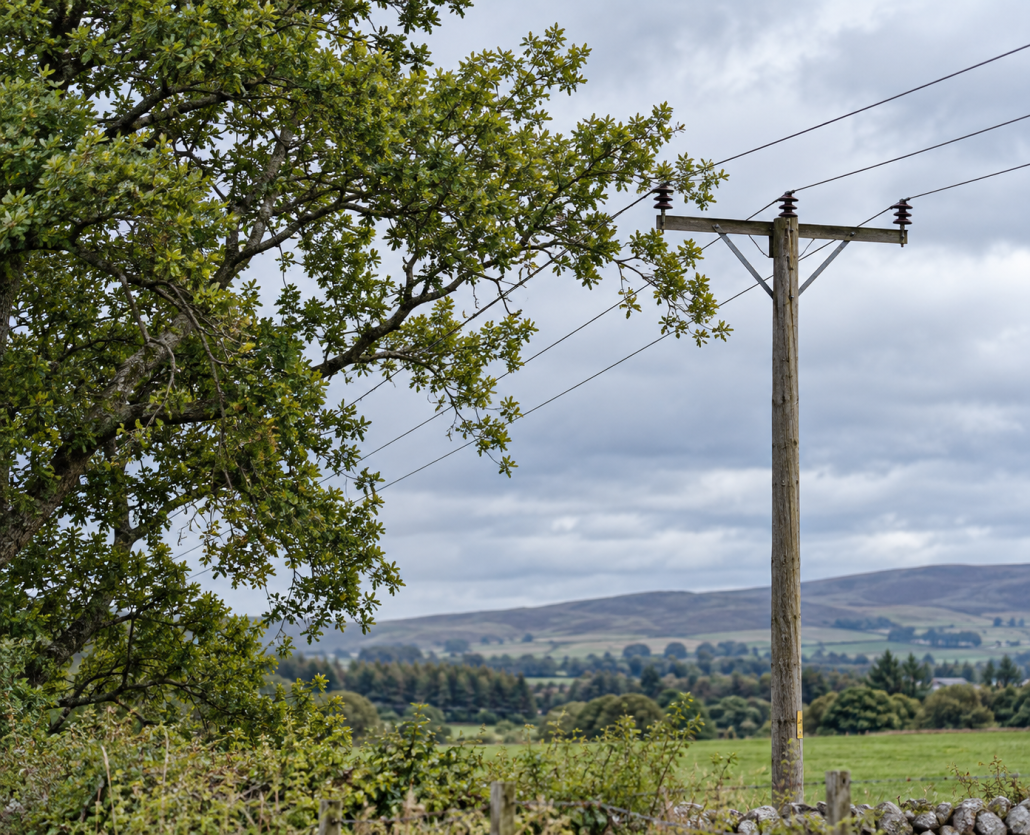
Trees Touching Power Lines: Who Should You Call and What Should You Do?
Stay Away
Do not touch the tree, branch, wire, fence or equipment involved.
Do Not Cut
Do not use a saw, ladder, pole pruner, rope or garden tool near the line.
Call 105
105 connects you with the electricity network operator for the area.
Keep Others Clear
Keep children, neighbours, pets, vehicles and contractors away.
Wait for Advice
The network operator determines the electrical safety arrangements.
999 if Life-Threatening
Tell emergency services clearly that electricity is involved.
What Should You Do if a Tree Is Touching a Power Line?
Move away, prevent other people from approaching and report it to the electricity network operator.
In Great Britain, the easiest route is normally to call 105. The service is designed for power cuts and electricity-network safety issues and directs the report to the appropriate network operator.
Do not first call an ordinary gardener or tree surgeon and ask them to remove the branch. Tree work close to live electrical equipment requires specific planning with the network operator.
An overhead conductor can remain live without visible arcing, and a line that has tripped off may be automatically or remotely re-energised.
Why Are Trees Near Power Lines So Dangerous?
The danger is not limited to somebody physically grabbing a bare electrical conductor.
Electricity can flash across a gap where a person, machine, branch or tool gets sufficiently close to a live line. HSE specifically warns that direct contact is not necessary for a fatal incident to occur.
Electricity can jump through an air gap without physical contact.
Wood should never be relied upon as electrical insulation.
Pole saws, ladders and pruning equipment greatly extend reach.
A branch can swing or fall towards the conductors unexpectedly.
MEWPs, cranes and loaders introduce additional reach and conductive paths.
A line that appears dead may become live again without warning.
Can the Tree Itself Become Electrically Dangerous?
Potentially, yes.
If a branch or stem is in contact with electrical equipment, do not assume that the danger exists only at the wire itself.
Moisture, contamination and the route through the tree can affect conductivity. HSE warns that electricity can pass through materials such as wood, plastic and rubber when circumstances allow.
Electrical hazards cannot be assessed safely by touch, appearance or whether you can hear buzzing.
How Do You Know Whether an Overhead Wire Is an Electricity Line?
Do not make the safety decision yourself based only on what the cable looks like.
HSE specifically warns that electricity lines carried on wooden poles can be mistaken for telephone or communications lines.
Do not assume it is. Confirm ownership before tree work.
Do not assume the outer covering makes it safe to touch or work beside.
Lack of visible electrical activity does not prove the line is dead.
What Is 105?
105 is the national telephone number for reporting electricity power cuts and network-related safety issues in Great Britain.
You do not need to work out which distribution network company owns the line before reporting an urgent problem.
This is particularly useful for homeowners who may not know whether their local electricity network is operated by SP Energy Networks, SSEN Distribution, Northern Powergrid or another distribution company.
The network operator can then determine what electrical safety measures and tree-management response are required.
Which Electricity Network Operator Covers Your Area?
TD Trees works across areas served by more than one electricity distribution network operator.
Central & Southern Scotland
Large parts of central and southern Scotland are within the SP Energy Networks distribution area.
North of Scotland
Much of northern Scotland is served by SSEN Distribution.
North East England
Northumberland and the wider North East are within the Northern Powergrid region.
For a safety report, you do not need to memorise these boundaries: calling 105 is normally the simplest starting point.
Is the Network Operator or the Tree Owner Responsible for Cutting the Tree?
There is no single answer for every site.
The network operator is responsible for the safe operation of its electricity network and controls how work can take place close to its electrical equipment.
A landowner may still have responsibilities for managing trees on their property, but that does not mean the owner should independently arrange cutting next to live lines.
Network Operator
Controls the electrical network, determines safe clearances and can arrange isolation, specialist advice or utility tree work where required.
Tree / Land Owner
May be responsible for ordinary tree management but should involve the network operator before work that could enter the electrical danger zone.
Contact the network operator first. They can inspect the relationship between the tree and line and explain what work, isolation or specialist contractor arrangements are required.
What Does SP Energy Networks Say About Trees Near Its Lines?
SP Energy Networks tells customers not to undertake tree-cutting work near an overhead power line themselves or arrange ordinary cutting without involving the network.
For non-emergency tree concerns close to its lines, SP Energy Networks can arrange for a tree cutter to inspect the trees and assess what work is required.
It also operates ongoing vegetation-management programmes to maintain safety and network reliability.
report the tree-line conflict, let the network operator assess the electrical risk, then establish who will undertake any necessary tree work.
Can the Electricity Supply Be Temporarily Switched Off for Tree Work?
Yes, where the network operator determines that temporary isolation is appropriate.
SSEN Distribution specifically provides a temporary-isolation service for situations including tree cutting near its overhead electricity cables.
The operator needs information about the work, location, line type, access and required timing so that the electrical network can be managed safely.
Isolation and re-energisation remain matters for the network operator.
How Close Can Tree Work Be to an Overhead Power Line?
HSE tree-work guidance uses a 10-metre planning threshold for arboricultural, aerial and ground work near overhead power lines.
Where work is proposed within 10 metres horizontally of the nearest wire — or where a tree, branch, machine or load could breach that zone — specialist advice from the line owner or network operator is required.
It is a trigger for specialist planning. The actual controls and safe working arrangements must come from the network operator for the particular line and job.
What if the Tree Is More Than 10 Metres Away but Could Fall Onto the Line?
It can still require network-operator involvement.
HSE guidance specifically says that work farther than 10 metres away must still be considered where a falling tree, branch, crane, MEWP or other equipment could enter the danger zone.
The correct question is therefore not just “how far is the trunk from the wire?” but “can any part of the work reach the electrical equipment?”
Why You Should Never Prune a Tree Near Power Lines Yourself
Ordinary garden pruning becomes a completely different risk when electricity is involved.
HSE explicitly advises the public not to arrange their own tree cutting where trees come near or into contact with overhead electricity lines without involving the electricity company.
Can Any Tree Surgeon Cut Branches Near Power Lines?
No.
Competence for normal tree pruning does not automatically mean competence to work near live electrical infrastructure.
HSE says tree work near electrical equipment should be carried out only as recommended by the network operator and according to the procedures it has established, using appropriately qualified and competent people.
The safe system may require isolation, additional supervision, specialist utility arboriculture or another control determined by the network operator.
What Can the Network Operator Do Before Tree Work Starts?
The appropriate response depends on the voltage, line construction, tree position and intended work.
Confirm the relevant electrical equipment and risk.
Determine restrictions appropriate to the network.
Switch the line off where this is the safe approach.
Utility arboricultural contractors may be used where appropriate.
Planned interruptions may affect neighbouring customers.
Power is restored only through the operator’s procedures.
Can Tree Work Ever Be Carried Out While the Line Is Live?
Specialist live-line arrangements exist, but this is not something a homeowner or ordinary contractor should decide for themselves.
HSE states that the first choice for managing the risk should be to undertake the work with the electrical equipment made dead where reasonably practicable.
Any decision to work close to live conductors has to satisfy stringent legal and safety requirements and requires appropriate procedures, competence and protective measures.
never assume that a live line can be worked around safely. Let the network operator determine the method.
What Equipment Might Be Used for Trees Near Power Lines?
Technical removals can require more than a climber and chainsaw.
The equipment is selected around the safe system of work, tree structure, available access and electrical controls rather than simply choosing the quickest way to remove timber.
Why Can Rigging Be Important Near Power Lines?
Ordinary free-falling branches may be unacceptable where electrical infrastructure lies close to the tree.
Rigging systems can allow arborists to control sections of timber and lower them into designated areas.
However, ropes and suspended timber introduce their own movement and electrical-proximity risks, so rigging must form part of the agreed safe system rather than being improvised on site.
Branches should not be allowed to swing, fall or drift towards network equipment, people, buildings or roads.
Why Do MEWPs and Cranes Need Special Planning?
A machine can enter the electrical danger area even when its wheels or base are a considerable distance from the line.
The boom, basket, crane jib, suspended timber and potential collapse or swing radius all need to be considered.
What if the Tree Is Touching the Wire but the Electricity Is Still Working?
Report it anyway.
A branch can contact or encroach upon electricity equipment without immediately causing a visible fault or power cut.
Movement in wind, moisture, further growth or branch failure can change the situation.
Do not wait for sparks, smoke or a power cut before reporting a dangerous tree-line interaction.
What if the Branch Is Sparking, Smoking or Arcing?
Treat this as an urgent electricity-network safety issue.
Move well away, keep everybody else away and call 105 immediately.
If there is a fire, serious injury or an immediate threat to life, call 999 and state clearly that electrical equipment is involved.
Maintain distance and follow the instructions of the emergency services and network operator.
What if a Tree Has Brought the Power Line Down?
Do not approach the tree or the cable.
A fallen line should be treated as live even if it is lying on the ground, appears broken or has stopped sparking.
Keep people and animals away and call 105. SSEN public-safety guidance advises staying at least five metres away from fallen or damaged overhead lines; always follow the network operator’s instructions for the particular incident.
A protection system may have switched electricity off temporarily and the network can be re-energised without warning.
What Should You Do After a Storm?
Strong winds can bring trees and overhead electricity infrastructure into contact in ways that were not present beforehand.
Report network damage before attempting any storm-clearance work. The fact that a road, driveway or garden is blocked does not make it safe to cut the tree before the electrical hazard has been controlled.
Why Is a Tree Hung Up in Power Lines Especially Dangerous?
The tree can be under substantial mechanical tension as well as presenting an electrical hazard.
Cut branches, root plates and split stems can move violently when load is released, while the supporting electricity line can also be damaged.
Mechanical pulling can change the electrical contact and cause uncontrolled movement.
What if the Branch Is Touching the Electricity Cable to Your House?
Treat it as an electrical safety issue rather than ordinary garden pruning.
Low-voltage overhead wires connected to buildings can still cause fatal electric shock.
HSE guidance explains that where work must be carried out near these wires, the line owner may need to arrange isolation, diversion or other appropriate precautions.
Domestic electrical voltage is still capable of causing fatal injury.
What if the Cable Is Privately Owned?
Some farms, estates, industrial sites and larger properties contain private electrical distribution after the network connection point.
The electrical owner and a competent electrical professional may therefore need to be involved as well as the arboricultural contractor.
Do not assume that private ownership makes the electrical hazard less significant. The same fundamental principle applies: the supply must be understood and a safe system agreed before tree work enters the danger area.
What if the Tree Is Not Touching the Line Yet?
This is the best time to act.
Planned vegetation management is far easier to organise than waiting until a branch is resting on the network during a storm.
Can Pruning Prevent Trees Reaching Power Lines?
Appropriate planned pruning can sometimes maintain useful clearance and reduce the likelihood of future contact.
The objective should not simply be to hack the line side of the tree back as hard as possible.
Selective Pruning
Branches can be shortened or removed strategically while retaining an appropriate tree structure.
Directional Management
Future crown growth can sometimes be directed away from electrical infrastructure.
Removal
May be justified where the tree presents an ongoing conflict that cannot reasonably be managed through pruning.
Should a Tree Be Topped to Keep It Away From Power Lines?
Not as a default response.
Indiscriminate topping can create large wounds and strong replacement growth, potentially creating another clearance problem in the future.
The preferred management should be determined by the tree’s species, form, location and long-term relationship with the line.
The safest immediate cut is not necessarily the best long-term tree-management specification.
When Might Tree Removal Be Better Than Repeated Pruning?
Some trees can be managed successfully beside overhead lines. Others may repeatedly grow into the required clearance space or present additional structural problems.
Where removal is appropriate, TD Trees provides professional tree felling and technical dismantling.
What Should Landowners and Commercial Sites Do About Trees Near Power Lines?
Overhead lines should form part of routine site risk management rather than being discovered only when contractors arrive.
TD Trees provides commercial arboricultural services, including technical removals near power lines, railways and major roads.
What Does a Safe Tree-Work Plan Near Power Lines Consider?
What if the Tree and Power Line Are Beside a Road or Footpath?
The electrical hazard is only one part of the work.
Technical tree operations may also require pedestrians, vehicles and members of the public to be kept outside the working area.
Depending on the location and work method, traffic management, barriers, temporary closures or additional supervision may be required.
Falling timber, ropes, machinery, traffic and public access still need independent control.
What if the Tree Has a TPO or Is in a Conservation Area?
Tree protection and electrical safety are separate considerations.
For planned non-emergency work, Tree Preservation Order or conservation-area controls may need to be checked before pruning or removal.
Where there is an immediate network or public-safety danger, report the hazard to the network operator first. Emergency and statutory situations can involve different legal processes from routine pruning.
The immediate hazard should be reported first; the relevant professionals can then determine what permissions or exemptions apply to subsequent work.
Do Wildlife Checks Still Matter?
Yes. Planned tree work should still consider active bird nests, bat roosts and other protected wildlife.
The urgency and electrical danger may affect how work is planned, but protected wildlife should not simply be ignored.
On complex sites, the electricity network operator, arboricultural contractor and ecological professionals may all need to coordinate the safest and legally appropriate approach.
When Is an Arboricultural Survey Useful Near Power Lines?
Surveys can be valuable where land contains numerous trees within potential falling distance of electricity infrastructure.
A survey can identify trees requiring management before branch failure or growth creates an urgent electricity-network problem.
What You Should Never Do Around a Tree and Power Line
The tree may already be in electrical contact.
A ladder greatly increases your reach towards the conductors.
Long tools can enter the electrical danger zone unexpectedly.
You cannot safely predict its movement or electrical status.
Assume every damaged electrical conductor is live.
Ordinary PPE does not make power-line tree work safe.
Electricity can be restored automatically or remotely.
Network-operator advice is required where the work can affect electrical equipment.
Trees and Power Lines: Myth vs Reality
| Common Assumption | Safer Explanation |
|---|---|
| “It isn’t sparking, so it must be safe.” | Live electricity can be present without visible sparks or noise. |
| “Wood doesn’t conduct electricity.” | Wood cannot be relied upon as electrical insulation, particularly when damp or contaminated. |
| “The wire is covered, so I can cut beside it.” | Do not assume a cable covering provides safe insulation for arboricultural work. |
| “The power is off, so the line is dead.” | Lines can be re-energised automatically or remotely unless the network operator has made them safe. |
| “My tree means I can cut it myself.” | Ownership of the tree does not override electrical safety requirements. |
| “Any tree surgeon can do it.” | Power-line tree work requires network-operator involvement and appropriately competent people working to an agreed safe system. |
What Information Should You Give When You Call 105?
Only take photographs from a safe location. Never move closer to the electricity equipment simply to obtain a better image.
Questions to Ask Before Hiring a Contractor Near Power Lines
How Planned Tree Work Near Power Lines Typically Progresses
Confirm the tree, line and intended work.
Network operator reviews the electrical risk.
Safe system, clearances and work method are agreed.
Electricity is made safe if the agreed method requires it.
Competent arborists undertake the planned operation.
Network operator controls safe return to service.
FAQs About Trees Touching Power Lines
What should I do if a tree is touching a power line?
Stay away, keep other people clear and report the situation to the electricity network operator by calling 105. Do not attempt to cut or move the branch.
Who do I call about branches touching power lines?
Call 105. It is the national electricity-network number for power cuts and network safety concerns in Great Britain.
Should I call 999?
Call 999 where there is a fire, serious injury or immediate threat to life, and tell the emergency services that electricity is involved. Report the network issue through 105 as well.
Can I cut a branch that is touching an electricity cable?
No. Do not undertake the work yourself. The electricity network operator must be involved so the electrical risk and safe system can be established.
Can a tree conduct electricity?
A tree should never be relied upon as an insulator. Moisture and contamination can allow electrical current to create a dangerous path through wood and surrounding materials.
Can electricity jump from a power line?
Yes. Flashover can occur when a person or object comes sufficiently close to a live conductor even without direct physical contact.
Is a power line safe if it is not sparking?
No. A live conductor may show no visible sign that electricity is present.
Is a line safe after the power goes off?
No. Electricity networks can re-energise automatically or remotely. Treat the line as live until its owner confirms it has been made safe.
Can I use a pole saw near power lines?
Not without the appropriate specialist planning and network-operator arrangements. Long tools can enter the electrical danger zone before the operator realises it.
Can any tree surgeon work near electricity lines?
No. Electrical-proximity work requires appropriately competent people following procedures and safety arrangements agreed with the network operator.
How far from a power line can tree work take place?
HSE uses a 10-metre planning threshold for tree work near overhead lines, including work that could enter that distance through falling timber or machinery. The actual safe clearance must be determined with the network operator.
What if the tree trunk is more than 10 metres away?
Network advice may still be required if the tree, a branch, crane, MEWP or other part of the operation could fall or reach towards the overhead line.
Can the electricity company switch the line off?
Yes, temporary isolation can form part of planned work where the network operator determines it is appropriate.
Does temporary isolation affect neighbours?
It can. Depending on the network arrangement, other properties may lose supply during a planned isolation, which is one reason the network operator must organise it.
Who pays for tree cutting near power lines?
It depends on the network, ownership, reason for the work and operator’s vegetation-management arrangements. Contact the network operator before assuming responsibility or commissioning work.
Will the electricity company cut my tree?
In some situations the network operator may arrange or commission the necessary vegetation work. In others it may provide safety arrangements so an appropriate contractor can undertake the tree work.
What if the branch is only close to the wire?
Contact the network operator before pruning where the work itself could bring a person, branch, tool or machine close to the electrical equipment.
Should trees near power lines be topped?
Not automatically. Planned selective or directional pruning may provide better long-term management. The correct specification depends on the tree and the required electrical clearance.
When should a tree near a power line be removed?
Removal may be considered where the tree creates an unsustainable repeated conflict, has serious structural defects or cannot reasonably be retained within the network’s clearance requirements.
What if a tree falls on a power line in a storm?
Stay away, keep others clear and call 105. Do not begin cutting the tree until the network operator has dealt with the electrical hazard.
What if the cable is lying on the ground?
Treat it as live. Do not approach, touch or move it. Call 105 immediately and keep everyone away.
Can I drive over a fallen power cable?
No. Stay away from damaged network equipment and follow instructions from the network operator or emergency services.
What if a vehicle or machine touches an overhead line?
Occupants should normally remain in the vehicle and warn others to stay away while the network operator is contacted. If fire creates an immediate need to escape, emergency procedures are different and 999 should be called.
Can a branch touching a power line start a fire?
Electrical contact can create arcing, faults and heat. Any smoking, burning or sparking tree-line contact should be treated as an urgent network safety issue.
Do power lines cause tree-related power cuts?
Trees and branches are a significant source of overhead-network faults, particularly during high winds and storms.
Can TD Trees work near power lines?
TD Trees lists technical tree removals near power lines among its commercial services. Where electrical infrastructure could be affected, work must be coordinated with the relevant network operator and undertaken under the required safe system.
Planning Tree Work Near Power Lines?
Electrical safety must come first. If a tree is touching, damaging or dangerously close to electricity-network equipment, contact the network operator before arranging tree cutting.
Once the required electrical controls and working arrangements are understood, TD Trees can provide professional arboricultural assessment and technical tree work, including complex dismantling and commercial tree operations.
TD Trees works across Edinburgh, Central Scotland, Southern Scotland, the Scottish Borders, Northumberland and surrounding areas, with experienced teams, specialist equipment and detailed work planning for technically demanding sites.
Sources and References
- Health and Safety Executive – Working Near Power Lines and Cables:
https://www.hse.gov.uk/treework/safety-topics/power-lines.htm - Health and Safety Executive – Overhead Power Lines:
https://www.hse.gov.uk/electricity/information/overhead.htm - Health and Safety Executive – Avoiding Danger From Overhead Power Lines (GS6):
https://www.hse.gov.uk/pubns/gs6.htm - Health and Safety Executive – Electricity FAQs:
https://www.hse.gov.uk/electricity/faq.htm - SSEN Distribution – Contact Us / Report a Dangerous Situation:
https://www.ssen.co.uk/about-ssen/contact-us/ - SSEN Distribution – Temporary Isolation for Tree Cutting:
https://www.ssen.co.uk/our-services/existing-electricity-supplies/temporary-isolation/ - SSEN Distribution – Farm & Overhead-Line Safety:
https://www.ssen.co.uk/power-cuts-emergencies/keeping-safe/farmsafety/ - SP Energy Networks – Trees Close to Power Lines:
https://www.spenergynetworks.co.uk/pages/what_do_i_do_if_there_are_trees_close_to_the_power_lines_on_or_close_to_my_property.aspx - SP Energy Networks – Contact Us / Electricity Emergencies:
https://www.spenergynetworks.co.uk/pages/contact_us.aspx - SP Energy Networks – Tree Safety Guidance:
https://www.spenergynetworks.co.uk/ - TD Trees – Commercial Tree Surgery:
https://www.tdtrees.co.uk/commercial/ - TD Trees – Tree Felling:
https://www.tdtrees.co.uk/tree-services/felling/